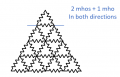
Repeated star delta transforms will reduce the triangles At each iteration to fewer new triangles each with R‘=2R/3 until you are left with just one star.
At university, I was given an exam question to work out the resistance of chicken wire.
I had to explain to my supervisor that on chicken wire each horizontal section is R/2 because it consists of two strands twisted together, and that if he wanted me to work out the resistance of a hexagonal mesh with equal value resistors he shouldn’t have said it was chicken wire.
I grew up in farming country - I know about chicken wire.
Repeated star delta transforms will reduce the triangles At each iteration to fewer new triangles each with R‘=2R/3 until you are left with just one star.
At university, I was given an exam question to work out the resistance of chicken wire.
I had to explain to my supervisor that on chicken wire each horizontal section is R/2 because it consists of two strands twisted together, and that if he wanted me to work out the resistance of a hexagonal mesh with equal value resistors he shouldn’t have said it was chicken wire.
I grew up in farming country - I know about chicken wire.
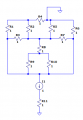
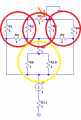
While the two groups of resistors circles in red form triangles (i.e., delta-connected resistors), the ones circled in yellow do not. At best, they for two triangles with R3 and R7, respectively, but then you have the tips of those triangles shorted.
What is the purpose of R11?
Your ground tap at the top forces an asymmetry to your circuit ensures that it is not equivalent.
If you think I'm looking at this wrong (and that is certainly possible), show how the individual resistors (via their reference designators) map to your repeated tiangle.
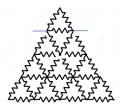
Speaking of the triangle, let's take a closer look at it:
Notice how I disconnected all but two resistors below the line. If all of the resistors are the same value, then the resistance of the top arc is 2R, as is the resistance of the bottom arc. The central path is, of course, just R. The parallel combination of the two arcs is R, and when this is put in parallel with the central path, the total resistance becomes R/2.
But what happens when I reconnect the rest of the resistors in the bottom part? These create additional parallel paths in the bottom arc, which will reduce the total resistance of the bottom arc below 2R. Then end result is that the total resistance will be LESS than R/2 with the additional resistors included.

 Facebook
 Google
 GitHub
 Linkedin