Triac questions

MisterBill2

Joined Jan 23, 2018
27,521
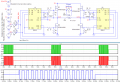
All of the proposed circuits are showing "ground" tied between the two switching transistors. If the circuit is supposed to be isolated from "ground" then that is a real problem. Isolation can be done but it requires a fair bit of extra effort.
So the need for ground isolation needs to be evaluated.
 

Ian0

Joined Aug 7, 2020
13,132
if FETs conduct in both directions, why do they have a body diode at all? if they could block current in both directions they would be the ideal transistor for my purposes.
It’s part of the manufacturing process, and for most applications it’s actually rather useful.
 

Ian0

Joined Aug 7, 2020
13,132
All of the proposed circuits are showing "ground" tied between the two switching transistors. If the circuit is supposed to be isolated from "ground" then that is a real problem. Isolation can be done but it requires a fair bit of extra effort.
So the need for ground isolation needs to be evaluated.
Normally, it’s the two sources that have to be floated, and it does need its own auxiliary supply to generate the gate voltages.
Is there really in this circuit no way of disabling this squarewave before it is generated or switching it off once it has been rectified? If so, it’s a lot simpler than trying to switch it as an AC signal.
 

MisterBill2

Joined Jan 23, 2018
27,521
Most oscillator circuits do not instantly start oscillation at steady state conditions. that is due to the basic nature of oscillation being a feedback arrangement and at T=zero there is nothing to be feeding back yet. This has been a challenge for designers ever since oscillation was discovered.
So the answer is that The easy way may not be able to provide the consistency required for the application. And so far we do not have any information about the application.
 

MisterBill2

Joined Jan 23, 2018
27,521
If the application is an induction heater the frequency stability and purity will not matter quite so much, and so a kkeyed oscillator might be OK. But if it is a transmitter it does matter a lot.
And certainly because a problem happens frequently does not mean that a late arrival will be aware of it. So why comment?
 

Thread Starter

l0vot

Joined Apr 29, 2013
111
Most oscillator circuits do not instantly start oscillation at steady state conditions. that is due to the basic nature of oscillation being a feedback arrangement and at T=zero there is nothing to be feeding back yet. This has been a challenge for designers ever since oscillation was discovered.
So the answer is that The easy way may not be able to provide the consistency required for the application. And so far we do not have any information about the application.
It's part of an ignition system, signal purity is irrelevant, but I don't have a scope that can record how quickly, and how consistently the oscillator bootstraps, multiple oscillators would be required, each would inevitably have different bootstrap characteristics, this could be a problem, or it might not be a problem.


Ian0: the entire oscillator buisness is because I couldn't find a transistor that is capable of switching DC that doesn't have a body diode, a FET/BJT without a body diode would essentially be the silicon equivalent of a relay, assuming it's reverse blocking voltage is high enough, this would be useful in many applications.
 

MisterBill2

Joined Jan 23, 2018
27,521
There are some serious silicon Carbide transistors that handle lots of power into the hundred gigahertz range. Of course they are not cheap. And a power oscillator driven by a stable oscillator might start very rapidly. And there were electronic ignition systems that did deliver a burst of oscillation, way back in the seventies. There are even gated amplifiers that switch on and off quite rapidly. And for them, the gating is switching the DC power on and off.
 

Ian0

Joined Aug 7, 2020
13,132
Ian0: the entire oscillator buisness is because I couldn't find a transistor that is capable of switching DC that doesn't have a body diode, a FET/BJT without a body diode would essentially be the silicon equivalent of a relay, assuming it's reverse blocking voltage is high enough, this would be useful in many applications.
If you're switching DC, generally the body diode isn't a problem - how about a little diagram showing what generates this squarewave, and where it goes after you switch it?
 

Thread Starter

l0vot

Joined Apr 29, 2013
111
If you're switching DC, generally the body diode isn't a problem - how about a little diagram showing what generates this squarewave, and where it goes after you switch it?
in order to drive the coils with DC there must be a capacitor across the switch, a diode across the cap results in a spark too weak to be useful, the switch MUST block current in both directions in order to work at 12V. If I have time I'll try some things, but if i use a transistor drive, I'm sticking with the royer since i need a step up transformer to drive the coil since there are no transistors capable of driving the coil properly at 12V, and it needs an AC drive to run properly at higher voltages. The original mosfet design posted by Danko would probably work, having a transformer at the core of this mess makes the weird electrical isolation and floating neutral required to use it possible, but i'll have to buy higher voltage fets.
 

MisterBill2

Joined Jan 23, 2018
27,521
in order to drive the coils with DC there must be a capacitor across the switch, a diode across the cap results in a spark too weak to be useful, the switch MUST block current in both directions in order to work at 12V. If I have time I'll try some things, but if i use a transistor drive, I'm sticking with the royer since i need a step up transformer to drive the coil since there are no transistors capable of driving the coil properly at 12V, and it needs an AC drive to run properly at higher voltages. The original mosfet design posted by Danko would probably work, having a transformer at the core of this mess makes the weird electrical isolation and floating neutral required to use it possible, but i'll have to buy higher voltage fets.
WHY would there need to be a capacitor and diode across a switch that sends DC to the primary of a pulse transformer??? The whole purpose of a spark transformer is to produce a spark. That does mean that the components used to drive the transformer must be adequate for the application, including voltage, current, power, and response times.
 
Top