Triac light dimmer controlled with DC voltage

MrAl

Joined Jun 17, 2014
13,709
Thanks, yes this is a much simpler circuit.
Hi,

Oh also, are you sure you need sub-cycle control? For many heating applications you do not need that much control. A simple on/off cycle is usually good enough and works well because heating is a fairly slow process.
 

MrAl

Joined Jun 17, 2014
13,709
Did you take a close look at the circuit Danko posted in post #11? It looks like a compact complete solution,, or did I miss something?
Hi,

I thought it was just a little too complicated for the modern age. Then again, a microcontroller would be the most modern here.
 

Ian0

Joined Aug 7, 2020
13,132
Hi,

I thought it was just a little too complicated for the modern age.
I wasn’t sure how a 555 behaves if the control voltage is taken too low or too high. @Danko only shows the results for CV>1V. The circuit must be well-behaved from CV=0, and also, maximum power is achieved at Vin=1V, which the opposite of the normal control protocol where 0V=off and 10V=fully on.
Then again, a microcontroller would be the most modern here.
but it would still need some form of isolated zero-crossing detector.
Zerocrossing detectors have been mentioned at length on this forum, so I needn’t go into details.
 

AnalogKid

Joined Aug 1, 2013
12,143
I am looking for a way to make a "light dimmer" (actually controlling a heating coil) using a triac, where I can control the duty cycle of the AC based on a DC voltage. In searching for such a circuit, I either find:

1) The basic light dimmer using a triac with a diac and a variable resistor slow or speed up the charging of the capacitor which triggers the diac at a certain voltage. Of course this requires someone actually turning a pot.

I would like to do this only using analog electronics. I would like it to be as simple as possible, and I don't need to achieve great linearity in the control,
Simple and analog ... Hmmm ... I'm simple, and my license plate is ANALOG, so -

First thoughts: Start with a basic TRIAC dimmer as in your #1.

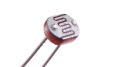
Replace the pot with a photoresistive cell (CdS).

Use the temperature circuit output to vary the brightness of an LED.

Encase the cell and LED in a dark tube.

Better yet, use a Clairex Photomod. This is a light source and CdS cell in a single unit. You will have to fiddle with the output of the temperature circuit to get the LED brightness range correct.

https://talonelectronics.com/shop/item.aspx?itemid=6476

ak

NOTE: No 555's were harmed or killed in the creation of this post. I tried, but the little bastards got away.
 
Last edited:

Ian0

Joined Aug 7, 2020
13,132
Simple and analog ... Hmmm ... I'm simple, and my license plate is ANALOG, so -

First thoughts: Start with a basic TRIAC dimmer as in your #1.

Replace the pot with a photoresistive cell (CdS).

Use the temperature circuit output to vary the brightness of an LED.

Encase the cell and LED in a dark tube.

Better yet, use a Clairex Photomod. This is a light source and CdS cell in a single unit. You will have to fiddle with the output of the temperature circuit to get the LED brightness range correct.

https://talonelectronics.com/shop/item.aspx?itemid=6476

ak
Use a bimetallic strip attached to a cord which is wrapped around the potentiometer shaft and then to a spring.
 

sghioto

Joined Dec 31, 2017
8,634
First thoughts: Start with a basic TRIAC dimmer as in your #1.

Replace the pot with a photoresistive cell (CdS).

Use the temperature circuit output to vary the brightness of an LED.

Encase the cell and LED in a dark tube.
I have used that exact circuit to vary the brightness of lights using audio. Basically an opto-isolator.
 

Thread Starter

KevinHowJones

Joined Jun 19, 2022
30
First thoughts: Start with a basic TRIAC dimmer as in your #1.

Replace the pot with a photoresistive cell (CdS).
I had the exact same idea. I didn't want to post about it until I got something working.

Better yet, use a Clairex Photomod. This is a light source and CdS cell in a single unit. You will have to fiddle with the output of the temperature circuit to get the LED brightness range correct.

https://talonelectronics.com/shop/item.aspx?itemid=6476
Thanks, I have been looking over various source/photoresistor packages but weren't sure what would work. I guess this is a place to start.
 

Thread Starter

KevinHowJones

Joined Jun 19, 2022
30
First thoughts: Start with a basic TRIAC dimmer as in your #1.

Replace the pot with a photoresistive cell (CdS).
I'm thinking this would probably be more of a fun academic experiment rather than a useful approach, as I look at the input current to output resistance curves on photoresistive couplers, of which I'm seeing don't have much of an operating range between full on and full off.
 

Thread Starter

KevinHowJones

Joined Jun 19, 2022
30
Use a bimetallic strip attached to a cord which is wrapped around the potentiometer shaft and then to a spring.
Wondering if this was meant as tongue-in-cheek, though I must admit I had considered something like that just because it is so old-old-school :)
 

Ian0

Joined Aug 7, 2020
13,132
Wondering if this was meant as tongue-in-cheek, though I must admit I had considered something like that just because it is so old-old-school :)
You're not meant to know - that's the British way.
But an old-fashioned bimetallic thermostat is digital - it's either on or off, so I wondered how to make it analogue!
Rotary dial thermometers have a helical bimetallic strip to rotate the pointer. At a guess such an arrangement would make sufficient torque to rotate a pot. One of those small angle pots that are use in joysticks might do.
Anyway, enough of this nonsense.
 

AnalogKid

Joined Aug 1, 2013
12,143
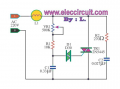
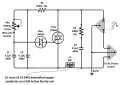
In a typical TRIAC dimmer, the pot is wired as a rheostat, or variable resistor, rather than as a potentiometer or voltage divider. So if the pot is , say, 100K, then a CdS cell should drop in nicely. Here are some example grabs from the innergoogle. Note that both schematics have a fixed resistor in series with the pot. This limits poser dissipation in the pot to a safe value when turned down to lower resistance values.

ak

https://i.pinimg.com/originals/89/3f/d7/893fd730b8774b5366fd6d0c02d6e2e5.jpg
1691541269606.png

https://w3circuits.blogspot.com/2016/03/simple-triac-dimmer.html
1691541336423.png
 

MrAl

Joined Jun 17, 2014
13,709
but it would still need some form of isolated zero-crossing detector.
Zerocrossing detectors have been mentioned at length on this forum, so I needn’t go into details.
Hi,

Yes there are methods to do zero crossing detection used with microcontrollers, it's not a big deal really. The isolation comes in using an opto-coupler driver like one (maybe more) that had been described here. That's the same with the version I posted when you go to a transformerless design.
If you need the entire thing isolated then maybe another regular opto-coupler for the zero cross detection front end.

If I remember right Microchip has design notes for using their parts for this kind of application.
 
Top