Triac light dimmer controlled with DC voltage

Thread Starter

KevinHowJones

Joined Jun 19, 2022
30
I am looking for a way to make a "light dimmer" (actually controlling a heating coil) using a triac, where I can control the duty cycle of the AC based on a DC voltage. In searching for such a circuit, I either find:

1) The basic light dimmer using a triac with a diac and a variable resistor slow or speed up the charging of the capacitor which triggers the diac at a certain voltage. Of course this requires someone actually turning a pot.

2) Circuits using a microcontroller (usually Arduino).

I would like to do this only using analog electronics. I would like it to be as simple as possible, and I don't need to achieve great linearity in the control, just something that gives rough control between full on and full off.

If anyone has any ideas how to do this I'd muchly appreciate it.
 

Thread Starter

KevinHowJones

Joined Jun 19, 2022
30
Edit: I just realized that requiring full turn on to full turn off might become a challenge, so I am removing that specification. Just so there is some degree of control.
 

crutschow

Joined Mar 14, 2008
38,314
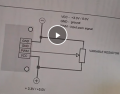
How about a board like this.
Although it states it's for an Arduino or Raspberry, the description says it can be controlled by a PWM signal or DC voltage.
One of the videos shows it being controlled by a voltage from a pot (below), so it would seem you could control it from an external DC voltage of from 0V to the module supply voltage.

It would seem that should do what you want.
What is the source for your control voltage?

1691173494840.png
 

ScottWang

Joined Aug 23, 2012
7,498
Is this what you want?
uC(Arduino) → optocoupler → TRIAC circuit → AC device
Google: photocoupler triac circuit.
 

Thread Starter

KevinHowJones

Joined Jun 19, 2022
30
Interesting, I saw that but blew past it because I had the impression it required a microcontroller. I'll look at it more closely.

Thanks!
 

Thread Starter

KevinHowJones

Joined Jun 19, 2022
30
Interesting, I saw that but blew past it because I had the impression it required a microcontroller. I'll look at it more closely.
How about a board like this.
Although it states it's for an Arduino or Raspberry, the description says it can be controlled by a PWM signal or DC voltage.
One of the videos shows it being controlled by a voltage from a pot (below), so it would seem you could control it from an external DC voltage of from 0V to the module supply voltage.
Hmmm, watching the video, it doesn't appear like he is getting much control there; it appears almost on-off.
 

SamR

Joined Mar 19, 2019
5,470
You're probably going to get into PWM, which is a timer chopped DC pulse. The timing and width of the pulse simulates AC and can be controlled usually with a potentiometer. But you are going to be using a digital DC circuit to do the timing. Edit: the triac output is simply the high voltage output switch to switch the AC on and off to vary the output voltage.
 

crutschow

Joined Mar 14, 2008
38,314
You're probably going to get into PWM, which is a timer chopped DC pulse.
Why?
The PWM is likely just averaged by an internal filter on the PCB to give a DC voltage to control the AC phase angle dimming (the AC is not being chopped by the PWM), so a DC voltage should work just as well as PWM.
 
Last edited:

MrAl

Joined Jun 17, 2014
13,667
I am looking for a way to make a "light dimmer" (actually controlling a heating coil) using a triac, where I can control the duty cycle of the AC based on a DC voltage. In searching for such a circuit, I either find:

1) The basic light dimmer using a triac with a diac and a variable resistor slow or speed up the charging of the capacitor which triggers the diac at a certain voltage. Of course this requires someone actually turning a pot.

2) Circuits using a microcontroller (usually Arduino).

I would like to do this only using analog electronics. I would like it to be as simple as possible, and I don't need to achieve great linearity in the control, just something that gives rough control between full on and full off.

If anyone has any ideas how to do this I'd muchly appreciate it.
Hi,

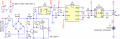
Since you will be using a triac, which is probably best for this kind of application, you don't really want PWM you want a variable delay. A variable delay allows you to control the phase angle when the triac turns on, then allows it to turn off by itself.

This is done with a ramp generator, and a comparator, and a very simple drive circuit. This can all be done with a single LM358 and a few other components like resistors and a capacitor or two.
The ramp generator is phase locked to the line voltage half cycle, the comparator compares the ramp to the DC control voltage. When the comparator changes state, it turns the triac. The triac stays on for the entire firing angle. When the line goes through zero again, the triac turns off by itself and the cycle starts over again.
Doing it this way allows very precise control of the firing angle with a DC voltage, which can even be a potentiometer for a regular lamp dimmer.

There is one caution though. When driving a heating coil you have to be aware of the resistance change as it is set for low heat settings.

I should be able to find this circuit for you I built a few of these years ago. One was to control a 15 amp angle grinder.
 

Ian0

Joined Aug 7, 2020
13,097
Hi,

Since you will be using a triac, which is probably best for this kind of application, you don't really want PWM you want a variable delay. A variable delay allows you to control the phase angle when the triac turns on, then allows it to turn off by itself.

This is done with a ramp generator, and a comparator, and a very simple drive circuit. This can all be done with a single LM358 and a few other components like resistors and a capacitor or two.
The ramp generator is phase locked to the line voltage half cycle, the comparator compares the ramp to the DC control voltage. When the comparator changes state, it turns the triac. The triac stays on for the entire firing angle. When the line goes through zero again, the triac turns off by itself and the cycle starts over again.
Doing it this way allows very precise control of the firing angle with a DC voltage, which can even be a potentiometer for a regular lamp dimmer.

There is one caution though. When driving a heating coil you have to be aware of the resistance change as it is set for low heat settings.

I should be able to find this circuit for you I built a few of these years ago. One was to control a 15 amp angle grinder.
That's a perfect description of the circuit I posted (except that the ramp is done with transistors)
 

Thread Starter

KevinHowJones

Joined Jun 19, 2022
30
Hi,

Since you will be using a triac, which is probably best for this kind of application, you don't really want PWM you want a variable delay. A variable delay allows you to control the phase angle when the triac turns on, then allows it to turn off by itself.
Yes, exactly. I didn't know quite how to put it which is why I used the light dimmer example. Thank you.

A PWM with too short of a cycle (much less than 60 HZ) would just turn the triac on at almost the beginning each phase, and a long PWM cycle, (much greater than 60 HZ) would allow for too much variation of temp of the heater between cycles, as well as much indetermination as you never know where in the 60 HZ phase it is going to trigger. A PWM close to 60 HZ would just be a crap shoot as to its behavior, unless it is synced like you say.

The ramp generator is phase locked to the line voltage half cycle, the comparator compares the ramp to the DC control voltage. When the comparator changes state, it turns the triac. The triac stays on for the entire firing angle. When the line goes through zero again, the triac turns off by itself and the cycle starts over again.
Yes, I was wondering if I would have to design a circuit which is also synced with the line voltage.

I should be able to find this circuit for you I built a few of these years ago. One was to control a 15 amp angle grinder.
That would be perfect if you can find it.

Thank you for your input.
 
Top