Tremolo troubles again

Thread Starter

Fluxor1964

Joined Jun 11, 2015
182
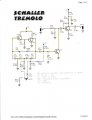
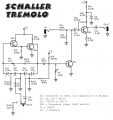
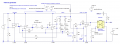
I have included the circuit that is giving me problems and could use some advice please, well sort of, I am using the single stage amp section which is working very nicely, I have up on the phase shift part after I realized I can't alter the frequency easily and replaced it with an astable NE555 timer circuit (not shown)....my problem is that on the base of Q1 I see the signal out from the NE555, I have nothing on the Collector except 9v.....the output from the amp section, the output from Q2 is the oscillator, not my audio signal....its like I am amplifying the output from the NE555 instead of my audio input?

Neil.
 

Attachments

bertus

Joined Apr 5, 2008
22,922
Hello,

The image you uploaded contains errors and can not be displayed.
Could you reduce the size and try again?

Bertus
 

bertus

Joined Apr 5, 2008
22,922
Hello,

Is capacitor C8 still used in conjunction with the 555?
I will post a more sharp picture of the schematic, so we can also read the notes:

SchallerTremolo.sch.jpg

Bertus
 

Thread Starter

Fluxor1964

Joined Jun 11, 2015
182
yes C8 is used still and strange thing is even though I am using a +9v supply, my oscilloscope shows the 555 output as going negative after C8
although it is positive before the cap.

Neil.
 

Thread Starter

Fluxor1964

Joined Jun 11, 2015
182
actually looking at the circuit I don't know how that would even work since isn't Q1 functioning as a preamp for the modulating signal before sending it into the audio amp Q2?

Neil.
 

AnalogKid

Joined Aug 1, 2013
12,126
Q1isn't a preamp. It is acting as a voltage-variable resistor. In parallel with R2, it is the shunt leg of a 2-resistor voltage divider. At the base of Q2 you should see only the tremolo modulation signal, and no audio.

The 555 output is going negative after C8 because the base-emitter junction of Q1 acts as a catch diode. It limits the max voltage on the right side of C8 to +0.7 V. As the left side of C8 transitions down from +8 V to 0 V (assuming a 9 V powered 555 circuit), the right side goes from +0.7 V to -7.3 V. ish.

Can you post your 555-based circuit? If you are using the 555 capacitor voltage to drive Q1 rather than its main output, the voltage levels in my description change but the overall idea is the same.

ak
 

Alec_t

Joined Sep 17, 2013
15,117
I'm not sure using a 555 as the oscillator will give pleasant-sounding results. Methinks the audio will sound 'chopped' (but perhaps that's what you're aiming for? :) ). The Schaller oscillator output is approximately sinusoidal, swinging between 0V and 8V, whereas the 555 output is a square wave. You might need to 'round off' the square wave before using it to modulate the audio.
 
Last edited:

Thread Starter

Fluxor1964

Joined Jun 11, 2015
182
Yes I am using pin 3 of the 555 to modulate.....

well I couldn't get that circuit to do anything useful so I have abandoned it and am now using a circuit with an LED and a LDR which is at least giving me some modulation and do you think my problems are over????.....hell no

like has been said, the square wave is a little brutal, so is there a way to turn it into a sinewave or can someone point me in the right direction
for a circuit that will provide me with an adjustable sinewave, I don't need much adjustment I wouldn't think, maybe between 2 Hz and 10Hz?

Neil.
 

Alec_t

Joined Sep 17, 2013
15,117
can someone point me in the right direction for a circuit that will provide me with an adjustable sinewave, I don't need much adjustment I wouldn't think, maybe between 2 Hz and 10Hz?
You could try this, using a shift register. I haven't built it, but in theory (LTspice says so, anyway :) )it should give a synthesised sine output tunable over about 2Hz-10Hz.
Sine(digital).PNG
 

Attachments

Thread Starter

Fluxor1964

Joined Jun 11, 2015
182
ok so I just got to try the circuit for the first time with my guitar and I am VERY impressed, I havn't tried it with a sine wave but
the squarewave from the 555 sounds awesome and better than I would have thought maybe due to the sustain of the note played, it doesn't sound choppy at all, at some point I will try this with a sine just cuz i'm curious but i'm going to adjust a couple componenet values, box this baby up and have some fun :)

Thanks everyone for your time.

Neil.
 

Alec_t

Joined Sep 17, 2013
15,117
Out of curiosity I simulated a tremolo circuit and compared the outputs when using a square-wave, a triangle-wave and a smoothed-off shaped triangle-wave for the modulation control.
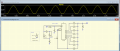
Here's the circuit :
Tremolo2.PNG
... and here are the shaped-triangle modulation control and output waveforms :
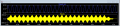
Tremolo2Waveforms.PNG
In case anyone wants to hear the results I've attached wav files of a 440Hz tone (unmodulated), plus the tone modulated respectively (to ~60% depth) by the triangle, the shaped-triangle and the square wave control signals. Delete the .txt file extension (needed to overcome upload limitations).
I can't hear the difference between the triangle mod result and the shaped-triangle mod result. Can you? I think commercial tremolo generators use plain triangle modulation. The square mod result is quite distinct though. I suspect the slow response of an LDR 'rounds off' the corners of a square, making its result less 'choppy' than expected.
 

Attachments

Top