Facebook
 Google
 GitHub
 Linkedin
I am learning about Transmission Lines here: http://www.allaboutcircuits.com/vol_2/chpt_14/2.html

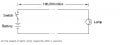
Assuming no warm-up time for the lamp filament, and no resistance along the 372,000 mile length of both wires, the lamp would light up approximately one second after the switch closure. Although the construction and operation of superconducting wires 372,000 miles in length would pose enormous practical problems, it is theoretically possible, and so this thought experiment is valid. When the switch is opened again, the lamp will continue to receive power for one second of time after the switch opens, then it will de-energize.
How about the case when the switch is put right next to the lamp? I think the lamp is no longer receive power after the switch opens, right?
Assuming no warm-up time for the lamp filament, and no resistance along the 372,000 mile length of both wires, the lamp would light up approximately one second after the switch closure. Although the construction and operation of superconducting wires 372,000 miles in length would pose enormous practical problems, it is theoretically possible, and so this thought experiment is valid. When the switch is opened again, the lamp will continue to receive power for one second of time after the switch opens, then it will de-energize.
How about the case when the switch is put right next to the lamp? I think the lamp is no longer receive power after the switch opens, right?
Attachments
-
 20.8 KB Views: 91