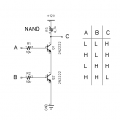
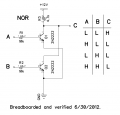
The normally BJT amplifies the current is working in the linear area, the Ic is depends on the Ib and count on hfe=Ic/Ib, and as you said to used the relay that is working in the logical area, hfe=Ic/Ib=10 for Vce saturation.
BJTs are often described as both a current controlled and voltage controlled current sources, but under varying circumstances.
The current control model, \(I_{C} = h_{FE}I_{B}\) is often used when we are in the linear region of operation, as this is "good enough."
However, other models like the Eber-Molls model, \(I_{C} = I_{S} \left(e^{\frac{V_{BE}}{V_{T}}}-1 \right)\) are used to address the fact that transistors are indeed transconductance devices, meaning that the collector current is determined by its base-to-emitter voltage.

 Facebook
 Google
 GitHub
 Linkedin