Transistors configuration.

Thread Starter

Xenon02

Joined Feb 24, 2021
504
if it is used as a coupling capacitor will usually reflect the input AC voltage because in general a capacitor passes AC current and blocks DC. The 'output' DC voltage would be zero referenced to ground.
Usually an AC measurement drops the DC offset voltage and just measures something like the peak to peak AC voltage.
Of course capacitor for DC is dilatation, and AC can pass though it.

But why the output DC voltage would drop to zero ?

Edit.

I don't know what do you mean that output would be zero here.
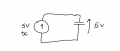
1657403764042.png
I have now 5 IQ so I may misundestood something.


PS.
I've read somewhere that those configurations has no effect on DC, why is that ?
 
Last edited:

MrAl

Joined Jun 17, 2014
13,704
Of course capacitor for DC is dilatation, and AC can pass though it.

But why the output DC voltage would drop to zero ?

Edit.

I don't know what do you mean that output would be zero here.

View attachment 271158
I have now 5 IQ so I may misundestood something.


PS.
I've read somewhere that those configurations has no effect on DC, why is that ?


Hi,

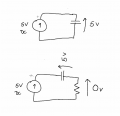
No actually this next diagram shows the situation where the output is zero volts DC.
The circuit on the bottom here. The voltage is zero across the resistor.
If the 5v DC source also had some AC content, only that would appear across the resistor and the amplitude would depend on the relative impedances of the cap and resistor.

CapSeriesParallel-1.png
 

ericgibbs

Joined Jan 29, 2010
21,442
hi X02
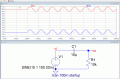
Perhaps a visual of the DC blocking action will help.
The vi is 10Vdc with a 1Vpp AC signal superimposed on the DC.
After the Cap, ie vo is the original 1Vac with the 10Vdc blocked.

E
EG 1721.gif
 

MrAl

Joined Jun 17, 2014
13,704
hi X02
Perhaps a visual of the DC blocking action will help.
The vi is 10Vdc with a 1Vpp AC signal superimposed on the DC.
After the Cap, ie vo is the original 1Vac with the 10Vdc blocked.

E
View attachment 271181
Hi Eric,

Yes good idea to show some waves on how this works.

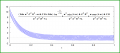
Here is another image and expression that shows what happens to the DC component. Looking at the expression, the sin and cos terms never go away completely while the exponential part (the first term) goes to near zero as time t progresses. Since Vdc (the DC voltage) is only contained in that first term, the DC voltage disappears eventually.

The various variables are:
Vdc is the input DC voltage
A is the input sine amplitude,
R is the resistor (R1 in Eric's drawing),
C is the capacitor (C1 in Eric's drawing),
w is angular frequency equal to 2*pi*f where f is the cyclic frequency in Hertz,
t is time in seconds.

For the graph i set the same values as in Eric's drawing:
R=10k, C=10uf, A=1 volt Ac, Vdc=10 volts DC, f=100Hz.

CapSeries-1.png
 
Top