Transistor switch circuit not distributing enough current

Thread Starter

programmer6502

Joined Feb 1, 2014
132
Hello,

I'm building a NIMH battery charger circuit that will be controlled by a microcontroller featuring current control. This is part of my circuit (without the current limiting portion) that I'm having trouble with. (Note: This is all in a proof of concept/prototype stage.)
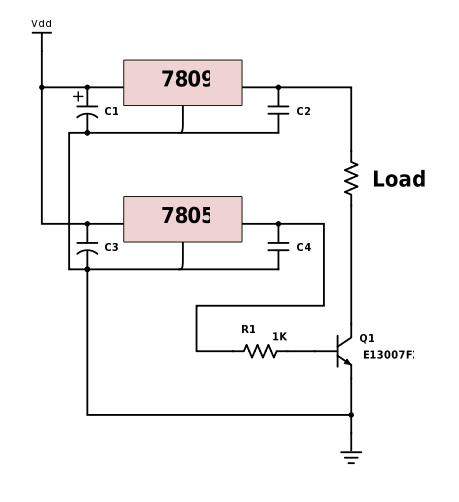


So what I have here is 7809 (1 amp) voltage regulator that provides the voltage my particular battery needs, and under that a 7805 (also 1 amp) regulator that represents the 5v a microcontroller would produce. That 5v in turn is fed into a 1k resistor that drops the voltage to about 0.6v, turns on the transistor, and finally starts feeding the load (or battery).

Now the problem I'm having is it won't produce more than about 130-140ma to the load with the 7809 rated at 1 amp! From what I understand the transistor is a current amplifier and the base current governs the collector current. So if it isn't getting enough base current then the output of my circuit isn't going to be very high. But I don't see how the base wouldn't be drawing the current it needs! The transistor I'm using is a E13007F2 (salvaged from a power supply). Datasheet found here.

I'm still fairly new to transistors so it could be that I'm not understanding the specs right and this transistor is not suitable.

Thanks
 

#12

Joined Nov 30, 2010
18,224
Eric showed that 4.4ma isn't enough to drive an amp through the transistor. When you change to a microcontroller, you are stuck with a low current supply. Therefore, you need more current gain. A mosfet could do that, or a second bipolar transistor configured for more current gain.
 

Thread Starter

programmer6502

Joined Feb 1, 2014
132
hi 6502,
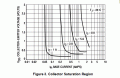
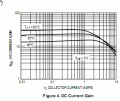
Look at these images of the Ib versus Ic.
Your transistor Ib =(5v -0.6v)/1000 = 4.4mA.
Use the graphs to show the Ic at this Ib.
E
Awesome, that's just formula I needed to see! I wondered if maybe the resistor had something to do with it.

Eric showed that 4.4ma isn't enough to drive an amp through the transistor. When you change to a microcontroller, you are stuck with a low current supply. Therefore, you need more current gain. A mosfet could do that, or a second bipolar transistor configured for more current gain.
Makes perfect sense, thanks for the suggestions on what to use!

Without knowing BCC, impossible to tell.

I would just short the BJT to see if it is the problem.
Yes, I bypassed the transistor and was able to draw full current to my load so that was indeed the problem.


Thanks all for the help! It's my first time doing something like this and my references didn't mention anything about the limited base current when arranged like so.

(Edit: Rather I learned that my transistor doesn't have the gain I need. My sources probably used something more suitable for their goals.)
 
Last edited:

#12

Joined Nov 30, 2010
18,224
I did one just yesterday for a guy that wants to slam a 30 amp solenoid. Mosfets are amazing at the amount of current you can run through them with a very minimal gate drive current.Door Solenoid.png
 

#12

Joined Nov 30, 2010
18,224
replace Q3 with a tl431 and the turn on/off will be much sharper.
U2 really has no reason to exist.
1) U2 will be replaced with a micro-controller chip, so it has to exist. The MCU is the heart of the intended circuit.
2) As much as I love Bordodynov, this circuit has missed a few points which seem important.
a) You can't connect R1 to an MCU and get the 40 ma to 50 ma needed by the base of Q1.
b) The current regulation function will be provided by the MCU so Q3 is irrelevant.
c) Replacing Q3 with a TL431 is therefore irrelevant.
d) I don't know where the 592 ma current limit came from because the TS is talking about 1 amp.
 

Bordodynov

Joined May 20, 2015
3,431
See PWM.
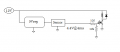
PWM signal after divider the filter capacitor . The voltage varies in proportion to the duty cycle. In this example 100% and 30%. The current through the battery ranges from 1A to 300mA.
Draft371.png
 

Thread Starter

programmer6502

Joined Feb 1, 2014
132
#12,

I like your reasoning, I'm not opposed to the mosfet idea at all.

And Bordodyno, funny because 300ma to about 1 amp is what I was looking at for my particular battery. I like your utilization of an op amp to control the transistor. In my prototype I was using an additional transistor to divert excess current.
 

Thread Starter

programmer6502

Joined Feb 1, 2014
132
Alright,

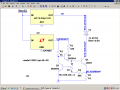
I've made two transistor switch circuits here on spice that both utilize a BJT to limit current. One consists of a darlington pair BJT and the other a mosfet; both outputting about 300mA to 1A with some tolerance. As seen on the pics, I've taken two measurements on each. One being the collector/drain current and the other the collector/drain voltage (while R2 is being adjusted in 1 Ohm increments in both circuits). The current measurements look good to me, but shouldn't the voltages be close to the 9v being provided at all times? They're way out there.

(First time on this simulator and the BJT and Mosfet models are somewhat random since I was experimenting)

BJT circuit:


Mosfet circuit:


#12

Joined Nov 30, 2010
18,224
I can't see the graphs but I can say the mosfet circuit shouldn't work. There is no impedance between the 5V source and Q2.
Q2 should start smoking.
 

Thread Starter

programmer6502

Joined Feb 1, 2014
132
I can't see the graphs but I can say the mosfet circuit shouldn't work. There is no impedance between the 5V source and Q2.
Q2 should start smoking.
Hah probably so. The idea there is that that Q2 shorts the Mosfet to ground when it exceeds the current limit and repeats an on and off process very quickly to seem as if there is a constant amount of current being supplied to the load. Might not be the best way to go about that.

Edit:
Yeah oops that needs a pull down resistor or something.
 
Last edited:

ericgibbs

Joined Jan 29, 2010
21,439
hi 6502,
It would help if you posted the LTS asc file of your circuits, when you post a plot image.
We could check your work easier and suggest modifications.
E
 
Top