Transistor LED dimmer

Audioguru again

Joined Oct 21, 2019
6,826
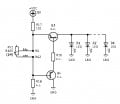
Your transistor Q3 will be an on-off switch and dimming might happen with temperature and 5V supply variations.
Replace Q3 with an NPN emitter-follower and redesign how it is turned on.
 

MisterBill2

Joined Jan 23, 2018
27,281
Yes, it can be some sort of INEFFICIENT resistive dimmer. A far better approach is to use a Pulse Width Modulation (PWM) scheme to vary the output. That is the better approach.
 

BobTPH

Joined Jun 5, 2013
11,482
It is exactly as efficient as a PWM circuit. I know it sounds wrong, but do the math, using the same average current for both circuits.
 

sghioto

Joined Dec 31, 2017
8,634
It is exactly as efficient as a PWM circuit. I know it sounds wrong, but do the math, using the same average current for both circuits.
I believe the term efficiency in this application is referring to the dissipation of the transistor in the linear mode vs PWM mode.
 

Thread Starter

william.in.rs

Joined Jul 14, 2012
22
Thank you all,
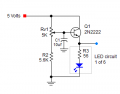
I've supposed that it is a dimmer because it is from a cheap webcam where the LEDs are used to light the object being recorded. The components marked with n.c. are not soldered to the PCB (both transistors and resistors R16 and R18). The orange wire from trim-pot is soldered to the LED anodes instead. LEDs can't be dimmed with 1M resistor in series, they could only be turned on when the trimpot's resistance is near zero or off otherwise, because even a slightest movement of the trimpot from zero position makes it's resistance several K which is too much for LED to light.
Am I right when I assume that R18 is about 2M to supply 3.3 to 5V to the base of Q4 and that Q3's dissipation should be at least 200 mW?
Is the purpose of R16 only to limit the base current of Q3? How can I determine it's value?
 

MisterBill2

Joined Jan 23, 2018
27,281
The math is wrong! In a PWM circuit there is no waste heat from a series resistance, while in a linear circuit there is power burned as heat in each of the series resistances. So while the power in the LED may be the same for either control mode, the wasted power iis vastly reduced in the PWM mode. The waste isnot in the LED power, but in the non-led power.
 

BobTPH

Joined Jun 5, 2013
11,482
Not talking about the resistor but the dissipation on the transistor. You do the math! :)
You are being silly. Why do you ignore the waste in one circuit and then declare that it is therefore more efficient than another circuit with the same waste in a different component?
 

Thread Starter

william.in.rs

Joined Jul 14, 2012
22
Sure MisterBill2.
That's definitely not what you show in post #1. Is that schematic just a guess?
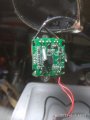
The schematic is my guess from the PCB (photo is attached).
I just want to make it working as it was designed. I could replace the trimpot with a smaller one, but it would take a lot of mechanical work because original 1M is built in the cable and have unusual dimensions.
 

Attachments

Thread Starter

william.in.rs

Joined Jul 14, 2012
22
The math is wrong! In a PWM circuit there is no waste heat from a series resistance, while in a linear circuit there is power burned as heat in each of the series resistances. So while the power in the LED may be the same for either control mode, the wasted power iis vastly reduced in the PWM mode. The waste isnot in the LED power, but in the non-led power.
Which part of my math is wrong? I was considering non-LED power: 6 LEDs with current 20mA each = 120mA. Transistor voltage drop is 1.7V (5V - 3.3V). that is 200mW power for transistor. R18 in series with RV1 gives 3.3V to 5V for the base of Q4.
 

ElectricSpidey

Joined Dec 2, 2017
3,316
I agree with Bob.

But forget that and ask @crutschow what he thinks.

I have been building lighted displays for a very long time (basically my niche) and I use PWM to get RGB color matching correct, simply because if you use linear control the blue and green LEDs dim before the red...and that's a no-no. (also color purity, but I have never had this need)

One can make the argument that PWM is more efficient based on POV but not as far as power requirements. (even this argument is dubious)

In my opinion "efficiency" is the effective illumination obtained from any given power used in total, not on which component wastes the heat.
 
Last edited:

ElectricSpidey

Joined Dec 2, 2017
3,316
The math is wrong! In a PWM circuit there is no waste heat from a series resistance, while in a linear circuit there is power burned as heat in each of the series resistances. So while the power in the LED may be the same for either control mode, the wasted power iis vastly reduced in the PWM mode. The waste isnot in the LED power, but in the non-led power.
Are you saying that you don't need the dropping resistor if you use PWM?
 

BobTPH

Joined Jun 5, 2013
11,482
I'm being silly? I don't think so.
You are ignoring the dissipation is the resistor, that is silly when calculating efficiency. As I asked before twice, show me the math, then I can correct it for you. You can even assume 0 volts across the PWM switch to make it sumpler.

But first maybe we should define efficiency. How about:

Pb = power drawn from battery = Vb * Ib

Pl = power dissipated in LED = Vf * If

e = Pl / Pb
 
Last edited:

Danko

Joined Nov 22, 2017
2,152
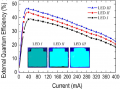
LEDs, depends on their type have maximal efficiency
at particular current, therefore PWM on such current
provides maximal efficiency in all range of average
light flow.

1686496411052.png
https://www.researchgate.net/public...emitting_diodes_by_localized_surface_plasmons

ADDED:
The max efficiency is achieved at a current very far below the normal operating current.
"normal" - is voluntary selected parameter, for decreasing lifetime of LEDs
(thousands hours instead hundreds thousands hours in max. eff. mode).
It is abnormal, not normal.
 
Last edited:
Top