transistor basics ( as buffer )

Thread Starter

electronicsenjoyer089

Joined Feb 24, 2025
182
hi,
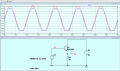
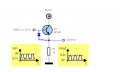
What do you think the V output would be?

E
hi,
What do you think the V output would be?

E
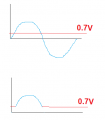
well in A.C what i got is a signal that is increasing from 0 to 9V, until it reaches 0.7V nothing appears in output, when i got more than 0.7V i can see it in output, so from 0 to 8.3V ( i know its a bit contradictory with what i said about d.c component first , but i didnt fully understand it yet..)
 

panic mode

Joined Oct 10, 2011
4,995
the basic thing to understand is that most of the characteristics of transistor are not linear (there is buch of exponential terms for example). this makes calculations and predictions hard. so when dealing with the problem of this nature one uses two approaches:
1. do a rough estimate to get quick results even if not perfect.
2. do a detailed calculation that produces better (more accurate) results.

the 0.7V is used in first case. crude estimates...

so based on that all input signals are treated based only if the input value at some point is above or below that 0.7V level.
if it is below, it is approximated that transistor is off and no collector current is present. if the input signal is above 0.7V then further check is needed if transistor is in linear or saturation region. when in linear, then crude estimate is applied. this still produces remarkably useful results even if not very accurate.

according to estimate, result of next two inputs are not distinguishable
1744721022664.png
 
Last edited:

Thread Starter

electronicsenjoyer089

Joined Feb 24, 2025
182
Hi,


No, An AC signal with no DC offset swings above and below zero, so 1Vac swings-1v > 0v +1v > 0v > -1v
e
ah ye my bad, then in that case if it swings from -9v to 9v for example, what i will see in output is a sine wave that goes from 0 to 8.3V. Because what happens is: until 0.7V it wont conduct ( so negative voltage wont make the diode conduct ) above that voltage it starts conducting, and the signal will have a drop of 0.7v) or im wrong?
 

Thread Starter

electronicsenjoyer089

Joined Feb 24, 2025
182
the basic thing to understand is that most of the characteristics of transistor are not linear (there is buch of exponential terms for example). this makes calculations and predictions hard. so when dealing with the problem of this nature one uses two approaches:
1. do a rough estimate to get quick results even if not perfect.
2. do a detailed calculation that produces better (more accurate) results.

the 0.7V is used in first case. crude estimates...

so based on that all input signals are treated based only if the input value at some point is above or below that 0.7V level.
if it is below, it is approximated that transistor is off and no collector current is present. if the input signal is above 0.7V then further check is needed if transistor is in linear or saturation region. when in linear, then crude estimate is applied. this still produces remarkably useful results even if not very accurate.

according to estimate, result of next two inputs are not distinguishable
View attachment 347049
ye i know its incorrect to say 0.7V but its not the problem here, im trying to understand how things works first, then i will look about real diode drop etc. but thanks
 

panic mode

Joined Oct 10, 2011
4,995
correct... from post #24 you seem to be on the right track.
but keep in mind that there are other concerns too: base voltage Vbe cannot be negative too much or transistor will be destroyed.
 

Thread Starter

electronicsenjoyer089

Joined Feb 24, 2025
182
correct... from post #24 you seem to be on the right track.
but keep in mind that there are other concerns too: base voltage Vbe cannot be negative too much or transistor will be destroyed.
ye i gotta look for the maximum VEB (cus its reversed) that my transistor can withstand before popping right? ( this i look i nthe datasheet). thanks btw
 

panic mode

Joined Oct 10, 2011
4,995
diode is used to protect transistor from negative voltage, regardless of input voltage polarity, Vbe is always within +/-0.7V and this is safe since considerably smaller than base breakdown voltage. most transistor have Vce breakdown of 45V or or higher, and Vc=9V, input could be not just -9V, it could be -36V
9V-45V=-36V

if you connect -9V to base, current will be (-9V-(-0.7V))/1k = -8.3mA

if you connect -36V, then current will be -35.3mA

not sure if your signal generator can handle this but ... transistor will be safe
 

crutschow

Joined Mar 14, 2008
38,520
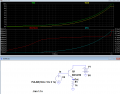
Here's a plot that shows how the Vbe (red trace) changes versus the input voltage and output current:
Note that it doesn't reach 0.7V until the output current (blue trace) is near 9mA.

1744728192371.png
 

WBahn

Joined Mar 31, 2012
32,870
that would be job for a diode:
View attachment 347053
Adding that diode changes the transfer characteristic radically.

Ignoring breakdown considerations (which can't be ignored in real life), without the diode, the output is essentially 0 V for any input voltage below about 0.7 V. But, with the diode, the output follows the input for negative voltages below about -0.7 V.

The transistor provides buffering between the input and the output, but the diode removes that buffering for negative input voltages.
 

crutschow

Joined Mar 14, 2008
38,520
If you connect the diode from base to ground with a series resistor to the input generator, then the base will be protected and the output won't see any negative voltages from the input.
 

panic mode

Joined Oct 10, 2011
4,995
Adding that diode changes the transfer characteristic radically.
how so? even without the diode, output of shown circuit still cannot reach negative voltage. transfer characteristic is not changed, all the diode does is protect transistor. in case AC input is applied
 
Top