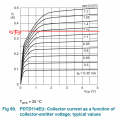
I'm concerning about the current which is listed on the above table. If the current of 370mA draws for only one segment when the peak current triggered, then the transistor collector current will allows approx. max. 350mA only. Since, Ib=12V/10K=1.2mA. Does it works effectively if I use this transistor to lit the 16-segment?.
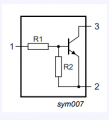
Why will there be a 9.4V voltage drop across R1?. The diode drop will be 0.6V to 0.8V only, right?. So, from my understanding, 9.4V should be across R2, and there will be 0.7V drop across the diode.
What I wrote on post #12 is wrong?.
So, I do not need to worry about the ABSOLUTE MAXIMUM RATINGS. If so, then, can I use the transistor (the one which we discussed in the earlier posts) as a switch to this segment?.
So, I do not need to worry about the ABSOLUTE MAXIMUM RATINGS. If so, then, can I use the transistor (the one which we discussed in the earlier posts) as a switch to this segment?.
Of course you need to worry about them -- if you exceed them then the device can fail or have significantly reduced life.
If you use the transistors as switches, then you need to have some other means to control the current to the desired operating level, which should be well below the absolute max ratings. For LED circuits, the simplest way to do that is to use a suitably sized resistor in series with each segment.
Yes, but you will need a resistor in series with each segment to provide the recommended LED current as determined by the supply voltage and the LED forward-drop voltage.
1) How much base voltage and current needs to be applied to draw maximum collector current of 500mA using 'PDTD114EU'?.
2) The half of the voltage will be present after R1 resistor. Right?. If I applied 5V before R1, then after R1 resistor the voltage will be 2.5V, which will applied to the base of the transistor, Right?.
The image you posted is the pinout of the transistor itself. The resistors are part of the integrated circuit, thus you cannot inject or test a voltage at the R1-R2 junction. If you want to experiment, use an input voltage of 5v through a 5K potentiometer connected to pin 1. Connect pin 2 to ground through a 1K potentiometer. Now you can measure the current from pin 3 to ground. You should always have a load otherwise you risk smoking the transistor. Once you get the output (Collector) current and voltage where you want it, measure the resistance of the base and emitter resistors. Work out the math using Ohm's Law to verify your findings.
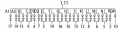
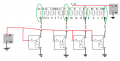
The common pin of the 16 segment display circuit has a common anode. So, in this case, can I use multiple transistors for the multiple segments which I want to lit as I shown below?. From the circuit diagram below, my understanding is that the green marked LED's only lit and will turn ON, and other LED's won't be switched ON, it will be OFF only because there is no path to pass the current through GND.
The resistor values that are connected in series to the collector of the each transistor, will be calculated later as per the datasheet recommendations.
Could you confirm that the rest of the LEDs that are not used/connected to the circuit below won't be damaged, Right?. Since there is no path to the current flow. Am I right?.
Could you confirm that the circuit below will work?. (or) do you want me to do any modifications?.
The circuit diagram below is an example one, just to make sure with you that this configuration will work or not?.
Since the maximum voltage required for the segments is 4.7V, how do you expect to reliably light them with only a 4V supply?
The minimum supply should be at least 6V for the LEDs.
Normally, you multiplex the different digits by switching both the anode and the cathodes. One anode is selected at a time and all of the cathodes for that anode are set. This allows you to control them all with #segments + #digits pins, instead #segments * #digits.

 Facebook
 Google
 GitHub
 Linkedin