Transient analysis - Dependent sources

MrAl

Joined Jun 17, 2014
13,704
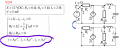
I will get back to your points later. Do you think the lastline of this transform is correct? this is about second order circuit/
View attachment 339217
It looks like 20v/s is correct if the switch opens the 30v source and the 5 Ohm resistor as well as connecting the cap to the 25 Ohm resistor. That's dv(0+)/dt, and dv(0-) would be different.

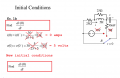
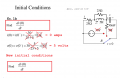
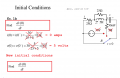
The only question is what exactly do they want you to calculate. The article is titled "Initial conditions", and it appears you calculated v(0-) and i(0-) but then you calculated dv(0+)/dt. They asked for v(0), i(0), dv(0)/dt, and di(0)/dt, without specifying the just before or just after t=0 point in time.
 

Thread Starter

linhvn

Joined Nov 6, 2024
297
It looks like 20v/s is correct if the switch opens the 30v source and the 5 Ohm resistor as well as connecting the cap to the 25 Ohm resistor. That's dv(0+)/dt, and dv(0-) would be different.

The only question is what exactly do they want you to calculate. The article is titled "Initial conditions", and it appears you calculated v(0-) and i(0-) but then you calculated dv(0+)/dt. They asked for v(0), i(0), dv(0)/dt, and di(0)/dt, without specifying the just before or just after t=0 point in time.
well, As for IL and Uc are inertia , right just before or after t=0, they have the same value.
 

Thread Starter

linhvn

Joined Nov 6, 2024
297
They are calculating the impedance, and to do that you always "kill" the sources. By killing the sources you effectively replace them with their impedances.
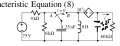
I get stuck at this finding characteristic equation , when t=0 switch from A to B, normally , we take out branches with dependent sources and resistors and find Req by thevenin, but with this circuit, how to deal with?
1735612233317.png
 
Last edited:

Thread Starter

linhvn

Joined Nov 6, 2024
297
They are calculating the impedance, and to do that you always "kill" the sources. By killing the sources you effectively replace them with their impedances.
Do you know why i=A1e^(st), is this beacause i is the root of first order equation?
1735622717856.png
 

MrAl

Joined Jun 17, 2014
13,704
well, As for IL and Uc are inertia , right just before or after t=0, they have the same value.
I think we are talking about different aspects of the circuit, but that's ok for now as long as you are happy with the results you got.
 

MrAl

Joined Jun 17, 2014
13,704
I get stuck at this finding characteristic equation , when t=0 switch from A to B, normally , we take out branches with dependent sources and resistors and find Req by thevenin, but with this circuit, how to deal with?
View attachment 339282
If you have doubts about some alternate method of calculating something, you should then analyze the circuit fully then decide what the characteristic equation is. Then you can compare it to the alternate method.
I think you can analyze this circuit exactly the way it is (I guess that second cap is 1.25nf ?). Do that first, then see what you can make of it. You can post results here also we can take a look. Please keep any calculations neatly printed as you have done in the past as it is hard to read some people's normal hand writing.
 

WBahn

Joined Mar 31, 2012
32,832
I get stuck at this finding characteristic equation , when t=0 switch from A to B, normally , we take out branches with dependent sources and resistors and find Req by thevenin, but with this circuit, how to deal with?
View attachment 339282
You do NOT take out dependent source. You zero independent source and leave dependent sources in place.
 

Thread Starter

linhvn

Joined Nov 6, 2024
297
You do NOT take out dependent source. You zero independent source and leave dependent sources in place.
yep, but how to transform the new circuit with independent source and leave dependent sources, got to do something with depentdent source, because L==>LS, C==> 1/(Cs), cannot juts leave it in place as you said.
 

MrAl

Joined Jun 17, 2014
13,704
well, As for IL and Uc are inertia , right just before or after t=0, they have the same value.
Hello again,

Here is a new exercise for you. You jumped over one fact that you never went back to so this will clear that up for you.
This exercise was designed to show you something you missed in the past and it should be very easy for you to do so I strongly suggest you do this exercise before going on with the other exercises.

This is almost the same as one of the other circuits you had, but this time the two initial conditions i(0) and v(0) are handed to you so you don't have to calculate either of those. In the previous circuit i0 was given as 1 amp, this time it is 0 amps, and v0 was given as 5 volts, and this time it stays at 5 volts (as shown). See if you can calculate the right value of dv/dt as before. It will of course be different this time. Ignore everything crossed out in red. Note the added resistor of 25 Ohms.

This is very important or I would not have taken the time to draw this up. You'll see why after you do it.
 

Attachments

Thread Starter

linhvn

Joined Nov 6, 2024
297
Hello again,

Here is a new exercise for you. You jumped over one fact that you never went back to so this will clear that up for you.
This exercise was designed to show you something you missed in the past and it should be very easy for you to do so I strongly suggest you do this exercise before going on with the other exercises.

This is almost the same as one of the other circuits you had, but this time the two initial conditions i(0) and v(0) are handed to you so you don't have to calculate either of those. In the previous circuit i0 was given as 1 amp, this time it is 0 amps, and v0 was given as 5 volts, and this time it stays at 5 volts (as shown). See if you can calculate the right value of dv/dt as before. It will of course be different this time. Ignore everything crossed out in red. Note the added resistor of 25 Ohms.

This is very important or I would not have taken the time to draw this up. You'll see why after you do it.
okay, t=0 means , switch in B position and it means, no voltage source and 5ohm resistor, the others remain the same.
 

Thread Starter

linhvn

Joined Nov 6, 2024
297
Hello again,

Here is a new exercise for you. You jumped over one fact that you never went back to so this will clear that up for you.
This exercise was designed to show you something you missed in the past and it should be very easy for you to do so I strongly suggest you do this exercise before going on with the other exercises.

This is almost the same as one of the other circuits you had, but this time the two initial conditions i(0) and v(0) are handed to you so you don't have to calculate either of those. In the previous circuit i0 was given as 1 amp, this time it is 0 amps, and v0 was given as 5 volts, and this time it stays at 5 volts (as shown). See if you can calculate the right value of dv/dt as before. It will of course be different this time. Ignore everything crossed out in red. Note the added resistor of 25 Ohms.

This is very important or I would not have taken the time to draw this up. You'll see why after you do it.
Can you give me a clear problem, that small i is the current before block of 25ressitor and 5h inductor???
 

Thread Starter

linhvn

Joined Nov 6, 2024
297
Hello again,

Here is a new exercise for you. You jumped over one fact that you never went back to so this will clear that up for you.
This exercise was designed to show you something you missed in the past and it should be very easy for you to do so I strongly suggest you do this exercise before going on with the other exercises.

This is almost the same as one of the other circuits you had, but this time the two initial conditions i(0) and v(0) are handed to you so you don't have to calculate either of those. In the previous circuit i0 was given as 1 amp, this time it is 0 amps, and v0 was given as 5 volts, and this time it stays at 5 volts (as shown). See if you can calculate the right value of dv/dt as before. It will of course be different this time. Ignore everything crossed out in red. Note the added resistor of 25 Ohms.

This is very important or I would not have taken the time to draw this up. You'll see why after you do it.
If small i is the current before the block parallel, U'(c) = 8V/s
 
Last edited:

MrAl

Joined Jun 17, 2014
13,704
Can you give me a clear problem, that small i is the current before block of 25ressitor and 5h inductor???
Yes I should have made the current arrow position more clear.
See the attachment.
'i' is through the first 25 Ohm resistor, but iL is also zero, so there is no energy in the system except v(0) the voltage across the cap, which is 5 volts.
This is mainly to show that there is no current in the inductor to start.
 

Attachments

MrAl

Joined Jun 17, 2014
13,704
Do you know why i=A1e^(st), is this beacause i is the root of first order equation?
View attachment 339291
Hi,

That would not be first order in general, but for example i2 will not be first order it would actually be 2nd order.
That form is sometimes used to show that the wave is an exponentially damped sinusoid, but I am not sure why they are pointing this out or why they wanted to show it this way. We would need more context, like maybe some examples just before that or earlier in the lessons they have shown up to that point and maybe even just after that.
 

MrAl

Joined Jun 17, 2014
13,704
Final result 8V/s
Hello again,

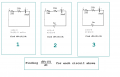
Ok, well I think you need to look at these problems again so I've drawn up a new image with three new circuits. They are simple and you have the basic idea how to do these so I don't think this will be hard for you to calculate. In fact, probably easy for you.
This will illustrate some very important facts.

As you can see, the first circuit #1 has no independent source in it, it just has an initial capacitor voltage and no initial current.
Circuit #2 is similar, but now there are all zero initial conditions and one source the 5v battery.
Circuit #3 is the same as circuit #2 but the battery polarity is flipped.

In all three you are asked to calculate the time derivative of the capacitor voltage dv/dt at t=0 as before.
You will find these rather simple to do but you will be interested to see all the results, if not right away then once we talk about it again after you post the results you got.
 

Attachments

Top