Yes,
Example:
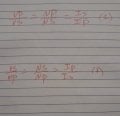
8/1 = 8/1 = 8/1 this is true. Looking from the P to S of the transformer.
and
1/8 = 1/8 = 1/8 this is true. Looking from the S to P of the transformer.
Another way to think about this: James took 1/8 of the pie AND James did not take 7/8 of the pie.
The part about the currents is sort of correct but it neglects to consider that the efficiency is always less than 100% It also totally neglects the effect of wire size.
Given that EFFICIENCY is usually expressed as ( POWER out divided by Power in) x 100%, and none of those equations include a power term, they can not be describing efficiency.
However, the second equation does relate to the maximum capability of a transformer if it were 100% efficient.
IT IS an effective way of reminding us that we can never get more out than we put in. And it does serve as a good way to estimate the capability of the transformer.
It is about a simple question of turn ratio and has nothing to do with efficiency.
Turn ratio can be expressed by the ratio of voltage, ratio of turns, or the ratio of current.
(Volts ratio = Trun ratio = 1/Current ratio) Or turn the formula upside down and it still works. (1/V = 1/T = Current)
Why don't you figure it out. I am not going to expand on Joule's Law that many people have written about in transformer theory. There is plenty of information on that subject online.
The only time when the secondary is the top divisor in a formula is in an efficiency formula.
and its not exclusively the only variable in the top divisor of the formula.
But that is the only time I seen the secondary used in the top divisor of an equation.
Like I stated already, in post #10. But with more elaboration than I provided.
AND really, a transformer ratio has nothing to do with the current. It has to do exclusively with the open circuit voltage ratio.
Well, at least it appears you recognize that you can't use those equations to say anything about efficiency.
I am not going to expand on Joule's Law that many people have written about in transformer theory. There is plenty of information on that subject online.
Nothing in those equations has anything do to with Joule's Law, which deals with the relationship between the energy converted to heat and the current flowing through a resistance over a period of time.
The only time when the secondary is the top divisor in a formula is in an efficiency formula.
and its not exclusively the only variable in the top divisor of the formula.
But that is the only time I seen the secondary used in the top divisor of an equation.
That is such a wrong assertion that it's really not even worth commenting on. Not to mention that fact that in BOTH of those equations, have the secondary as the "top divisor" (you might want to look up what a 'divisor' is, by the way). In the first equation, you have the secondary current divided by the primary current, and in the second you have the secondary voltage divided by the primary voltage. So, according to your assertion, both of them are efficiency formulas, and since they are reciprocal of each other, you are therefore claiming that efficiency is always equal to 1/efficiency.
In a current transformer the voltage is dependent on both the turns ration and the current. And at all times, a current transformer is a very special case device.
In a current transformer the voltage is dependent on both the turns ration and the current. And at all times, a current transformer is a very special case device.
Wouldn't that be that the voltage is dependent on the current, the turns ratio and the burden resistance?
(Of course, that's an ideal current transformer. In a real current transformer the magnetising inductance plays a part as well)

 Facebook
 Google
 GitHub
 Linkedin

 777.7 KB Views: 39