Transfer Function of circuit

Thread Starter

champ01

Joined Aug 22, 2012
10
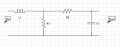
Trying to find the transfer func of the circuit attached, in laplace

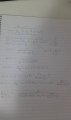
My answer I got was: Vo(s)/Vi(s) = R1 / (sCR1 + sCR2 + 1)(sL + R1)

Just wondering if anyone can verify my answer?
 

Attachments

Thread Starter

champ01

Joined Aug 22, 2012
10
with verification I was just wanting to know if I got the right answer or not, not for anyone to solve it for me.
 

t_n_k

Joined Mar 6, 2009
5,455
In reality one has to solve it to verify your result anyway.

As a comment only, perhaps it would have been more informative if you had expanded the function to show a second order polynomial (a*s^2 + b*s +c) in the denominator.

I believe you have an error in what would be the 's' term coefficient in the aforementioned denominator expansion. The 's^2' and constant terms in the expanded denominator polynomial look OK.
 

MrAl

Joined Jun 17, 2014
13,693
Hi,

Yes i agree there is something wrong. You should not get a term with R1^2 in it.
Try again, then post result.
 

MrAl

Joined Jun 17, 2014
13,693
Hi,

Sorry that still does not look right.

Also, your final result should be in the form of two polynomials, one numerator and one denominator:

Hs=N/D=(a*s^2+b*s+c)/(d*s^2+e*s+f)

where a and/or b may be zero, and no coefficients will be negative.
 

WBahn

Joined Mar 31, 2012
32,783
are my first three equations of circuit analysis correct? could be my algebra needing a brush up
Your setup equations look fine.

But look at this equation:

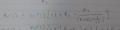
upload_2015-4-10_23-13-14.png

Always, always, ALWAYS check your units!

sL has units of impedance
R has units of impedance

what are the units on that last fraction? It's unitless. Can you add a unitless quantity to an impedance?

This means that everything beyond this point (that uses this equation) is guaranteed to be wrong and was a waste of time. ALWAYS track and check your units as you go.
 

MrAl

Joined Jun 17, 2014
13,693
Hi,

That may be right, but still not in the right form. You should multiply out the denominator so you have only one polynomial in the denominator and only one in the numerator, with no fractional parts in either.
So this is an example:
5/(s^2*2+3*s+5)

while this is not in proper form yet:
10/(s^2*2/R1+3*s/R1+5)

because of the divisions.

Sometimes you keep the divisions, but that's for a different reason.
 

WBahn

Joined Mar 31, 2012
32,783
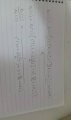
I've re-worked again:
The units work out, now ask if the answer makes sense.

Ask about bounding cases. You have four obvious ones, namely the various combinations of when the inductance and capacitance are zero and infinity.

If the inductance and capacitance were both zero (i.e., if the inductor were replaced with a short and the capacitor replaced with an open), what would the transfer function be? Does your solution reduce to that result?

Same for the other three combinations.
 
Top