Okay Eric.Hi D,
By bypassing the 768K resistor with the 1000pF the response to high going Vout spikes, it will increase the Vfb thus pull down the Vout faster to the desired Vout.
Personally, I would not include the 49.9R and 1nF
E
Okay Eric.Hi D,
By bypassing the 768K resistor with the 1000pF the response to high going Vout spikes, it will increase the Vfb thus pull down the Vout faster to the desired Vout.
Personally, I would not include the 49.9R and 1nF
E
I don’t know where they have come from either. They don’t appear in any datasheet I looked at.Thanks Ian. I'm still stuck at V1,V2,V3 and those unknown resistor(R3,R4 and R5) in the circuit. What's the purpose or intension of including V1,V2,V3 and R3,R4 ,R5? Could please help me to understand?
View attachment 322471
Got it Ian. Thanks a lot for the help.I don’t know where they have come from either. They don’t appear in any datasheet I looked at.
One thing is certain: connecting extraneous components to a feedback pin usually leads to trouble, even Connecting a long pcb track to it might not be too good. Apart from the resistive divider to set the output voltage (and maybe a capacitor for a bit of phase lead as @ericgibbs has been telling you about) connecting anything else there won’t end well.
I want to measure Switching frequency and duty cycle. In order to do that i have probed at FSW pin(Signal is yellow colour). I have also probed at Vout pin(signal in green colour) to record output voltage for my reference.Okay Eric.
FSW is the resistor that sets the frequency of the internal oscillator. No guarantee as to what sort of waveform might be present. It could even go into a current mirror, in which case there would be no waveform.I want to measure Switching frequency and duty cycle. In order to do that i have probed at FSW pin(Signal is yellow colour). I have also probed at Vout pin(signal in green colour) to record output voltage for my reference.
![]()
Following are my queries:
1. Why I'm getting triangular like shaped waveform at FSW pin?
2. To measure switching frequency and duty cycle, is FSW is the pin i have to probe it or SW?
3. How to measure switching frequency and duty cycle?
Below is the circuit for this testing:
![]()
Okay will surely check this.FSW is the resistor that sets the frequency of the internal oscillator. No guarantee as to what sort of waveform might be present. It could even go into a current mirror, in which case there would be no waveform.
Probe the SW pin.
Provided that the inductor current is continuous, you will see a squarewave.
if the inductor current is discontinuous, you will see a lot of ringing.
Difficult to say, but maybe your feedback loop is unstable. You will see when you connect the scope.What is this buzzing sound which occurs once the EN pin is On( When EN is made short to Vin)?
No , I haven't used it.Difficult to say, but maybe your feedback loop is unstable. You will see when you connect the scope.
Did you use the values from the datasheet on the comp pin?
One of the capacitors has a red triangle on it on your circuit diagram.
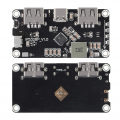
Since now I have got the desired output voltage as 9V, I tested my boost circuit board to charge the loads like mobile(Oppo F17 pro) , camera(EK7000) and Li-battery by using IP5328P fast charge power management SOC board as below.No , I haven't used it.

Hi Ian, Since now I have got the desired output voltage as 9V, I tested my boost circuit board to charge the loads like mobile(Oppo F17 pro) , camera(EK7000) and Li-battery by using IP5328P fast charge power management SOC board as below.Difficult to say, but maybe your feedback loop is unstable. You will see when you connect the scope.
Did you use the values from the datasheet on the comp pin?
One of the capacitors has a red triangle on it on your circuit diagram.
@Ian0 @ericgibbs Could you please help me in this?Hi Ian, Since now I have got the desired output voltage as 9V, I tested my boost circuit board to charge the loads like mobile(Oppo F17 pro) , camera(EK7000) and Li-battery by using IP5328P fast charge power management SOC board as below.
![]()
So using DC power supply I set Voltage as 3V and current 1A and gave this input to my Boost circuit board which gave me Vout =9V. At Vout i connected the above black board(IP5328P).
I observed that camera as well mobile doesn't charge when connected to any of the type A ports or type C port but only Li-battery gets charged when EN pin is ON. If the EN pin is turned off camera starts charging but mobile doesn't charge. Same test if I repeat but without Boost circuit board and only with power supply where I had set voltage as 5V and current as 1A. In this case mobile as well as camera and battery gets charged.
Please help me to know why with the boost circuit board mobile and camera are not getting charged but only battery gets charge.
No current is drawn from the device.Hi Dik,
Can you measure the actual current drawn by each device, from the 9v boost?
E
Hi @ericgibbs , if I connect mobile or camera to any of the port(Type A or Type C) for charging no current is drawn. Could you please help me to know what might be the reason that the mobile or camera is not charging or drawing any current in the case when boost circuit board is connected but mobile and camera start charging when connected to only bench supply(without boost circuit board connected)?No current is drawn from the device.