TP4056 Reverse Voltage Protection Causing Short?

Thread Starter

DevKappa

Joined May 24, 2019
3
Hi all,
I am attempting to follow a small scheme that is supposed to protect the TP4056 IC from reverse voltage. (Typical application (last page of datasheet) shows exactly the schematic of the module itself)
When accidentally reversing the BAT- and BAT+ terminals the magic smoke is released. While these modules are cheap to begin with, I'd much rather provide a simple protection solution.

I've come across this setup:


I am using what I could find around me, which is a 2N5401 PNP BJT as a replacement for 2N29087A in the reference picture and a HUF76145S3S MOSFET as a replacement for IRL2203.

I am just doing this on a small breadboard for experience, so it looks something like this in practicality:


When the battery is inserted in the correct orientation the IC works normally as we expect. However, when I reverse the battery I witness an immediate short with high current which is isn't supposed to happen. This implies I have made a grave mistake because this is exactly what happens when I reverse the battery directly from the module's BAT output.

Can someone point me into the right direction?
I don't know a whole lot about electronics but this is one of those annoying things that makes me wish I had some experience.

Much Appreciated, Thanks :)
 

crutschow

Joined Mar 14, 2008
38,322
I think you have the Mosfet backwards.
No. The TS's circuit is correct.
Your circuit will connect through the MOSFET substrate diode if the battery is reverse connected.
The MOSFET conducts in the reverse direction when the battery is connected normally (MOSFETs conduct equally well in both directions when ON).
Have you tried the simulation with the battery reversed?

TS, your breadboard seems to have the MOSFET drain and source shorted together as they appear to be both connected to the same (right-most) ground track.
 
Last edited:

eetech00

Joined Jun 8, 2013
4,704
No. The TS's circuit is correct.
Your circuit will connect through the MOSFET substrate diode if the battery is reverse connected.
The MOSFET conducts in the reverse direction when the battery is connected normally (MOSFETs conduct equally well in both directions when ON).
Have you tried the simulation with the battery reversed?

TS, your breadboard seems to have the MOSFET drain and source shorted together as they appear to be both connected to the same (right-most) ground track.
Yes...there is a momentary large current spike, a few pico seconds long, and then goes to zero current.
 

crutschow

Joined Mar 14, 2008
38,322
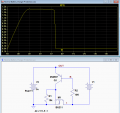
Here's the LTspice simulation of the TS's circuit.
V1 represents the battery output that is being reverse connected (X-axis).
Note that the current out of V1, I(V1), goes to zero as its voltage goes from positive to negative, indicating that the reverse connection is being blocked.

upload_2019-5-25_11-5-55.png
 

crutschow

Joined Mar 14, 2008
38,322
Yes...there is a momentary large current spike, a few pico seconds long, and then goes to zero current.
Then something else is blocking the current because your MOSFET, as shown, cannot block the reverse current.
The substrate diode will conduct.
Look at the MOSFET's source voltage.
 

eetech00

Joined Jun 8, 2013
4,704
Then something else is blocking the current because your MOSFET, as shown, cannot block the reverse current.
The substrate diode will conduct.
Look at the MOSFET's source voltage.
Which way is normal current flow between the charger and battery?
(When being charged)
 

crutschow

Joined Mar 14, 2008
38,322
Which way is normal current flow between the charger and battery?
(When being charged)
Out of the charger and into the battery.
And through the MOSFET from right to left.
(Which is the same direction as when the battery is reversed. That's why protection against reverse battery connection is tricky.)
 

Thread Starter

DevKappa

Joined May 24, 2019
3
TS, your breadboard seems to have the MOSFET drain and source shorted together as they appear to be both connected to the same (right-most) ground track.
Whoops, not sure how I missed that. I moved the drain and resistor to a separate segment of the breadboard and now everything seems to be working great :)

This comment also sparked my interest:
This looks like a nice minimalistic solution. The document refers to several different "Small Packaged FETs with Low Rds(on)" which have rDS(on) values ranging between 68mΩ and 80 mΩ. Is it better to just go with something like this instead? Are there any noticeable downsides?

Regards
 

crutschow

Joined Mar 14, 2008
38,322
This looks like a nice minimalistic solution. The document refers to several different "Small Packaged FETs with Low Rds(on)" which have rDS(on) values ranging between 68mΩ and 80 mΩ. Is it better to just go with something like this instead? Are there any noticeable downsides?
Yes, the downside is, it won't work for your requirements.
That simple solution only works for protection against a reverse battery connection to a device being powered, where the current direction reverses when the battery is reversed.
That doesn't work for a charging circuit, where the current direction doesn't change from normal charging, to a reversed connection.
That's why the charger protection circuit is more complicated.
 

Thread Starter

DevKappa

Joined May 24, 2019
3
Yes, the downside is, it won't work for your requirements.
That simple solution only works for protection against a reverse battery connection to a device being powered, where the current direction reverses when the battery is reversed.
That doesn't work for a charging circuit, where the current direction doesn't change from normal charging, to a reversed connection.
That's why the charger protection circuit is more complicated.
Ahh, that makes total sense. Because the battery is a voltage source instead of a load, right?
 

crutschow

Joined Mar 14, 2008
38,322
that makes total sense. Because the battery is a voltage source instead of a load, right?
Sort of.
It's because the battery is a load that looks like a voltage, but the charger forces current into the battery plus terminal, instead of out, when it's providing power to a load.
 
Last edited:
Top