total power from the source and power factor

Thread Starter

PG1995

Joined Apr 15, 2011
832
Thank you.

The supply voltage is equal to the sum of the line drop and the load drop, Vs=|I|⋅(Z_line+Z_load).
I did find Z_load to be 29.2967+j39.0626 and |I| also found to be 25.6002 A. I believe that the calculations were correct.

The current magnitude |I| is found from the given load voltage (1250 V-rms) and consumption (32 kVA).
I already did.

The line impedance is given, (9+j13).
The load impedance is calculated Z_load=1250/I, however the current |I| must be separated into its real and imaginary parts using the given power factor at the load.
I already found Z_load but don't know how to separate the current I into its real and imaginary parts. I don't know how to proceed. The same goes for V. Only the magnitudes of voltage and current, Vrms and Irms, are known. Thanks for your help.
 

MrAl

Joined Jun 17, 2014
13,708
@MrAl,
Thank you. I do understand your point and aware of it. I committed a blunder while doing the calculation. The terms leading or lagging when used with power factor only convey the information if θv is smaller or larger than θi. Power factor is cosine of θv-θi and cosine cannot be negative even if the angle θv-θi is negative. I'd be more careful in future. Thanks.

@RBR1317,
Thank you. I get your point and this point was somewhere there in my mind but then I didn't pay too much attention to it. I even thought of finding θv then couldn't figure out the way to do it. We know that cos(θv-θi)=0.6⇒(θv-θi)=cos⁻¹(0.6)=0.9273 but as it is stated in the question statement that the power factor is leading therefore θv-θi should be negative and hence it should be -0.9273, in my opinion.

But I still don't know how to find individual θv to find voltage phasors V across the two impedances. I'd appreciate if you could guide me on that. Thanks.
Hi again,

Well you seem to be contradicting yourself because in one place you say the angle is 0.9273 and in the other you say it is -0.9273 so i am not sure yet if you had resolved this issue.

If we define:
P the real power (P),
Q the 'imaginary' power (VAr),
Pa the apparent power (VA),

then we have:
Pa=sqrt(P^2+Q^2)

which is always positive. Since we have P the real power that will be positive when the load is absorbing power, so for a passive load like an RC it should be positive. That gives us:
PF=P/Pa

and because both Pa and P are positive, PF must be positive.

Now to calculate the angle:
cos(Ang1)=PF
cos(Ang1)=0.6
cos(Ang1)=3/5
Ang1=acos(3/5)
Ang1=0.927295218 approximately.
[just for reference acos(3/5)=atan(4/3), triangle: a=4, b=3, c=5]

Now the apparent power is 32000 watts for the RC so the real power is:
P=32000*0.6=19200

Now from Ohm's Law we have:
R=V^2/P

and since V=1250 we get:
R=1250^2/19200=15625/192 Ohms, approx: 81.380208333 Ohms.

Next we know the apparent power:
sqrt(P^2+Q^2)=32000

and we know P=19200 so solving that for Q we get:
Q=-25600 or Q=25600, [checkpoint: 25600=19200*(4/3) triangle: a=4, b=3 from above]

and since we know this is capacitive we can use Q=25600.
Again using R=V^2/P except this time X=V^2/P we have:
X=1250/25600=15625/256=61.03515625

The reactance of a cap is:
X=1/(w*C)

so we know:
15625/256=1/(w*C)

Solving this for C we get:
C=256/(15625*w)

and setting w=1 we get:
C=256/15625=0.016384 (Farads)

Next we calculate the inductor for the other (series) part of the circuit...
X=w*L

and since we choose w=1 we have simply:
X=L

and since X=13 that means L=13 Henries.

The series resistor is 9 Ohms, so now we have all four circuit elements for an assumed angular frequency of w=1. This allows us to handle the circuit just like any other circuit.

See if that helps. Note this is a good way to do this for several reasons, but if you want to do it the other way too that is up to you and you probably should.

It should be apparent that with the R and C calculated above for the parallel part of the circuit the current angle is leading because it's an RC circuit, so current leads voltage, and that means it has a power factor leading.
 
Last edited:

Thread Starter

PG1995

Joined Apr 15, 2011
832
Thank you, @MrAl.

I already indirectly said that correct power factor angle is 0.9273 as shown in this solution. Just for the reference, here is the question statement again.

I like your approach and I think that I understand it too. In my attempt, it looks like that I did everything correct and just stuck at one last point about how to get the individual angles for current and voltage. Could you please guide me on that? I'm sorry if I'm missing something obvious. Thanks.
 

RBR1317

Joined Nov 13, 2010
715
I already found Z_load but don't know how to separate the current I into its real and imaginary parts. I don't know how to proceed. The same goes for V. Only the magnitudes of voltage and current, Vrms and Irms, are known.
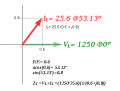
I like to draw a diagram to keep track of what's going on.
Load-Phase.png
Unless you separate the current into real and imaginary components, you can't find Z_load impedance. And you need the sum of the line impedance and load impedance to find the magnitude of the supply voltage.
 

Thread Starter

PG1995

Joined Apr 15, 2011
832
Thank you, @RBR1317.

I think that I have solved it.

I was missing a subtle point. I was thinking along the wrong line. I was trying to find some kind of absolute angles for current and voltage although it doesn't really matter. What matters is their relative relation. Like if power factor is leading then current leads voltage and let's say θv-θi=-60 degree. We can assume the voltage to be at 0 degrees and therefore current at 60 degrees, or we can assume voltage at 60 degrees and current at 120 degrees and so on. It doesn't really matter. Only the relationship between the angles matter. Thanks a lot.
 

Attachments

Last edited:

Thread Starter

PG1995

Joined Apr 15, 2011
832
Hi again,

The impedance is inductive when X is positive or capacitive when X is negative. Therefore, impedance Z = R + jX is said to be inductive or lagging since current lags voltage, while impedance Z = R - jX is capacitive or leading because current leads voltage.

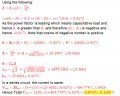
Please have a look here. In the question statement it says that the power factor is lagging but my answer came to be 7.5-10j. Shouldn't it have been 7.5+10j because the load is inductive and lagging?

The formula which was used to find Z at the end was derived like this. Thank you
 

Attachments

Thread Starter

PG1995

Joined Apr 15, 2011
832
Hi,

This is an addition to my previous post.

Could we say that in an AC series circuit the current thru all the components has same phase but the voltage has different phase across each component?

Likewise, could we say that in an AC parallel circuit the voltage across all components has same phase but the current has different phase thru each components?

Thanks.
 

MrAl

Joined Jun 17, 2014
13,708
Hi,

This is an addition to my previous post.

Could we say that in an AC series circuit the current thru all the components has same phase but the voltage has different phase across each component?

Likewise, could we say that in an AC parallel circuit the voltage across all components has same phase but the current has different phase thru each components?

Thanks.

Hello again,

The formula you are using that results in a negative imaginary part, where did that come from?
The key point is this:
If you calculate the complex power from the voltage and the impedance, then you should be able to calculate the impedance from the voltage and the complex power. That's something you should do.

So if you start with impedance a+b*j then you should end up with a*b*j once you reverse the process. If you dont, then one formula or interpretation is wrong. For example, can Q be negative?
Check on that because your formula is either wrong or misinterpreted.

Yes the current in a series circuit has the same phase in each element. When the current is solved for it will be a complex number like a+b*j and there's only one phase for that possible. If the phase was different between two nodes that are shorted out that would mean a voltage drop across a zero ohm shunt which we dont allow in a conservative system.
Yes the voltage phase for a parallel circuit is the same across all elements. That's more apparent. If the phase was different, there would be current in the wire between two nodes with short circuits between them which is not possible in a conservative system.
 

Thread Starter

PG1995

Joined Apr 15, 2011
832
Thank you, @MrAl.

The formula you are using that results in a negative imaginary part, where did that come from?
Let me go over it again.

The impedance is inductive when X is positive or capacitive when X is negative. Therefore, impedance Z = R + jX is said to be inductive or lagging since current lags voltage, while impedance Z = R - jX is capacitive or leading because current leads voltage.

Please have a look here. In the question statement it says that the power factor is lagging but my answer came to be 7.5-10j. Shouldn't it have been 7.5+10j because the load is inductive and lagging?

The formula which was used to find Z at the end was derived like this.

I started with S=Vrms^2/Z*
Z*
= Vrms^2*P/(P^2+Q^2) + j {Vrms^2*P/(P^2+Q^2)}
(Z*)* = Vrms^2*P/(P^2+Q^2) + j {Vrms^2*P/(P^2+Q^2)}
Z = Vrms^2*P/(P^2+Q^2) - j {Vrms^2*P/(P^2+Q^2)}

Thank you.
 
Last edited:

MrAl

Joined Jun 17, 2014
13,708
Thank you, @MrAl.


Let me go over it again.

The impedance is inductive when X is positive or capacitive when X is negative. Therefore, impedance Z = R + jX is said to be inductive or lagging since current lags voltage, while impedance Z = R - jX is capacitive or leading because current leads voltage.

Please have a look here. In the question statement it says that the power factor is lagging but my answer came to be 7.5-10j. Shouldn't it have been 7.5+10j because the load is inductive and lagging?

The formula which was used to find Z at the end was derived like this.

I started with S=Vrms^2/Z*
Z*
= Vrms^2*P/(P^2+Q^2) + j {Vrms^2*P/(P^2+Q^2)}
(Z*)* = Vrms^2*P/(P^2+Q^2) + j {Vrms^2*P/(P^2+Q^2)}
Z = Vrms^2*P/(P^2+Q^2) - j {Vrms^2*P/(P^2+Q^2)}

Thank you.
Hi,

Yes i think you might have the right idea BUT if Q is already negative then that last formula will be a sum not a difference.

But let's start from the beginning. We have a voltage E (rms) and an impedance a+b*j. To calculate the complex power Pc we do:
Pc=E^2/(a+b*j)

and simplifying that we get:
Pc=a*E^2/(b^2+a^2)-j*b*E^2/(b^2+a^2)

and from this we can see that:
P=a*E^2/(b^2+a^2)
Q=-b*E^2/(b^2+a^2)

and so Q ends up being negative.

Now we calculate PQ=P^2+Q^2 and get:
PQ=(b^2*E^4)/(b^2+a^2)^2+(a^2*E^4)/(b^2+a^2)^2

and note that even if Q is negative this comes out the same as if it was positive because of the squaring of Q.

Now that we have P, Q, and PQ, we can try the formula:
Z=E^2*P/PQ-j*E^2*Q/PQ

and after simplifying we get:
Z=a+b*j

which is EXACTLY what we started with, so we did something right.

But now let's calculate Z after ignoring the sign of Q which makes it positive. We have:
Z=E^2*P/PQ-j*E^2*|Q|/PQ

and we get:
Z=a-b*j

which is NOT what we started out with.

Now lets just reverse the process where we got the complex impedance Pc.

Starting with the actual Pc which was:
Pc=(a*E^2)/(b^2+a^2)-(j*b*E^2)/(b^2+a^2)

and now we divide:
Z=E^2/Pc

and we get:
Z=a+j*b

which is the correct result. Now lets change the sign of the imaginary part of Pc:
Pcn=(a*E^2)/(b^2+a^2)+(j*b*E^2)/(b^2+a^2)

and now calculate E^2/Pcn and we get:
Z=a-j*b

which is the wrong result again.

This tells us that Q must retain it's sign in order to get the right result.
I looked on Wikipedia and they may have it wrong too, as they show the lagging power factor as having a positive Q and leading PF as having negative Q, which does not work out right. You could check that out too.

So your formula may be correct, but you have to apply it correctly which means retaining the sign of Q.
Alternately if you make your formula a sum instead of a difference, then Q would have to be positive.
When i do the straightforward calculation as above however, i get a negative Q so i would believe that must be right.
 

Thread Starter

PG1995

Joined Apr 15, 2011
832
Thank you, @MrAl.

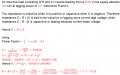
I agree with you. The way I had calculated Q earlier was wrong because it'd always result into a positive Q. I have fixed it now. But my result is still the same because Q is in fact positive in this case. Where am I going wrong? Do you think that 7.5-j10 is the right answer? Thanks.
 

Attachments

Last edited:

MrAl

Joined Jun 17, 2014
13,708
Thank you, @MrAl.

I agree with you. The way I had calculated Q earlier was wrong because it'd always result into a positive Q. I have fixed it now. But my result is still the same because Q is in fact positive in this case. Where am I going wrong? Do you think that 7.5-j10 is the right answer? Thanks.
Hi,

Did you not say that there was a lagging power factor?
A lagging power factor means a+b*j and not a-b*j.
So either you dont have a lagging power factor or the impedance must be a+b*j.
The problem specification indicated a lagging power factor, and that means a lagging current in the load, and that in turn means a+b*j and not a-b*j.

You said that Q is positive, but how did you come to that conclusion?
In the previous post i showed that a lagging power factor should have a minus Q.

See the attachment for a discussion on leading and lagging currents with an example of a simple series RC circuit. Note that the current leads the voltage and the impedance is of the form a-b*j or to put it another way, a+b*j with b negative. For an arbitrary numerical example, 1-2*j and not 1+2*j. That's a capacitive load however.
The first two graphs show leading and lagging referenced to a zero degree reference sine wave, while the very last graph shows leading and lagging in the RC circuit. The current leads the voltage lags in the capacitor.
 

MrAl

Joined Jun 17, 2014
13,708
Thank you.


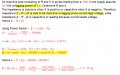
Please have a look here. You can see that how Q is found. I don't think that I made any mistake. Thanks.
Hello again,

We can deem Q negative or positive, it does not matter when we are trying to calculate the impedance as long as we get the right impedance. If we get the wrong impedance, then it's obvious it can not be right.

An impedance a+b*j is inductive and as you know that has lagging power factor.
An impedance a-b*j is capacitive and as you know that has leading power factor.

There's not much else that can be said about this i dont think. If you have a lagging power factor, then SOMEHOW you must get a form like a+b*j with 'b' positive and since 'a' is resistance that will normally be positive too.

It's up to you what you want to believe is true. We can probably find references that state that Q is positive or maybe always positive, but the end result for the impedance must have the right power factor.
 

Thread Starter

PG1995

Joined Apr 15, 2011
832
Thank you, @MrAl

I'm not saying that Q is always positive. We are going in circles now. I was just saying that I was sure that my calculation was correct and I didn't commit any mistake, and finally I found a positive value for Q which leads to a-jb form for the load although for an inductive load with lagging power factor as stated in the question statement it should have been a+jb. Either there is a mistake in my calculation somewhere which I'm not able to trace, or there is something wrong with the question statement. Please help me if you could. Thanks.
 

MrAl

Joined Jun 17, 2014
13,708
Thank you, @MrAl

I'm not saying that Q is always positive. We are going in circles now. I was just saying that I was sure that my calculation was correct and I didn't commit any mistake, and finally I found a positive value for Q which leads to a-jb form for the load although for an inductive load with lagging power factor as stated in the question statement it should have been a+jb. Either there is a mistake in my calculation somewhere which I'm not able to trace, or there is something wrong with the question statement. Please help me if you could. Thanks.
Hi again,

What i was saying was that you START with the knowledge that the impedance must be a+b*j because the load has a power factor that is lagging. Nothing else matters as much as that.
This means that if you get a-b*j then you MUST change a sign somewhere so that you get a+b*j. I suggested that Q is made negative, but in some references it may look positive. Either way, you must get a+b*j.

If you use sin(angle) you get negative Q so i cant see how you can get positive Q anyway, but it does not matter as much as the FINAL result which MUST be a+b*j.

This means if you did everything right and still get the wrong answer then that doesnt necessarily mean you made a mistake, but in that case you must still end up with a+b*j. So here we have a sort of convention that we must follow, similar to how for current flow we can use either positive conventional flow or negative electron flow. For either current flow convention we must come up with the same result which here is a lagging power factor.

However if you want to explore this more, how did you get a positive Q when i get a negative Q and sin(angle) yields a negative Q?

My engineering handbook isnt that much help here as they state that for a lagging power factor Q should be positive. That may just be the convention they are following though. When i look at other references, they do not show BOTH types of power factor, only one, which does not help to understand completely what convention they are following.
The positive Q for lagging convention may have come from an original understanding of Q as being part of the power and power for passive loads is always positive. It's not really power though, and when used in calculating the apparent power it's sign does not matter because it gets squared.
 

Thread Starter

PG1995

Joined Apr 15, 2011
832
Thank you, @MrAl.

However if you want to explore this more, how did you get a positive Q when i get a negative Q and sin(angle) yields a negative Q?
For sin(0.9270), you get a positive number! The full calculation is here. Thanks.
 

MrAl

Joined Jun 17, 2014
13,708
Thank you, @MrAl.


For sin(0.9270), you get a positive number! The full calculation is here. Thanks.
Hello again,

Ok so you started with a negative current angle and then did sin(Vph-Iph) and got a positive value because Vph-Iph with Iph negative is a positive quantity, and so sin(plus_quantity) is positive. That makes sense.
My engineering handbook suggest the same, but they also define:
VA=E*I_hat=P+j*Q
where
I_hat is the negative of the current. This suggests that Vph-Iph that was Vph-(-Iph) should be Vph(-(-(-Iph))) so that seems to have the opposite sign.

But this just brings us back to the place where in order to get a lagging phase angle we must end up with the impedance in the form a+b*j. That means no matter what sign we accept for Q, we must calculate the passive load as having a form as a+b*j which would be R+j*w*L. There's no other way to get a lagging power factor in power line applications because we normally restrict our angles to 0 to 90 degrees or -90 degrees to 0 degrees (without going to multiple components of course).

So you may accept whatever form you want for calculating Q, but in order to answer the question for a lagging power factor you must end up with the right impedance, which you should realize must be true. If they ask for a lagging power factor, then you must give them a lagging power factor.
There's no harm in trying it though. Try calculating the current angle and see what you get with whatever result you get.

BTW, you have a current angle roughly 53 degrees leading with the impedance 7.5-10*j, are you trying to suggest that the angle should be called 307 degrees lagging?
 
Last edited:
Top