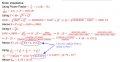
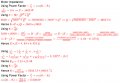
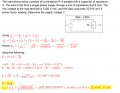
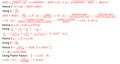
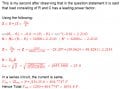
I had thought that "a" choice is the answer because it's the closest to my answer. I had also thought that my answer varies due to rounding off error. At the bottom here it is shown how the power factor was found. Thank you.
PS: Thank you for pointing this out, @MrAl. The correct answer is "b" and not "a". I don't know where I have made the mistake.
I had thought that "a" choice is the answer because it's the closest to my answer. I had also thought that my answer varies due to rounding off error. At the bottom here it is shown how the power factor was found. Thank you.
PS: Thank you for pointing this out, @MrAl. The correct answer is "b" and not "a". I don't know where I have made the mistake.
Where did you get the formula for calculating the power factor, by taking the ratio of real power to imaginary power? I dont believe power factor is defined like that, so look it up see what you can find.
For what it's worth, i got 'b' to 4 significant figures I think you can get closer too to 'b'.
The power factor is dimensionless, since it is the ratio of the average power to the apparent power, pf = P/S= cos(θv − θi) where S=|S| is magnitude of complex power. I don't think that I used a wrong formula.
@PG1995 The answers given were in scientific notation to four figures. You should do your calculations with scientific notation to five figures. Try that with this question so you have a feel for what you need to do in the future.
My question is about the formula S=(Irms²)*Z where S and Z are complex quantities in phasor form, and Irms=√(S/Z).
Irms is supposed to be a numerical quantity without any angle; it shouldn't be a complex quantity because it's a magnitude of Irms phasor. How come division of two complex number produces a real number? Could you please guide me?
I was doing this problem and this point came to my attention. Thank you.
I agree with you.
S = Vrms*Irms ∠(θv-θi) Z = Vrms/Irms ∠(θv-θi)
Irms = sqrt{(Vrms*Irms) * (Irms/Vrms)} ∠{(θv-θi)-(θv-θi)} = sqrt{Irms * Irms} ∠0 = Irms
There was also an error in my calculation because one of my calculators was set to degree mode and that's also made it difficult to interpret the formula. I've fixed it now and angle is zero now as it should have been.
The power factor is dimensionless, since it is the ratio of the average power to the apparent power, pf = P/S= cos(θv − θi) where S=|S| is magnitude of complex power. I don't think that I used a wrong formula.
Well i suggested that you used the wrong formula. Recall the power triangle. https://en.wikipedia.org/wiki/Power_factor
You used real power over reactive power which does not look right nor comes up with the right answer. Reactive power alone is not the same as apparent power.
I like Joe's suggestion too that you work with higher precision because that is the only way you can know for sure that you got the right answer. You should get at a min of 2 digits that match but prefer the whole 4.
I didn't use real power over reactive power rather I used real power over apparent power, i.e. P/S, where apparent power is |S|=S=Vrms*Irms. On the other hand, reactive power, Q, is Vrms*Irms*sin(θv-θi). I'll do it again with more precision tomorrow. Thanks.
I didn't use real power over reactive power rather I used real power over apparent power, i.e. P/S, where apparent power is |S|=S=Vrms*Irms. On the other hand, reactive power, Q, is Vrms*Irms*sin(θv-θi). I'll do it again with more precision tomorrow. Thanks.
Well that's not what it looks like on your calculation sheet that's why i mentioned it.
What you put in the numerator was the real part and what you put in the denominator was the reactive power.
I'll check out your more precise calculation when you get it ready.
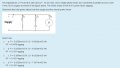
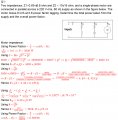
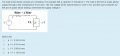
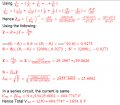
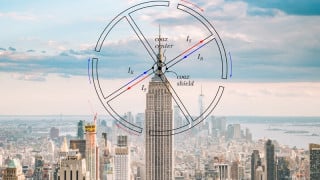
This is the question statement with answer choices. Here is my first attempt at the solution and this is my second after realizing that it was stated in the the question statement that power factor is leading. Where am I going wrong? My answer doesn't match any of the given choices. The choice "d" is supposed to be correct choice. Let me know if you want me to attach latex code. Thank you.
At the very end of the calculation the voltages are added together as though they are in phase. But consider, if the same current is flowing through two different impedances in series, why should one expect the voltages to have the same phase angle?
This is the question statement with answer choices. Here is my first attempt at the solution and this is my second after realizing that it was stated in the the question statement that power factor is leading. Where am I going wrong? My answer doesn't match any of the given choices. The choice "d" is supposed to be correct choice. Let me know if you want me to attach latex code. Thank you.
If we have power level A and power level B, and we take the ratio:
C=A/B
or even:
C=B/A
how does that ever make C negative when the load is absorbing power?
Power factor is the ratio of two powers.
I think maybe you just need to review what power factor really is. The power triangle shows apparent power over real power as the power factor. If the load is passive, that implies that the two powers are both positive.
What else you could try if not for any other reason but to test your results is to try to convert the given problem into real components such as resistor, inductors, and capacitors, and then go from there. They tell you right off that one is an L and one is a C, so if you could find equivalent values for those two then you can check your results using that information even with a circuit simulator. This method is very informative and worth doing.
For power absorbing loads:
A leading power factor means the current leads the voltage.
A lagging power factor means the current lags the voltage.
I did not want to state too much right away because i thought maybe you want to try to figure some of this out for yourself. When you do that, it has more meaning to you and thus you may remember it better.
In particular, look for when, if ever, the power factor sign changes.
@MrAl,
Thank you. I do understand your point and aware of it. I committed a blunder while doing the calculation. The terms leading or lagging when used with power factor only convey the information if θv is smaller or larger than θi. Power factor is cosine of θv-θi and cosine cannot be negative even if the angle θv-θi is negative. I'd be more careful in future. Thanks.
@RBR1317,
Thank you. I get your point and this point was somewhere there in my mind but then I didn't pay too much attention to it. I even thought of finding θv then couldn't figure out the way to do it. We know that cos(θv-θi)=0.6⇒(θv-θi)=cos⁻¹(0.6)=0.9273 but as it is stated in the question statement that the power factor is leading therefore θv-θi should be negative and hence it should be -0.9273, in my opinion.
But I still don't know how to find individual θv to find voltage phasors V across the two impedances. I'd appreciate if you could guide me on that. Thanks.
The supply voltage is equal to the sum of the line drop and the load drop, Vs=|I|⋅(Z_line+Z_load).
The current magnitude |I| is found from the given load voltage (1250 V-rms) and consumption (32 kVA).
The line impedance is given, (9+j13).
The load impedance is calculated Z_load=1250/I, however the current |I| must be separated into its real and imaginary parts using the given power factor at the load.

 Facebook
 Google
 GitHub
 Linkedin