It's worth noting that the MOSFET itself will conduct in either direction just fine as long as the gate-source voltage is adequate. The body diode won't blow up if the MOSFET is conducting, since there won't be enough voltage across the body diode for it to even conduct. Of course you need to ensure the source-drain voltage can never get too high or you'll release the magic smoke.
A MOSFET is occasionally intentionally operated in the reverse direction.
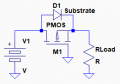
A example is for reverse polarity protection of a device (below).
Notice that the PMOSFET conducts in the reverse direction (same direction as the substrate diode) when V1 is plus.
In this mode the MOSFET is fully turned on since the source voltage is more positive than the gate (and a MOSFET conducts equally well in both directions when on).
If V1 is accidentally reverse connected, then the PMOSFET is off (source more negative than the gate) and the substrate diode is reverse biased, so no reverse current flows to the load.
This has the advantage over a series diode used for reverse protection, in that the drop of the MOSFET when ON is only the load current times the on-resistance of the MOSFET (which can be very low) instead of the forward drop of a diode which is a least 0.4V even for a Schottky diode.
A MOSFET is occasionally intentionally operated in the reverse direction.
A example is for reverse polarity protection of a device (below).
Notice that the PMOSFET conducts in the reverse direction (same direction as the substrate diode) when V1 is plus.
In this mode the MOSFET is fully turned on since the source voltage is more positive than the gate (and a MOSFET conducts equally well in both directions when on).
If V1 is accidentally reverse connected, then the PMOSFET is off (source more negative than the gate) and the substrate diode is reverse biased, so no reverse current flows to the load.
This has the advantage over a series diode used for reverse protection, in that the drop of the MOSFET when ON is only the load current times the on-resistance of the MOSFET (which can be very low) instead of the forward drop of a diode which is a least 0.4V even for a Schottky diode.
Hello, first of all, sorry for replying to a old post, this is my first post here and not sure how ‘not done’ it is around here, but I came across this thread when googling for what happens if a FET is used in the ‘reversed’ direction. And it seems like your answer here spells it out very well, thank you for that! I see the application in reverse polarity detection indeed and I saw an application where a Nchannel fet was used in the positive line (so not the return path) and they used a charge pump IC to drive the gate. My question is, it here is any downside to using a FET in the reversed direction (other than the chance for damaging it if the gate is controlled wrongly and the FET base diode starts to need to conduct all the current the user draws). Since you are the only one that i have found to spell out the FET conducts equally well, I would like to ask you, do you know of any downsides or things to be aware of when using a FET in reverse?
There is no damage to the mosfet. When "on" both N-channel and P-channel conduct is both directions. The application to which you refer (reverse polarity protection) is one for which the body diode doesn't matter. The mosfet avoids the diode drop one with see with a simple diode in its place.
There is no damage to the mosfet. When "on" both N-channel and P-channel conduct is both directions. The application to which you refer (reverse polarity protection) is one for which the body diode doesn't matter. The mosfet avoids the diode drop one with see with a simple diode in its place.
Thank you for your answer, I’m happy to have more confirmation and sorry to doubt your writing in the last sentence but i am looking for some confirmation and would like to double check. Do you maybe mean to write “The mosfet avoids the diode drop one -would- see with a simple diode in its place.”? Thanks in advance for your reply. Cheers Nando
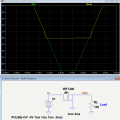
Below is the LTspice simulation of my post #7 circuit for forward and reverse bias conditions:
The output very closely follows the input for positive voltages, indicating the P-MOSFET is conducting (in its reverse direction), and blocking the negative voltage in its forward direction.
You can see the small difference in the two when the voltage goes below about +1V, where the substrate diode starts carrying the current (and you see the diode forward drop), since that voltage is below the 1V Vgs ON threshold of the MOSFET.
If you keep Vcc less negative than -0.5V, so that the diode doesn‘t start to conduct, then it will work perfectly well, just as well as if Vcc were positive.
But when would you have a Vcc below 0.5V? Suppose you had an audio signal, which was AC, but less than 0.5V peak, you could use the MOSFET to switch it on and off.
MOSFETs are used with Vcc negative in synchronous rectifier circuits.
Thank you for your answer, I’m happy to have more confirmation and sorry to doubt your writing in the last sentence but i am looking for some confirmation and would like to double check. Do you maybe mean to write “The mosfet avoids the diode drop one -would- see with a simple diode in its place.”? Thanks in advance for your reply. Cheers Nando
Yes, I mean "simple" as opposed to the more complicated circuit using a P-channel mosfet for reverse-polarity protection. A "simple" forward-biased diode can be used to provide reverse polarity protection. The voltage drop may be insignificant in many applications, but consider a situation where a single lithium-ion cell is powering a 3.3V (nominal ) circuit that includes a voltage regulator. There, a 0.7 V drop can be significant. A Schottky diode helps but doesn't completely avoid it.

 Facebook
 Google
 GitHub
 Linkedin