TL494 Boost Converter Problem

Sensacell

Joined Jun 19, 2012
3,786
"sorry I haven't got what do you mean
if you mean the MOSFET gate current it's very small value in nA, and the drop across each 10K is about 1.2mA , but I guess this isn't your question"

This statement is only true at DC- you are not operating at DC.

Mosfet gates look like capacitors.

To get the transistors to switch on and off at high speed (100 kHz ) requires that you charge and discharge the gate capacitance very quickly.
This rapid charge and discharge can require several amps, depending on factors.

Your gate drive scheme cannot discharge the gates quickly, you need to source AND sink high currents into the gate capacitance.
There are many gate driver IC's designed to do this.
 

Bordodynov

Joined May 20, 2015
3,428
You need to interconnect the collector pins and interconnect the emitter pins. With an emitter, put a 200 ohm resistor on the ground. Then put an emitter follower on a PNP transistor (the base of the transistor to the newly added resistor). Shun the Base-Emitter of the Transistor with a 1N4148 Diode. This amplified signal and apply to the gates of the transistors. A high level will be formed through a diode, and a low level through a pnp transistor.
 

Thread Starter

AymanKhuzundar

Joined Apr 2, 2017
61
I wasn't asking what you designed for but what the peak current limit of the inductor is. Inductance is only one of the factors for selection of the inductor.

Please read the first two paragraphs in the attached application note.
OK, I've made the inductor by my self with 1.00 mm copper wire wounded on a ferrite core (With no calculations, just wound then measure the inductance, and I know that 1.00 mm copper wire can handle 5A with some cooling methods)
 

Thread Starter

AymanKhuzundar

Joined Apr 2, 2017
61
You need to interconnect the collector pins and interconnect the emitter pins. With an emitter, put a 200 ohm resistor on the ground. Then put an emitter follower on a PNP transistor (the base of the transistor to the newly added resistor). Shun the Base-Emitter of the Transistor with a 1N4148 Diode. This amplified signal and apply to the gates of the transistors. A high level will be formed through a diode, and a low level through a pnp transistor.
This is another connection to fast the turn-off time ? previous comments told me to use the push-pull connection of the IC, would your suggestion be better than that they told me about ?
also I may decrease the switching frequency so I can decrease the losses, any suggestion about this?
 

Thread Starter

AymanKhuzundar

Joined Apr 2, 2017
61
"sorry I haven't got what do you mean
if you mean the MOSFET gate current it's very small value in nA, and the drop across each 10K is about 1.2mA , but I guess this isn't your question"

This statement is only true at DC- you are not operating at DC.

Mosfet gates look like capacitors.

To get the transistors to switch on and off at high speed (100 kHz ) requires that you charge and discharge the gate capacitance very quickly.
This rapid charge and discharge can require several amps, depending on factors.

Your gate drive scheme cannot discharge the gates quickly, you need to source AND sink high currents into the gate capacitance.
There are many gate driver IC's designed to do this.
Thanks for that, yesterday I've read more subjects on this topic and got the idea that a resistor from the gate of the MOSFET to the ground isn't suitable for this high speed switching.
does the TL494 offer that high current to sink and source in the Push-Pull Configuration ? (I know that it's output current can be 200mA but is it enough to charge and discharge the gate capacitance ?)
 

Thread Starter

AymanKhuzundar

Joined Apr 2, 2017
61
Hello,

What core material did you use?
The frequency range that can be used will depend on this material.

Bertus
a ferrite core, the inductance of the inductor I've chosen was applicable to handle 100KHz switching frequency, but does the material also limit the speed ?
 

mvas

Joined Jun 19, 2017
539
You could try using the IC in push-pull mode, with the Output Control pin connected to Ref instead of ground, and with the presently-unused output transistor being used instead to pull down the FET gates. That will speed up the FET switch-offs.
When you change the "Output Control" pin from Ground to REF,
you change the TL494 Switching Mode from "Single-Ended Parallel Outputs" to "Push-Pull Outputs".

In Push-Pull mode ...
a) One output transistor pulses ON for the ODD PWM Cycles
b) The other output transistor pulses ON for the EVEN PWM Cycles

Push-Pull mode is not the same thing as having a Totem-Pole / Complementary Gate Drive outputs.

The TL598 PWM IC does have Totem-Pole / Complementary outputs.
The TL494 PWM IC has Open Emitter / Collector Single-Ended outputs.

Your idea will cause every other PWM Pulse to be dropped ( ie completely missing ) which prevents CCM - Continuous Current Mode.
 

mvas

Joined Jun 19, 2017
539
also do I need a resistor between the PWM and the bases of the transistors ? if yes what's its value ?
In that Complementary Gate Driver circuit, there is no resistor between the PWM and the Bases of the Transistors.
The "Gate Resistor" is between Emitter and the MOSFET.

If you don't understand the "Complementary Gate Driver" circuit then consider a simple MOSFET Gate Driver IC.
 
Last edited:

mvas

Joined Jun 19, 2017
539
also can I connect two MOSFETs in parallel at the same Push-Pull circuit ? as I want to use the internal push-pull configuration of the TL494
You cannot use "Push-Pull" mode because you do not have a Push-Pull circuit.
Your circuit is a "Single-Ended / Parallel Output" design.
As, I previously suggested, I would connect both Outputs in Parallel since you are operating the TL494 in "Parallel Output" mode.
 

Thread Starter

AymanKhuzundar

Joined Apr 2, 2017
61
Your idea will cause every other PWM Pulse to be dropped ( ie completely missing ) which prevents CCM - Continuous Current Mode.
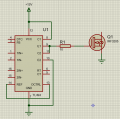
I haven't got the idea, why it will be completely missing if I connect them as shown in the attached schematic ? Capture1.PNG


Show me your mathematical formula, where you computed: "nA" for Gate Current.
I haven't computed it ! I don't know that it should be computed !!!


In that Complementary Gate Driver circuit, there is no resistor between the PWM and the Bases of the Transistors.
OK, but what's the thing that will limit the current that goes through the bases of the transistors? (sorry but I want to understand every step so I can learn from my mistakes) I know that the average output voltage of the PWM signal is computed as Vout(avg) = Duty * Vcc ; so when the duty cycle is 90% then the voltage at the base of each transistor would be 0.9*12=10.8V , am I right ?


You cannot use "Push-Pull" mode because you do not have a Push-Pull circuit.
Your circuit is a "Single-Ended / Parallel Output" design.
As, I previously suggested, I would connect both Outputs in Parallel since you are operating the TL494 in "Parallel Output" mode.
I can change the design if the Push-Pull is better than the Parallel Output design , but also In General can I connect two MOSFETs in parallel at the same Push-Pull circuit ? or shall I make -or use- a Push-Pull circuit for each MOSFET ?

and thanks a lot for helping me to understand <3 <3
 

mvas

Joined Jun 19, 2017
539
True for the TS's original circuit.

These can be wired as a totem-pole, as per post #36, to give push-pull operation, albeit at half the clock frequency.
You can ... but it is a "garbage" design.

In your so-called "TL494 Totem Pole" design ...
a) The Top Half of the Totem Pole will Pulse On only during the Odd PWM Cycles
b) The Bottom Half of the Totem Pole will Pulse On only during the Even PWM Cycles

That is not equivalent to the "Totem-Pole" operation of a TL598.
The MOSFET should be ON, only when either Output is ON.

In your fake "Totem-Pole" design, your MOSFET is ON ...
A) Starting with the Upper / Odd PWM pulse and
b) Ending with the Lower / Even PWM pulse
That is a very, very, very bad design.

See message #38 for a proper TL494 "Parallel Output" mode design with Complementary Transistor Gate Drive
That is a correct design for the TL494.
The TL494 does not support totem pole output, the TL598 does.
 
Last edited:
Top