TL494/594 Buck converter timebase distorted

Thread Starter

Mario74m

Joined Sep 1, 2019
18
Can you post the schematic that the screen shots represent?
I'd like to simulate it and see how closely they match.
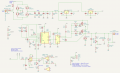
Sure, here it is:
schematics.png

And also the LTspice circuit model that I've been using to simulate the device, it may be helpful. I tried to use the exact component models, expect for those missing from the library, where I used the most similar ones.

The screenshots are with 5 Ohm ohmic load, as opposed to the spice model where it is lower, with stress at one moment, to simulate for current limiting and feedback compensation.
 

Attachments

Thread Starter

Mario74m

Joined Sep 1, 2019
18
Have a real good look at the 0V connections around the control IC. Make sure that they all go to a single point, which the joins to the power ground by one track.
Also check that the interference isn’t on the 15V supply. 7815s don’t have the best PSRR at high frequency!
I'll check the 15V supply in the afternoon. It does look like the in-built current source of the TL494 which charges the timing capacitor to obtain the ramp feels the stress from the FET switching on at the begining of each period, so it could be supply related.

I was hoping that I would be able to avoid giving too much thought to interference at what I saw as a relatively low frequency of 25kHz, especially compared to modern SMPS frequencies, but it seems I was wrong. I'm aware that my prototype PCB leaves a lot to be desired in terms of layout optimization. It's a single layer PCB with copper pour for ground plane in the back in areas unoccupied by tracks and front side jumper wires connecting the isolated GND islands. I attached the PCB photos at the beginning of the thread. Further complication is the replacement of the IR2110 with IR2117 where I had to adapt the pinout using jumpers in the back. I'm sure it contributes to interference. For the final "product" I planned to order a professionaly made two- or three-layer board with dedicated ground plane, so presumably that would help with interference issues.

Edit: I found this excellent appnote from TI (https://www.ti.com/lit/an/slyt202/slyt202.pdf) and now I see what you mean regarding the 7815 frequency characteristics.
 
Last edited:
Top