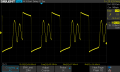
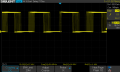
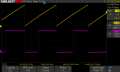
TL494/594 Buck converter timebase distorted

Alec_t

Joined Sep 17, 2013
15,121
Is your bootstrap capacitor getting charged?
Normally, it would be charged when the low-side MOSFET switches on, but you have no low-side MOSFET because it is not a synchronous converter.
Because of the presence of the L101 inductor the FET source goes about 0.5V negative when the FET turns off. So the bootstrapping should work ok. Simulation with an IR2110 model says it does, and the last scope shot above also show Vs going slightly negative.
 

Thread Starter

Mario74m

Joined Sep 1, 2019
18
Your post #16 scope shots indicate that the bootstrap isn't working. Missing connection to the bootstrap cap?
If the bootstrap were working, HO should be giving about 55V peak (according to my LTspice simulation). However, VBS would then be about 27V, violating the 25V Absolute Maximum spec for the 2117 (or the 2110).

Edit:
The decaying ringing in your scope shots suggest that diode 105 could be leaky. It is being used very close to its rated reverse voltage limit (30V).
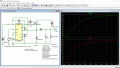
Great tips, thank you for the time you dedicated to my problem. I’ll be able to work on the project tomorrow afternoon at earliest, meanwhile I double checked with my LTSPICE simulation (attached - it is IR2110 based, since it stalls when I use the IR2117 model that I have). Voltage spikes on VB reach some 51V, which is near your value. I'll check with the IR2110/17 datasheet.

Just to mention - the reason I used IR2110 in non-synchronous configuration was exactly the fact that the LTSPICE simulation showed it would work.

Oh, and I forgot to apologize for my not-so-perfect English language skills - it is not my native tongue.
 

Attachments

Ian0

Joined Aug 7, 2020
13,141
Your post #16 scope shots indicate that the bootstrap isn't working. Missing connection to the bootstrap cap?
If the bootstrap were working, HO should be giving about 55V peak (according to my LTspice simulation). However, VBS would then be about 27V, violating the 25V Absolute Maximum spec for the 2117 (or the 2110).
Nonsense - The IR2117 will stand 600V on Vb. Vb will be 14.5V above Vs, because the bootstrap capacitor is charged from the supply on Vcc.
 

eetech00

Joined Jun 8, 2013
4,705
You're right, of course, thank you for your remarks! I don't know what was I thinking, I just automatically drew wires although I studied the IR2110 datasheet beforehand, and did not do the final check. Anyway, I corrected the connections with the help of a scalpel and some jumper wires on the PCB, so my IR2110 is now connected as in the attached image (of course, it's much uglier now, and I'm aware I introduced new parasitics). I also replaced the TL594 and IR2110 ICs with new ones (in case I fried the old ones). But to no avail - the timing waveform is unchanged, still distorted with identical bias and peak values as in the former case.
I think Lan0 suggestions should have worked. See below.
Note the 2110 is powered by 15v.

1698029584677.png
 
Last edited:

Ian0

Joined Aug 7, 2020
13,141
I remember now. . . It can't get started if it is a battery charger, if it is turned on after the battery is connected, because there is no initial path to ground to charge C1. That is provided in this case by R2.
 

Thread Starter

Mario74m

Joined Sep 1, 2019
18
Ian0's suggestions are working, and eetech's spice simulation results are consistent with my own dating back to the initial design. After replacing the IR2110 with IR2117 the regulator still wasn't working correctly due to bootstrap capacitor not charging - while reworking the pcb to adjust for new pinout, I missed one capacitor pin so it was floating. After I connected it, I get 12V on output, and I'm able to regulate it as designed. Great thanks to anyone who dedicated their time and contributed to the thread so far!

However, some of the waveforms are less then ideal because of large amount of ringing on the Mosfet source and all other voltages that are referenced (or dependent) to it. Here are some scope shots:

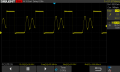
MOSFET V_source:
MOSFET_V_S.png

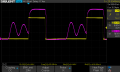
IR2117 IN(ch1)+HO(ch2):
IR2117 IN+HO.png

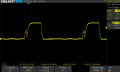
MOSFET V_GS:
MOSFET V_GS.png


An interesting one - scope probe pin in air around the toroidal inductor, with ground clip on PCB GND copper pour:
FI_MAGNETIC_AC.png


So, the circuit output is correct, the only thing that kinda worries me is the glitch in the rising edge of the V_GS waveform, but I'm not sure whether to attribute the ringing to the resonant circuit formed by output (low ESR) capacitor and inductor (don't think so, since its resonant frequency is around 600Hz according to calculation, while the ringing frequency seems to be around 150kHz). In that case, maybe a small ohmic resistance in series with the capacitor could help to dampen the oscillations. Or it could be atributted to the stray magnetic flux from the inductor, or the parasitics due to my jumper wires from PCB reworking. Or possibly some other reason?
 
Last edited:

eetech00

Joined Jun 8, 2013
4,705
Ian0's suggestions are working, and eetech's spice simulation results are consistent with my own dating back to the initial design. After replacing the IR2110 with IR2117 the regulator still wasn't working correctly due to bootstrap capacitor not charging - while reworking the pcb to adjust for new pinout, I missed one capacitor pin so it was floating. After I connected it, I get 12V on output, and I'm able to regulate it as designed. Great thanks to anyone who dedicated their time and contributed to the thread so far!

However, some of the waveforms are less then ideal because of large amount of ringing on the Mosfet source and all other voltages that are referenced (or dependent) to it. Here are some scope shots:

MOSFET V_source:
View attachment 305746

IR2117 IN(ch1)+HO(ch2):
View attachment 305744

MOSFET V_GS:
View attachment 305743


An interesting one - scope probe pin in air around the toroidal inductor, with ground clip on PCB GND copper pour:
View attachment 305747


So, the circuit output is correct, the only thing that kinda worries me is the glitch in the rising edge of the V_GS waveform, but I'm not sure whether to attribute the ringing to the resonant circuit formed by output (low ESR) capacitor and inductor (don't think so, since its resonant frequency is around 600Hz according to calculation, while the ringing frequency seems to be around 150kHz). In that case, maybe a small ohmic resistance in series with the capacitor could help to dampen the oscillations. Or it could be atributted to the stray magnetic flux from the inductor, or the parasitics due to my jumper wires from PCB reworking. Or possibly some other reason?
The waveforms look like the converter is in DCM.
Were the waveforms captured with the converter loaded? If so, what was the load?
 

Thread Starter

Mario74m

Joined Sep 1, 2019
18
The waveforms look like the converter is in DCM.
Were the waveforms captured with the converter loaded? If so, what was the load?
100 ohm external resistive load (a cement resistor), plus inbuilt 10 kOhm parallel to it (see schematics-but I presume that it is negligable in this context).
 

Ian0

Joined Aug 7, 2020
13,141
Don't bother about the ringing when it goes into discontinuous mode - it is quite normal. Just look at the waveforms from an ordinary flyback converter. It will stop as soon as it is in continuous current mode.
 

Ian0

Joined Aug 7, 2020
13,141
Interesting. A Spice simulation of the TS's schematic shows ringing in continuous current mode. I wonder why the difference?
Something else might be ringing? The top picture in post #27 is classic discontinuous mode ringing. There is the MOSFET conducting phase, followed by the DIODE CONDUCTING phase, then when the inductor runs out of current, there is nothing left in circuit except the inductor and the MOSFET's drain-source capacitance, with no load resistance - the Q will be huge.

I bet you could make a quasi-resonant converter, by switching the MOSFET back on at the first positive peak of the ringing. There would be very little voltage across it, so much reduced switching losses.. . . but that's another project!
 

Thread Starter

Mario74m

Joined Sep 1, 2019
18
OK, so I tried to calculate the critical current for the CCM-DCM limit according to a TI appnote that I have, and if I'm correct it is 0.313A for my component values, which translates to 38Ohm load. Therefore I cranked up the current by connecting two 10 Ohm 10W cement resistors in parallel and obtained 2.3A at output. The waveforms:

V_source (xN, x1):
SDS00126.png

SDS00127.png

V_gate-source:
SDS00128.png

IR2117 IN pin:

SDS00132.png

So, occasional glitches on V_GS, but also on the input of the driver, and a bit unstable switching frequency, but the ringing is gone, it would seem?

I must say that it pleases me that all the active components (FETs, ICs and bridge and low-side Schottky diodes) are almost stone cold at this current even without heatsinks, which amounts to some 10-15% of the maximum designed value. The only thing that heats up is the PTC inrush current limiter, but that's inevitable. I ran it only for two minutes, though, to avoid the load resistors to glow, but I think that with heatsinks and (maybe) a fan, the circuit would be able to provide 200W of power without overheating.
 
Last edited:

eetech00

Joined Jun 8, 2013
4,705
OK, so I tried to calculate the critical current for the CCM-DCM limit according to a TI appnote that I have, and if I'm correct it is 0.313A for my component values, which translates to 38Ohm load. Therefore I cranked up the current by connecting two 10 Ohm 10W cement resistors in parallel and obtained 2.3A at output. The waveforms:

V_source (xN, x1):
View attachment 305790

View attachment 305791

V_gate-source:
View attachment 305792

IR2117 IN pin:

View attachment 305795

So, occasional glitches on V_GS, but also on the input of the driver, and a bit unstable switching frequency, but the ringing is gone, it would seem?

I must say that it pleases me that all the active components (FETs, ICs and bridge and low-side Schottky diodes) are almost stone cold at this current even without heatsinks, which amounts to some 10-15% of the maximum designed value. The only thing that heats up is the PTC inrush current limiter, but that's inevitable. I ran it only for two minutes, though, to avoid the load resistors to glow, but I think that with heatsinks and (maybe) a fan, the circuit would be able to provide 200W of power without overheating.
Looks like you changed the switching frequency?
 

Ian0

Joined Aug 7, 2020
13,141
You've got the explanation of that odd pulse at the start of the Vgs waveform right there - 2nd picture in post #35. The control IC is suffering form jitter and is sending out a double pulse.
Unfortunately, that's what you get from using an old-as-the-hills IC instead of a modern one.
Double pulses like that are bad for reliability as they increase the switching loss.
The clock doesn't look too stable either!
 

Thread Starter

Mario74m

Joined Sep 1, 2019
18
Haven't changed the switching frequency, that's the scope measurement subsystem getting confused from all the glitches I suppose.
Curiously enough, the clock seems to be as stable as it could be (it is determined by the R_T / C_T combination on two pins of the TL494). However, the C_T ramp has noise exactly at the points of PWM signal switch-on and off- (caused by the very switching, as it seems from the time sequence), which is enough to cause it to throw a false pulse. Agreeably, this is probably the consequence of internal design of the ancient IC that TL494 is, but it's also a good analysis excercise, at least for me.
I have made some more screenshots in case anyone is still interested.

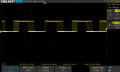
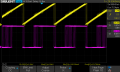
The TL494 CT ramp/clock signal (ch1) and E1/E2 emitter output/pwm signal (ch2):
SDS00145.png
SDS00146.png

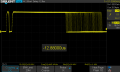
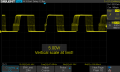
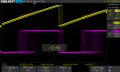
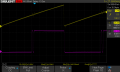
The TL494 CT ramp/clock signal (ch1) and E1/E2 emitter output/pwm signal (ch2) - single shots. Here the noise and it's consequence on the PWM signal is clearly visible:
SDS00148.pngSDS00149.png
 

eetech00

Joined Jun 8, 2013
4,705
Haven't changed the switching frequency, that's the scope measurement subsystem getting confused from all the glitches I suppose.
Curiously enough, the clock seems to be as stable as it could be (it is determined by the R_T / C_T combination on two pins of the TL494). However, the C_T ramp has noise exactly at the points of PWM signal switch-on and off- (caused by the very switching, as it seems from the time sequence), which is enough to cause it to throw a false pulse. Agreeably, this is probably the consequence of internal design of the ancient IC that TL494 is, but it's also a good analysis excercise, at least for me.
I have made some more screenshots in case anyone is still interested.

The TL494 CT ramp/clock signal (ch1) and E1/E2 emitter output/pwm signal (ch2):
View attachment 305803
View attachment 305804

The TL494 CT ramp/clock signal (ch1) and E1/E2 emitter output/pwm signal (ch2) - single shots. Here the noise and it's consequence on the PWM signal is clearly visible:
View attachment 305805View attachment 305806
Can you post the schematic that the screen shots represent?
I'd like to simulate it and see how closely they match.
 

Ian0

Joined Aug 7, 2020
13,141
Have a real good look at the 0V connections around the control IC. Make sure that they all go to a single point, which the joins to the power ground by one track.
Also check that the interference isn’t on the 15V supply. 7815s don’t have the best PSRR at high frequency!
 
Top