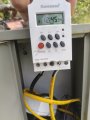
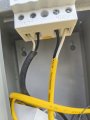
I am using this timer Kawasan, setting 2300 the LED lights are turned off, but after turning off, there are some still LED burning vaguely, slightly? Is there some electricity leaking to the load?
What you are seeing is ghost voltage or stray voltage. It is caused by induction of voltage from the parallel runs inside the cables and was never a problem in the incandescent lighting days since it has almost no ability to drive a load.
But LEDs will light perceptibly with even a very small current so now it can be seen. A small load is enough to stop it (e.g. a nightlight bulb, or a 3K PTC properly rated for the mains voltage (if you don’t know what this means, don’t do it).
What you are seeing is ghost voltage or stray voltage. It is caused by induction of voltage from the parallel runs inside the cables and was never a problem in the incandescent lighting days since it has almost no ability to drive a load.
But LEDs will light perceptibly with even a very small current so now it can be seen. A small load is enough to stop it (e.g. a nightlight bulb, or a 3K PTC properly rated for the mains voltage (if you don’t know what this means, don’t do it).
The stray currents are going to persist for as long as you have your mains power turned on. The current involved is very tiny, it would have no real impact on your usage in terms of billing.
The stray currents are going to persist for as long as you have your mains power turned on. The current involved is very tiny, it would have no real impact on your usage in terms of billing.

 Facebook
 Google
 GitHub
 Linkedin