555 timer kit modification show-and-tell

Thread Starter

tsmspace

Joined Mar 16, 2026
42
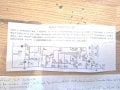
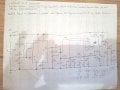
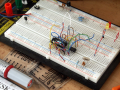
I am working on modifying this amazon-available cheap 555 timer based waveform generator. I have a first assembled prototype that will allow me to easily swap out capacitor values.

The kit produces a square wave, then this square wave passes across a line of resistors with capacitors to ground between them, gradually shaping the wave into a sine wave. I based my modification of the video "better 555 duty cycle control" by pkae electronics. I'm sure these are all basic common designs but that's where I decided to make the kit modification after. As for the selectable capacitor values I added that after noticing that the larger capacitor values used in the kit (which I think runs at 1Khz or so out of the box) did not allow higher frequencies to pass.

Right now i have the default capacitor value of 473, as well as 103 and 102 selectable in the two most important shaping locations. I also made the capacitor coupling the sine wave selectable between 103 (default) and 102 after on the breadboard I found the 103 did not pass higher frequencies, although it has not effect on shaping the wave that I can see, and it does not seem to ever need to be 103, as 102 does seem to work fine in the full range I have tested the kit. I would say the kit is able to produce a 50% duty cycle square wave to just below 150Khz, up from around 5khz as the lowest possible frequency, although if you are able to accept a much higher duty cycle it can go to higher frequency, probably like 180khz and still be stable in the current construction. this construction does add some noise, I think though, so using high quality switches and making all the selectable caps permanently soldered would probably improve results.

I have not, however, managed to produce quality sawtooth and triangle waves across the spectrum, I can do so here and there, although I can usually make for a reasonable sine wave assuming you don't need a high vpp. I will attach pics.

besides just putting every capacitor into there and then monkeying with it at every frequency, (a truly daunting task) I'm not sure the best way to select the ideal values. I don't want more than 3 values for each selector, just to keep it simple, although I may need up to 5 is what it seems, which would be non-ideal because I don't know about tiny 5 pole switches, but I don't recall seeing any, and although these jumpers are really fun, they are not made of performance conductors, so there is a lot of noise from them I think.

Moderation: Cleaned up your very poor images.

here's a video link where I try to kind of demonstrate it
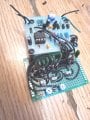
146.jpg144.jpg143.jpg
 
Last edited by a moderator:

ci139

Joined Jul 11, 2016
1,963
the ® board seems like an sales item = NOT that they have put a loads of science behind it . . .

. . . is that -- don't mess the ® PCB - for incase : you will decide that making a totally different DiY prototype for desired output waveforms is more reasonable than improving an unimprovable ?
 

MrChips

Joined Oct 2, 2009
34,646
The best solution is the venerable XR8038 which unfortunately is no longer being manufactured. There is some stock still around but very hard to find. Another solution is XR2206. For both XR8038 and XR2206, be aware that many will be clones and not the genuine part.

AI Overview

Alternatives to the obsolete XR8038/ICL8038 waveform generator include the XR2206 (sine/triangle/square), AD9833 (modern DDS), and NTE864 (direct replacement), alongside DIY kits using these chips. For better performance at lower costs, DDS modules offer superior frequency stability compared to analog alternatives.

Top Alternatives & Replacements:

  1. XR2206: A widely used, though also older, monolithic function generator capable of producing high-quality sine, triangle, and square waveforms, often found in DIY kits.
  2. AD9833: A modern, low-power, programmable DDS (Direct Digital Synthesis) waveform generator that provides sine, triangle, and square waves. It is more accurate and stable than analog chips.
  3. NTE864: A direct, drop-in replacement for the ICL8038, although it can be more expensive.
  4. XR2209: A monolithic voltage-controlled oscillator (VCO) that offers excellent frequency stability for triangle and square waves.

Alternative Approaches:

  1. DIY Kits: Pre-assembled kits based on the XR2206 or Chinese clones of the ICL8038/8038 are cost-effective for hobbyists.
  2. Discrete Circuits: Using operational amplifiers (op-amps) and comparators (e.g., 74HC14) to build a function generator from scratch.
  3. DDS Modules: Using ready-made DDS modules (like those based on AD9850 or AD9833) for higher precision needs.

Key Considerations:

  1. The original ICL8038 is obsolete, and available parts are often clones.
  2. While ICL8038 clones exist, they may have lower-quality output.
  3. For better sine wave quality, Wien bridge-based generators are suggested.
  4. Max038 is an option for higher frequencies but is also obsolete.
 

Thread Starter

tsmspace

Joined Mar 16, 2026
42
A simple filter will not produce good aproximations, but only, at best, "fair" results. There would be one frequenncy for best results..
the ® board seems like an sales item = NOT that they have put a loads of science behind it . . .

. . . is that -- don't mess the ® PCB - for incase : you will decide that making a totally different DiY prototype for desired output waveforms is more reasonable than improving an unimprovable ?
The best solution is the venerable XR8038 which unfortunately is no longer being manufactured. There is some stock still around but very hard to find. Another solution is XR2206. For both XR8038 and XR2206, be aware that many will be clones and not the genuine part.

AI Overview

Alternatives to the obsolete XR8038/ICL8038 waveform generator include the XR2206 (sine/triangle/square), AD9833 (modern DDS), and NTE864 (direct replacement), alongside DIY kits using these chips. For better performance at lower costs, DDS modules offer superior frequency stability compared to analog alternatives.

Top Alternatives & Replacements:

  1. XR2206: A widely used, though also older, monolithic function generator capable of producing high-quality sine, triangle, and square waveforms, often found in DIY kits.
  2. AD9833: A modern, low-power, programmable DDS (Direct Digital Synthesis) waveform generator that provides sine, triangle, and square waves. It is more accurate and stable than analog chips.
  3. NTE864: A direct, drop-in replacement for the ICL8038, although it can be more expensive.
  4. XR2209: A monolithic voltage-controlled oscillator (VCO) that offers excellent frequency stability for triangle and square waves.

Alternative Approaches:

  1. DIY Kits: Pre-assembled kits based on the XR2206 or Chinese clones of the ICL8038/8038 are cost-effective for hobbyists.
  2. Discrete Circuits: Using operational amplifiers (op-amps) and comparators (e.g., 74HC14) to build a function generator from scratch.
  3. DDS Modules: Using ready-made DDS modules (like those based on AD9850 or AD9833) for higher precision needs.

Key Considerations:

  1. The original ICL8038 is obsolete, and available parts are often clones.
  2. While ICL8038 clones exist, they may have lower-quality output.
  3. For better sine wave quality, Wien bridge-based generators are suggested.
  4. Max038 is an option for higher frequencies but is also obsolete.
As noted, the 555 is not a particularly good device to use for making a variable-frequency waveform generator.
Would you be interested in alternate circuits?

crutschow , yes I'm interested in other designs but I'm kind of on a learning progression as it were,,, I can't just shlap any circuit together, this 555 one was in my wheelhouse. I'm not trying to produce a signal generator that I use for any irl purposes, it's just the hobby of putting it together and making it work. I picked up a couple of unijunction transistors from ebay, I want to try to make an oscillator with those. Really I want to put together a tank circuit oscillator, but haven't managed to make sense of that one in a way that produces a circuit on a breadboard.

MisterBill2 , So, really my best option would be a bag of capacitors, and some sockets at each of the key capacitor points, and just depending on which frequency I wish to produce, I just pop in a different capacitor. Could I put resistors in series with these capacitors and make those variable instead? Maybe I should put variable resistors in front of the capacitors so that I can turn these potentiometers to increase the charge time of them rather than swapping capacitors?

ci139 , yes definitely. It's just one of those kits you might buy in the learn to solder section. It's not supposed to ever do anything other than get put together and tested on an oscilloscope. I like to build those kits though because I get to solder, and they come with all the parts, but overall there aren't that many total kit varieties in the budget range. There are more kits of course, but they really go up in price, for example you can build a hifi amp or something. I kind of want to focus on basic electronics and you can find radio kits like ham or something, but these are also quite expensive, and then I would just do the same thing where I put it together, prove it works, and put it aside, so I prefer to focus on these budget items.

Mr. Chips ,, I actually already have a kit for the xr2206 and icl8038 , I'm sure they're all clones, it's just budget kits from amazon/ebay. I also bought some individual chips of each hoping I would then try to put together the reference schematic in their respective datasheets. I haven't done that yet but my two kits work. the xr2206 kit works better I think, there are loads of videos on that one. I guess icl8038 kit might work better with a genuine chip in it, or maybe that's not the problem idk.They all did work fine for the "prove it on a oscilloscope" test. I do plan to later try to make some oscillators with op amps, I have a few in a tube. the ad9833 I see is more something one would use with an arduino or something, I may get to exploring that or not idk. it's kind of a different activity than schlapping kits together. I'm more likely to want to try to make a unijunction oscillator and a basic lc oscillator and prove those on an oscilloscope, although at present I have not tried either, just looked at them on the computer.
 

MrChips

Joined Oct 2, 2009
34,646
Assembling simple, low cost kits is useful for learning to read schematics, working with components, improving your soldering techniques. By all means, do this if you want to make something useful, for example, a simple power supply for your projects or workbench.

If you want to learn about circuits, experiment, and rip apart, use solderless breadboards.

1777841115880.png
 

Thread Starter

tsmspace

Joined Mar 16, 2026
42
Are you familiar with op amps?
If so, do you have any to shlap something together with?
I have a couple, and have seen a few simple oscillator circuits I might try. I haven't gotten to that yet. I DID however just have a little success getting a 4871 unijunction transistor to oscillate. However, I did also fail at getting both of the 2n2646 unijunction transistors I got to work in a similar configuration. I checked them, though, according to a video, and they read very high resistance in all directions, so they might be no good, which I guess is common with ebay unijunctions-in-a-can . I did get the one good 4871 though, which was 15$ for one, so i did have a successful unijunction oscillator experiment (which i did do on a breadboard).

I have a couple of lm741 8 pin op amps.
 
Top