timer and pull solenoid to drop a shelf (total beginner)

Thread Starter

Ramener

Joined Dec 23, 2023
4
Hello all!

I want to build an automatic hay feeder for my horse. I have the carpentry in hand, but the electronics have me stumped.

Using a timer, it would trigger a pull solenoid (or maybe there is a better type of latch?) for a second or two, allowing one end of the shelf to drop. With several of these shelves installed, I could work late, and my horse wouldn't be hungry waiting on me. She could get a steady stream of snacks all day.

Here's a video of one https://www.youtube.com/shorts/zNSmQ3nTOWE

If anyone could give me some simple directions on how to make this work, my horse would be very happy, and I would be forever grateful!

I think I can start this project with a multi station sprinkler timer, but I am not sure exactly how to proceed from there (or maybe I can't- please correct me if I am wrong) Something like this https://www.dripdepot.com/dig-battery-operated-dc-multi-station-controller-stations-6, and maybe a catch like this https://www.ebay.com/itm/126155574421 am I missing something, or is it as easy as that?
 
As usual this kind of things are easy done with some microcontroller.
If you don’t want to learn how to program it you can place an offer/job on upwork.com or freelancer.com.
Some guy will do it for you for few bucks in one day.
 

MisterBill2

Joined Jan 23, 2018
27,164
Certainly this is an interesting project! An interesting possibility could be to use the sprinkler timer to control a series of sprinkler valves to control compressed air to operate the shelf release mechanism. The reason to even consider that is safety. An air powered release will not overheat if it is jammed or stuck on. And the valves used for sprinkler controls are already designed for constant operation.

Certainly it would be a more elaborate scheme, but it could be implemented with commonly available hardware. I have some ideas about the simple release mechanisms if there is any interest in the concept.
 

Tonyr1084

Joined Sep 24, 2015
9,744
The problem with sprinkler timers is the period of time they can be on for. To my knowledge, 1 minute is the absolute minimum duration of powering a sprinkler line. That means for one minute your solenoid will be constantly powered and could overheat; possibly catching fire. Now, if your horse likes hot meals - - - .

But fortunately there is a way to shorten the pulse further. A capacitor and a relay in series can switch on for a second or two. That may be enough time for the solenoid to fully actuate and drop the shelf. You'd have to build and test for that. I'll assume the size of the control box would not be an issue.
 

sghioto

Joined Dec 31, 2017
8,633
The problem with sprinkler timers is the period of time they can be on for.
The irrigation system the TS listed uses latched DC solenoids, so there is only a brief pulse to activate and deactivate.
The unit is powered from 2 AA batteries from the description and installation manual.
The timer will work but will need a circuit and a 12 volt battery to convert those pulses to operate those 12 volt latches also listed.
 

Tonyr1084

Joined Sep 24, 2015
9,744
Using a timer, it would trigger a pull solenoid (or maybe there is a better type of latch?) for a second or two
The irrigation system the TS listed uses latched DC solenoids, so there is only a brief pulse to activate and deactivate.
Yeah, I missed that point.

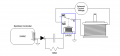
Nevertheless, one could use a programmable sprinkler controller that plugs into the wall. I don't know if the TS has power at the horse stall, I can't imagine not. A programmable AC powered unit can be used as in the diagram below:
Screenshot 2024-10-26 at 7.52.50 AM.png
IF the TS chooses the battery powered unit the controller can directly activate a standard relay such as is drawn. The diode, capacitor and bleeder resistor would not be needed but a diode across the relay coil would be highly recommended, if not outrightly needed. (TS: ask for clarity on which direction the diode needs to be placed and where)

I've used those battery powered sprinkler controllers before but I don't know if they'll have enough power to drive a relay. AND you'd either have to find a relay that will operate at that low a voltage (3VDC). If not then additional circuitry may be needed if that approach is taken. And possibly a relay that operates on that low a voltage might not have sufficient current capability in its switch.

MY controller will run Nine zones, first, zone 1, then 2, then 3 and so on to zone 9. Each zone can run for no longer than 99 minutes. With 8 zones a period of 12 hours can be covered, dropping one shelf every 90 minutes. If that suits the needs of the TS then this just might be the way to go. Even if a battery powered unit is used, finding one with the ability to control 8 different solenoids will likely be impossible. Multiple units would be needed. The biggest battery powered controller I've seen or used has been four zones. And off hand I don't know what the max duration is. Thinking aloud, a positive pulse can trigger the first shelf. 99 minutes later (if possible) zone 2 pulse can be used to trigger the second shelf, for a total of 4 shelves. The next set of shelves would have to be on another controller.

Finally, and yes, I can be verbose - forgive me but I've always taught to be thorough in my explanations; finally you could use individual single zone controllers for each shelf. Eight shelves, eight controllers. So there IS a solution out there.
 

MisterBill2

Joined Jan 23, 2018
27,164
The irrigation system the TS listed uses latched DC solenoids, so there is only a brief pulse to activate and deactivate.
The unit is powered from 2 AA batteries from the description and installation manual.
The timer will work but will need a circuit and a 12 volt battery to convert those pulses to operate those 12 volt latches also listed.
The suggestion I offered (post #5) used the standard water solenoid valves to send compressed air to the drop mechanism. Those pneumatic operators are quite easily made from old bike wheel inner tubes. Much safer. And not a single bit of wire or any 555 timer involved.
 

Tonyr1084

Joined Sep 24, 2015
9,744
The suggestion I offered (post #5) used the standard water solenoid valves to send compressed air to the drop mechanism. Those pneumatic operators are quite easily made from old bike wheel inner tubes. Much safer. And not a single bit of wire or any 555 timer involved.
Definitely a sound approach. However, it appears the system is already built. Taking what we have to work with, a programmable timer with multiple outputs could be all that's needed.

I just had another thought: Suppose you want shelf 1 to drop. If there's a microswitch held activated by the presence of the shelf, as soon as the solenoid is triggered - the dropping of the shelf and opening of that microswitch could then deactivate the solenoid. Obviously the solenoid won't deactivate until the shelf has dropped. So having a programmable timer that can deliver sufficient current to drive the solenoid on time, we don't have to worry about duration of energy and heat. It would be quite short. Just long enough to make the shelf drop.

Now all we need is an 8 channel timer.
 

MisterBill2

Joined Jan 23, 2018
27,164
My take is that it is at the planning stage:
From post #1:" I want to build an automatic hay feeder for my horse. "

So now the question will be, AS FOR MANY OF THE SUGGESTIONS at this site, is how much ability, and how many resources, does the TS possess?
No matter how good the instructions, if the skills are not there, somebody can't assemble the circuit with a single 555 timer.
 

Tonyr1084

Joined Sep 24, 2015
9,744
My take is that it is at the planning stage:
From post #1:" I want to build an automatic hay feeder for my horse. "
OK, yes. Perhaps it IS in the planning stage. What I took from the video was that this is a system he already possesses. That his desire was to automate it. But you may be right. Perhaps he has none of the materials yet and wants to plan out how he's going to build the same thing.

Ramener could you clarify for us? Have you built any of this yet?
 

Thread Starter

Ramener

Joined Dec 23, 2023
4
I am so excited to see all of these suggestions!

I am totally in the planning stages. The video isn't my box, it is an example so people could see what I want to control. Words can be so inadequate sometimes.

My electronic skills are limited, though I am an A+ direction follower, and can usually figure out how things go together in the end. Designing a circuit from scratch is beyond me. I'm more Mechanically inclined.

The idea that I could use compressed air is certainly one I hadn't considered, reducing fire risk is always important.

Battery powered is preferred, because then I could use one in the paddock, not just the stall, but not required.

The number of latches controlled isn't a big deal- I can always add shelves in multiples of that and use more controllers. It's getting the shelves controlled in the first place that has me stumped.

I really appreciate all the input!
 

Tonyr1084

Joined Sep 24, 2015
9,744
I'm more Mechanically inclined.
I have a neighbor who's "Mechanically inclined". There's nothing he can't screw up. Just kidding. While that is true of my neighbor, I'm not suggesting anything derogatory against you. Whatever method you use to drop a shelf it has to be strong enough to hold the weight then have sufficient force to drop the shelf.
 

MisterBill2

Joined Jan 23, 2018
27,164
A section of inner tube under a hinged shelf could be a fairly reliable way to dump the contents sitting on the shelf. But the poly-E tube is not always cheap, unless you can pick it up while some place is remodeling their system. Or find a contractor that always discards spool ends.
 

sghioto

Joined Dec 31, 2017
8,633
Battery powered is preferred, because then I could use one in the paddock, not just the stall, but not required.
It's getting the shelves controlled in the first place that has me stumped.
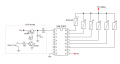
I believe the Timer and 12 volt Solenoids listed in post #1 are feasible with this interface circuit.
The Zone output from the Timer is a 30ms 3 volt pulse designed for latching type solenoids.
The 12 volt solenoids require power for 1 second to fully retract.
The interface circuit converts the short 3 volt pulse to a 1 second 12 volt pulse to activate the solenoid through the ULN2003 driver.
1730405852507.png
 
Last edited:

Tonyr1084

Joined Sep 24, 2015
9,744
I believe the Timer and 12 volt Solenoids listed in post #1 are feasible with this interface circuit.
The Zone output from the Timer is a 30ms 3 volt pulse designed for latching type solenoids.
The 12 volt solenoids require power for 1 second to fully retract.
The interface circuit converts the short 3 volt pulse to a 1 second 12 volt pulse to activate the solenoid through the ULN2003 driver.
View attachment 334682
NOTE: Zone 1 Out from a sprinkler controller (the AC powered type) will have a 24VAC output. However, the positive pulse from a battery powered type should have no problems. If you go with the AC powered controller then a diode is recommended from the output to the "1 of 6 circuits" circuit. This will prevent back feeding Q1 with 24VAC. Even with the battery powered controller a diode would not be a bad idea. After all, it's going to push a negative pulse to supposedly close a sprinkler valve.
 

MisterBill2

Joined Jan 23, 2018
27,164
NOTE: Zone 1 Out from a sprinkler controller (the AC powered type) will have a 24VAC output. However, the positive pulse from a battery powered type should have no problems. If you go with the AC powered controller then a diode is recommended from the output to the "1 of 6 circuits" circuit. This will prevent back feeding Q1 with 24VAC. Even with the battery powered controller a diode would not be a bad idea. After all, it's going to push a negative pulse to supposedly close a sprinkler valve.
What sort of sprinkler valve, or common solenoid, uses a reverse voltage to reverse the motion??? I am very familiar with sprinkler valves and they are all spring return towards the off mode. That is because they are pilot operated diaphram valves. The coil pulls a small plunger up, allowing the supply pressure to open the much larger water passage.
 

Tonyr1084

Joined Sep 24, 2015
9,744
What sort of sprinkler valve, or common solenoid, uses a reverse voltage to reverse the motion???
https://www.dripdepot.com/dig-battery-operated-dc-multi-station-controller-stations-6
Screen Shot 2024-10-30 at 10.09.27 PM.png

Note: DC Latching Solenoids
Screen Shot 2024-10-30 at 10.10.31 PM.png
The irrigation system the TS listed uses latched DC solenoids, so there is only a brief pulse to activate and deactivate.
The unit is powered from 2 AA batteries from the description and installation manual.
The "Brief" pulse to latch is (for sake of a better way of putting it) the pulse is a positive going pulse to open the valve. Once the valve has been opened it remains open until there's a negative going pulse, which closes the valve. In between pulses (open and close) no electrical power is needed. That's what makes battery powered systems work for the whole season. Imagine how quickly batteries would be drained if it had valves that needed to be opened and held open by an electrical current. I actually have a few of these in my plumbing drawer from when I first started using drip irrigation. The problem I experienced with them is if the battery is weak but strong enough to open the valve but then becomes too weak to close the valve you can have water running all night and not know it; possibly for days. That's a big reason why I went with a home sprinkler system that is AC powered. Those AC powered systems typically (if not exclusively) operate on 24VAC. I missed the "Pulsed DC" valves in my initial read-through, which is why I went off in the direction I did with the continuously powered solenoids. Setting just a brief period, 1, 2, 5 or even 10 seconds of powered time will pull the solenoid, assuming it has enough strength to overcome the friction of releasing the shelf without the concerns for an overheating solenoid coil. That was the approach I went after. Other opinions have been offered and are of well worth considering. I did like the idea of the air powered solenoids. But then there'd be a need for a compressor.
 
Last edited:

MisterBill2

Joined Jan 23, 2018
27,164
OK, I see it is a battery operated system, those are not used by the folks around here because of no need for them.
And based on the technical description from the website, I would not consider that system ever, at any wonderful price.
 
Top