Time-Shifted Square Using Schmitt?

Thread Starter

johnyradio

Joined Oct 26, 2012
615
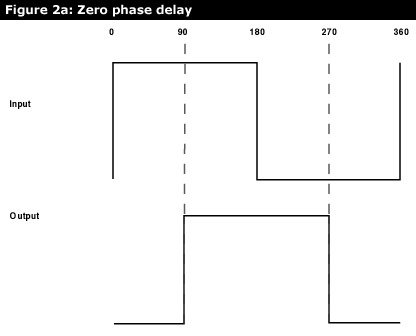
My intention is using the RC filter to apply a little delay to the input, so that the Schmitt output is a square wave that's time-shifted from the first square wave.

Desired output:

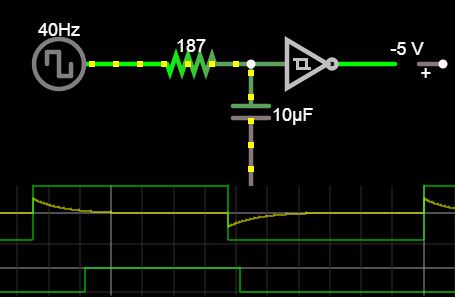
Here's my attempt. But the output of the Schmitt is curvy, not square. Why?
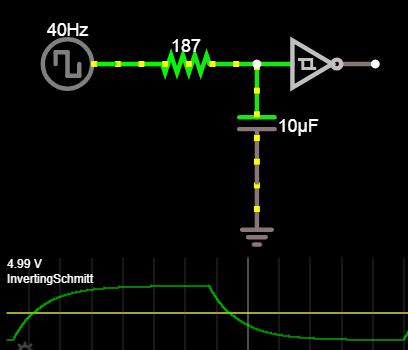
http://tinyurl.com/ydx8bhmk
 

Thread Starter

johnyradio

Joined Oct 26, 2012
615
I think you have a too large capacitor and need another Schmitt.
It appears from my new screenshot below, that my cap is a good value.

If you want to get the same phase then you need to in series with a Schmitt Inverter at the output.
if i want what same phase? Do what in series? i'm trying to delay phase.

That looks like the input to the gate, not the output.
indeed, not sure why that happened. Seems it wants an "voltmeter output" after the schmitt. This works:
(falstadt)
http://tinyurl.com/y9cv6mqh

It's close to what i want, but why is the rising delay different than the falling delay?


Do i need a bias resistor? On the input to the schmitt? Should it's value be related to the RC resistor-value?

Thx
 
Last edited:

MrChips

Joined Oct 2, 2009
34,809
You are attempting to create monostable multivibrator pulses with RC circuits. It can be done that way but it is easier using monostable multivibrator ICs.

What is the range in frequencies of your signal?
How much delay do you need?
Is the phase delay always 90°?
 

crutschow

Joined Mar 14, 2008
38,504
why is the rising delay different than the falling delay?
Don't know.
Perhaps it's the value for the Schmitt trigger threshold in that model.

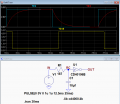
Below is the LTspice simulation, which has the same delay for both the rising and falling signal, which should be close to the real circuit.

upload_2018-10-4_13-44-13.png
 

Thread Starter

johnyradio

Joined Oct 26, 2012
615
it is easier using monostable multivibrator ICs.
and might be easier with an arduino, but in this case trying to do this with a schmitt.
What is the range in frequencies of your signal?
How much delay do you need?
Is the phase delay always 90°?
You're asking re my RC values? My values shown seem to work well enough for this investigation. The delay in my use-case will be fixed, always the same, but not necessarily 90°.

Perhaps it's the value for the Schmitt trigger threshold in that model. Below is the LTspice simulation, which has the same delay for both the rising and falling signal, which should be close to the real circuit.
Thx for doing that. I suspect it's a flaw in the falstad engine. I trust your LTspice more! If correct, then my circuit is good.

Thx!
 

MrChips

Joined Oct 2, 2009
34,809
With one dual monostable multivibrator IC such as CD14538 you can create a delayed pulse output.
However, the delay and the pulse width will be fixed.
 

Thread Starter

johnyradio

Joined Oct 26, 2012
615
Below is the LTspice simulation, which has the same delay for both the rising and falling signal
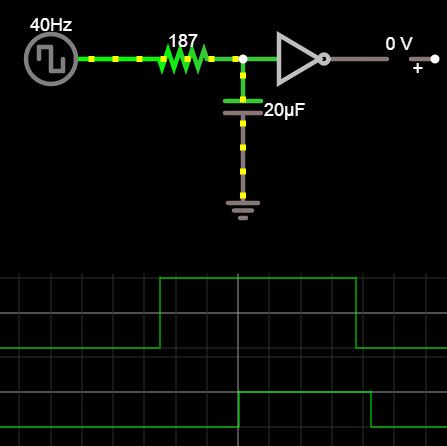
Can you plz try plugging in 20 uF for the cap? I'm getting radically different delays, and i think it's due to hysteresis. I think it would require a gate without hysteresis to get identical delays.

Update:
Shucks, i'm getting different delay times with a regular inverter too. I think bias is needed, or maybe a series cap someplace.
 
Last edited:

ebeowulf17

Joined Aug 12, 2014
3,307
Can you plz try plugging in 20 uF for the cap? I'm getting radically different delays, and i think it's due to hysteresis. I think it would require a gate without hysteresis to get identical delays.

Update:
Shucks, i'm getting different delay times with a regular inverter too. I think bias is needed, or maybe a series cap someplace.
Or you could download LTspice. It's free, and incredibly powerful and useful.

Many (most?) chips list high and low thresholds in their datasheets, so you should be able to determine whether or not the trip points and delays will be symmetrical without running ANY simulation (although I'll admit it is quite comforting seeing a simulation confirm expected behavior before dropping money on parts.)
 

Thread Starter

johnyradio

Joined Oct 26, 2012
615
Here you go.
Note that 187Ω is too low a load resistance for most signal sources.
Better go use a higher value, such as 1.87kΩ with a 2μF cap, which gives you the same time-constant and signal delay.
Fantastic! Thx, @crutschow !

Or you could download LTspice. It's free
Great! Would've done it before, but I thought it was expensive. I just installed it, and trying to do this. Some youtube tutorials in my near future :)
 
Last edited:

ScottWang

Joined Aug 23, 2012
7,501
Hi @ScottWang , i still didn't get your meaning above. Can you explain? What do you mean by "same phase"? Also, did you forget a word in "you need to in series". Seems to be a word missing.
I just thought that probably you need the input and output are the same phase, so I mentioned that you need to add another schmitt inverter, if your orginal idea that the phase is reverse then you just ignore what I said.
 

Thread Starter

johnyradio

Joined Oct 26, 2012
615
Is the input square wave actually AC (-5 to +5 V) at #10? That will account for different delays. Crutschow's input is from 0 to +5 V.
Great point! But I'm doing unipolar.

I believe I the apparent time difference wasn't. The issue was: I needed to wait for the cap to settle to equilibrium. Then I get equal delay :)

Thx!
 

ebp

Joined Feb 8, 2018
2,332
I'm quite baffled by both #10 and #5. In both cases the input waveform apparently has twice the amplitude of the output (and appears to be centred around zero - the yellow trace at #5 has the same baseline and is presumably the current through the resistor and would actually be AC even if the input were unipolar) and the outputs are not inverted as they should be.
 
Top