Time Constant calculation

Thread Starter

TimoG

Joined Nov 2, 2017
17
For the circuit below I am trying to calculate the combined time constant of charging. I know that for a single capacitor and resistor the equation is: T = RC. In order to calculate it for the series below would I be able to combine (R1 + R2) and (C1 + C2) and then use the time constant equation? Or should I figure out the separate time constants for R1,C1 and R2,C2 and then combine them somehow?
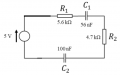
upload_2017-11-5_19-10-22.png
 

Thread Starter

TimoG

Joined Nov 2, 2017
17
But note that the value of two capacitors in series is not the sum of their values.
OK so just to clarify that combining the resistor and capacitor values and then using the time constant equation will give the correct result?

And then in order to calculate the voltages across C1 and C2 once charging is complete (5T) would I use the following equation?:
upload_2017-11-5_19-46-46.png

If so would Vs for C2 be different from Vs for C1 as there is a voltage drop across each resistor?
 

AlbertHall

Joined Jun 4, 2014
12,624
OK so just to clarify that combining the resistor and capacitor values and then using the time constant equation will give the correct result?
Yes.
If so would Vs for C2 be different from Vs for C1 as there is a voltage drop across each resistor?
Are you asked for the voltages at 5T, when charging will be almost complete, or when charging is fully complete?
When charging is complete the current will be zero - no voltage across either resistor.
 

Thread Starter

TimoG

Joined Nov 2, 2017
17
Yes.

Are you asked for the voltages at 5T, when charging will be almost complete, or when charging is fully complete?
When charging is complete the current will be zero - no voltage across either resistor.
The question says "fully charged" so I guess the voltages will be zero as you say. (maybe it was a trick question!)
 

WBahn

Joined Mar 31, 2012
32,784
OK so just to clarify that combining the resistor and capacitor values and then using the time constant equation will give the correct result?

And then in order to calculate the voltages across C1 and C2 once charging is complete (5T) would I use the following equation?:
View attachment 138738

If so would Vs for C2 be different from Vs for C1 as there is a voltage drop across each resistor?
You are correct that, in that equation, Vs for each capacitor will be different, but your reasoning is incorrect. Once fully charged, no current will be flowing and hence no voltage across the resistors. But the applied source voltage will be split amongst the two capacitors.
 

Thread Starter

TimoG

Joined Nov 2, 2017
17
You are correct that, in that equation, Vs for each capacitor will be different, but your reasoning is incorrect. Once fully charged, no current will be flowing and hence no voltage across the resistors. But the applied source voltage will be split amongst the two capacitors.
OK so will the voltage split between the capacitors be a function of the resistor values? ie. will VC1 be equvalent to the voltage drop across R1?
I have to clarify that I am trying to find the voltage "on" each capacitor and not "across" each capacitor in case that caused confusion.
 

AlbertHall

Joined Jun 4, 2014
12,624
OK so will the voltage split between the capacitors be a function of the resistor values?
No. The capacitors have had the same current flowing for the same time so they will have the same charge stored in them.
Also, consider what the total voltage across the capacitors must be, given that there is no voltage across the resistors. You don't need to do any calculation to get that value.
 

Thread Starter

TimoG

Joined Nov 2, 2017
17
No. The capacitors have had the same current flowing for the same time so they will have the same charge stored in them.
Also, consider what the total voltage across the capacitors must be, given that there is no voltage across the resistors. You don't need to do any calculation to get that value.
OK so the voltage across both capacitors in series is equal to the input voltage, but what is the voltage across the individual capacitors?
 

MrAl

Joined Jun 17, 2014
13,698
Hello,

This circuit really requires a little circuit analysis to get all the values.
Otherwise you have to just use formulas thrown at you. For example, the capacitive voltage divider.
 

WBahn

Joined Mar 31, 2012
32,784
OK so will the voltage split between the capacitors be a function of the resistor values? ie. will VC1 be equvalent to the voltage drop across R1?
NO! The voltage drop across R1 is proportional to the instantaneous current through R1 and after you reach steady state that current is ZERO so the voltage drop across those resistors is ZERO!

Because the capacitors are in series, the same current must always flow through each. That's what it means for two components to be in series. What do you know about the voltage across a capacitor as a function of the current flowing through it? You will need to assume that the initial charge on the capacitor is zero, but that is a fairly reasonable assumption.

I have to clarify that I am trying to find the voltage "on" each capacitor and not "across" each capacitor in case that caused confusion.
What does it mean for a voltage to be "on" something?

Voltage is, by definition, a difference of electric potential energy per unit charge between two points. So the only reasonable interpretation of the voltage "on" a capacitor is the voltage difference across the terminals of the capacitor.
 

Thread Starter

TimoG

Joined Nov 2, 2017
17
NO! The voltage drop across R1 is proportional to the instantaneous current through R1 and after you reach steady state that current is ZERO so the voltage drop across those resistors is ZERO!

Because the capacitors are in series, the same current must always flow through each. That's what it means for two components to be in series. What do you know about the voltage across a capacitor as a function of the current flowing through it? You will need to assume that the initial charge on the capacitor is zero, but that is a fairly reasonable assumption.
I used the equations from #12 because they seemed to make sense. Since charge on both capacitors is the same when the capacitors are fully charged, I came up with this equation:
C1*Vc1 = C2*Vc2 (from Q=C*V)
And also:
Vc1 + Vc2 = 5
Solving gives values for Vc1 and Vc2. Are these the correct voltages across each capacitor?
 

WBahn

Joined Mar 31, 2012
32,784
I used the equations from #12 because they seemed to make sense. Since charge on both capacitors is the same when the capacitors are fully charged, I came up with this equation:
C1*Vc1 = C2*Vc2 (from Q=C*V)
And also:
Vc1 + Vc2 = 5
Solving gives values for Vc1 and Vc2. Are these the correct voltages across each capacitor?
Voltages and currents (and charge, for that matter) each have polarity. So until you define the polarity of Vc1 and Vc2, it's impossible to tell you whether you are correct or not because there are four possible combinations and you equation will be correct for at most one of them.

But you are on the right track.
 

Thread Starter

TimoG

Joined Nov 2, 2017
17
Voltages and currents (and charge, for that matter) each have polarity. So until you define the polarity of Vc1 and Vc2, it's impossible to tell you whether you are correct or not because there are four possible combinations and you equation will be correct for at most one of them.

But you are on the right track.
I am not sure how to go about calculating the polarities of voltage and current as there was no value given for the frequency of the voltage source. Would the analysis in #16 work if the voltage source was DC? Maybe this is what the question was trying to ask.
 

WBahn

Joined Mar 31, 2012
32,784
I am not sure how to go about calculating the polarities of voltage and current as there was no value given for the frequency of the voltage source. Would the analysis in #16 work if the voltage source was DC? Maybe this is what the question was trying to ask.
The frequency has nothing to do with it.

Let's say that I tell you that the flow of water in a pipe that connects Tank A to Tank B is 5 gallons per minute. Is the level of water in Tank A increasing or decreasing? You have no way to know based on the information I gave you because you don't know the direction of the flow. But if I label the pipe with an arrow pointing from Tank A to Tank B and tell you that the flow is 5 gallons per minute, you know that the flow is towards Tank B so the level in Tank A is decreasing. If, on the other hand, I say that the flow is -10 gpm, you know that the level in Tank A is increasing.

If, on the other hand, I had chosen to label the pipe with the arrow pointing in the other direction, then the flow in the first example would have been -5 gpm and it would have been +10 gpm in the second.

The same with electrical current or with voltage.

Fundamentally, the defined directions are completely arbitrary -- you can literally flip a coin if you want. But you need to label the polarities so that the results can be interpreted correctly.

Just saying that the current in a resistor is 5 A is only part of the answer -- we generally need to be able to determine which direction the 5 A is flowing.

Just saying that the voltage across a capacitor is Vc1 is only part of the answer -- we generally need to be able to determine which side of the capacitor is at the higher voltage once given a value for Vc1.

Look at the original circuit you provided. Did it just say that the voltage of the supply was 5 V? No. It indicated the polarity of that voltage.
 

Øivind Bakke

Joined Aug 22, 2017
12
Hi TimoG,

I would consider the system as a whole and solve T from there. Add the capacitors (C_tot=C1*C2/(C1+C2)) and resistors (R_tot=R1+R2) and use the formula you provided (T=RC). However, if your question is what the stationary voltage across each of the two capacitors are, its not really needed. It's been previously written, that the stored charge Q is equal in each capacitor. You also know that the voltages across both have to be equal to the input source(5V) at stationary operation. Hence, you can use a set of equation to solve it.
Q=C*V; Q1=Q2=Q; V=5V; C1=56nF; C2=100nF; V1/2=voltage across the respective capacitor.
Q=C1*(V-V2);
Q=C2*(V-V1);
leads to:
C1*(V-V2)=C2(V-V1);
solve one voltage in respect to the other and voilà.
 
Last edited:
Top