That's cool, it's a Zx80 simulator, looks like the Sinclair.
I have very little use for it now though since the huge progress on CPUs and all since then.
This thread justappeared to me for the firsttime. At least I do not recall seeing it before. LONG AGO I assembled a "6800D2" single board computer tha I got cheap because the one who bought it had not realised it needed to be assembled AND SOLDERED! So I bought it from him and assebled it WITH IC sockets for ALL the logic. Then I realized I did not have a clue about programming it, so I sold it.
Ha, yes one of the things you have to do if you build your own single board computer is study the instruction set for the CPU.
I started with the 8080 CPU then went to the Z80, and the Z80 had a LOT more instructions than the earlier 8080. It was a blessing at the time, I could do "anything" with it (ha ha).
The 8080 board I wired by hand, the Z80 board I etched myself so it was a lot neater job. But get this: I programmed it through a what they now call a "bootloader' so I could use my Z80 based TRS80 computer via parallel printer port (2 wires) to program the single board computer. It was able to do a lot with just 32k or 64k of ram (don't remember which) and just a 32k ROM (if I remember). The ROM only needed a little bit of code to act as the interface between the two computers to program the RAM, from where the uploaded code would run. It was all done in .asm (ha ha).
I learned Fortran on a Xerox Sigma 7 mainframe punching card decks, leaving the decks wrapped in the billing address sheet in the "inbox" and coming back the next day to see if it actually ran or got lost in a loop due to a coding error in the late 60's. Also, on an IBM 300 minicomputer coding in PL1 as it didn't have the capacity to run Fortran but had full hands-on access. I was curious about the TRS 80 and considering buying one but short on the funds to do so. But it wasn't until I had my hands on an Apple ii running Lotus 123 and also connected as a terminal for our HP 1000 Minicomputer "Miniframe" that completely gob smacked me. It was instantaneous feedback. Any errors were immediately apparent and no more card punching, loading, compiling, running the program, and waiting to see if the program ran or not!!! That and a word processer program and suddenly the Wang Word Processors that had replaced the secretarial IBM Selectrics were obsolete, and I was hooked for life! HP 150s and Thinkjet printers soon populated every manager, and supervisor's desk and cost less than the terminals we used for the HP 1000 and also acted as terminals for it. That was the real beginning of my career and soon led to almost every operating area having distributed computer control and alarm systems integrated into them supplanting manual, pneumatic, electric and electronic standalone/integrated 4-20ma loop controls. Not to mention all the proliferation of electronic Programmable Logic Controls for the electrical systems and integrating electronic variable speed motor drives into them as well. Automation alone reduced the plant population from -1900 employees to ~1200 in a relatively short period of time. That reduction in force was accomplished through early retirement incentives (monetarily better to retire than continue working!) and normal attrition and not through termination of employment thankfully.
I learned Fortran on a Xerox Sigma 7 mainframe punching card decks, leaving the decks wrapped in the billing address sheet in the "inbox" and coming back the next day to see if it actually ran or got lost in a loop due to a coding error in the late 60's. Also, on an IBM 300 minicomputer coding in PL1 as it didn't have the capacity to run Fortran but had full hands-on access. I was curious about the TRS 80 and considering buying one but short on the funds to do so. But it wasn't until I had my hands on an Apple ii running Lotus 123 and also connected as a terminal for our HP 1000 Minicomputer "Miniframe" that completely gob smacked me. It was instantaneous feedback. Any errors were immediately apparent and no more card punching, loading, compiling, running the program, and waiting to see if the program ran or not!!! That and a word processer program and suddenly the Wang Word Processors that had replaced the secretarial IBM Selectrics were obsolete, and I was hooked for life! HP 150s and Thinkjet printers soon populated every manager, and supervisor's desk and cost less than the terminals we used for the HP 1000 and also acted as terminals for it. That was the real beginning of my career and soon led to almost every operating area having distributed computer control and alarm systems integrated into them supplanting manual, pneumatic, electric and electronic standalone/integrated 4-20ma loop controls. Not to mention all the proliferation of electronic Programmable Logic Controls for the electrical systems and integrating electronic variable speed motor drives into them as well. Automation alone reduced the plant population from -1900 employees to ~1200 in a relatively short period of time. That reduction in force was accomplished through early retirement incentives (monetarily better to retire than continue working!) and normal attrition and not through termination of employment thankfully.
Isn't technology wonderful (???!!!)
It seems it has an evil flip side. Great for the short run, VERY bad for the long run. It's almost like we are ignorant of the consequences ... like kids eating lots and lots of candy. It looks so good, but then ends up doing lots of harm later. Don't we ever learn?
Maybe the problem is that the technology is, in a way, smarter than we are, so we can't see what is really in store for us in the future. It's almost like it 'takes over' and then it's too late to go back because we've come too dependent on it.
If we keep following this path (and we will) what is to become of our civilization. A thought: what if there are advanced intelligent beings out there as thought by many, but they grew smarter and realized that technology does not improve things it makes things worse, except in moderation. Maybe that is why we don't see any yet, they realized that they had to moderate the technology and that could have meant limit it so much that they can't develop long range space craft.
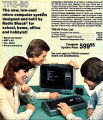
My TRS80 back in the early 1970's was over $1000 USD, I think it may have been close to $2000 USD can't remember that well now. Imagine that now, a computer with a 4Megahertz CPU for over $1000 USD.
It's a little interesting that we only came 1000 times farther than that since then, with a (rough average) 4Gigahertz CPU for the regular type home computer, although we do have multiple core CPU's now. The closest to that came sometime later with the dual CPU motherboards.
The thing that hurts me the most these days is the SSD 'shortage'. That's just plain stupid. I guess it is due to a shortage of NAND flash memory.
I still have that Radio Shack "Color Computer" up in the attic someplace. What is funny is that I have seen those computer used to control test machines quite well, and they cost less than a PLC at the time. The main flaw was the lackof unternal non-volatile memory. So any program had to be stored extenally.
I wonder if there is available a compact non-volatile memory for the 6809 color computers. THAT would be good even today.
Did I get a later model perhaps? I think I also got the line printer with it and some software. Can't remember that far back.
I know I did not get the hard drive, which was $400 USD.
My computer, in the same era, was only a "color computer" that had a composite video output, and probably a channel 3 RF video output. It also included a digital bus port for adding floppy drives or other I/O. It included the ROM for extended color basic, which could do a lot of things.
My computer, in the same era, was only a "color computer" that had a composite video output, and probably a channel 3 RF video output. It also included a digital bus port for adding floppy drives or other I/O. It included the ROM for extended color basic, which could do a lot of things.
I used the RS "color computer" too but don't remember what kind of video output it had. It was a regular monitor I think with color, but don't remember much else. That model came after mine.
Mine had the OS such that the file system would only go from 1980 to 1987 which I though was strange, but I later learned that they only wanted to use 3 bits for the date, thus the 0 to 7 only. I had to create software that could save the real dates on the floppy as there was always unused space. They did come out with an update for that OS but I never got it.
I did buy the "word processor" software because I did not feel like writing my own at the time. It was a very small program but did everything I needed. Today's stuff is so overdone it's crazy.
Most of the stuff like that though had to be written in asm not a higher level language. I did asm for the lower level stuff, but created a pascal program to do pascal.
The text editor must have been very small taking up less than 16kB for sure, yet it did everything I need a text editor to do.
It would be hard to go back to that computer now but not because of the functionality for simple stuff like that, but because the screen is too small. I got the portable version that closes up into a sort of suitcase. The screen was much smaller than the regular size units.
My recollection is that the output was NTSC Composit Video. There was an expansion port for a floppy drive, or game cards, an an "Extended Color Basic" IC that I traded a guy for. A couple of guys who also contracted with my employer at that time used the expansion port to load code into PROMs to run machies our company built. That was impressive, and evidently a very good design feature. I recall that I also purchased a bunch of RAM, so I think that it gave me 64K instead of 16 K.
Evidently there were two different versions of the color computer, with the second version using a totally different processor.
I still have that color computer, stored in it's box, because it was a significant cash investment at the time.
Then along came the IBM "PC" and copies and clones, and things changed forever.
AND, I am still not completely sure that it was an actual benefit for human kind.
My recollection is that the output was NTSC Composit Video. There was an expansion port for a floppy drive, or game cards, an an "Extended Color Basic" IC that I traded a guy for. A couple of guys who also contracted with my employer at that time used the expansion port to load code into PROMs to run machies our company built. That was impressive, and evidently a very good design feature. I recall that I also purchased a bunch of RAM, so I think that it gave me 64K instead of 16 K.
Evidently there were two different versions of the color computer, with the second version using a totally different processor.
I still have that color computer, stored in it's box, because it was a significant cash investment at the time.
Then along came the IBM "PC" and copies and clones, and things changed forever.
AND, I am still not completely sure that it was an actual benefit for human kind.
Mine didn't even have dot pixel graphics. To get that I would have had to buy an add on graphics card. Instead I used the dot matrix printer that had individual dot capabilities.
On screen if I wanted to plot a waveform I had to use something like an asterisk for each dot. That limited the graph area to a very small space maybe 80 'dots' across and 20 'dots' down.
The Sinclair only allowed 40 chars across if I remember right. Composite TV doesn't work well for wide lines of text.
https://www.tweaktown.com/news/1130...with-no-more-dram-or-hbm-available/index.html
Memory capacity for all of 2027 has reportedly been booked and sold, with no more DRAM or HBM available
According to a new report, Samsung, SK hynix, and Micron's DRAM and HBM memory capacity for 2027 is now sold out with no additional supply available.
https://www.tweaktown.com/news/1130...with-no-more-dram-or-hbm-available/index.html
Memory capacity for all of 2027 has reportedly been booked and sold, with no more DRAM or HBM available
According to a new report, Samsung, SK hynix, and Micron's DRAM and HBM memory capacity for 2027 is now sold out with no additional supply available.

 Facebook
 Google
 GitHub
 Linkedin