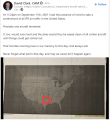
In 1958, New York City police officer Richard Perry was photographed practicing basic Spanish using phonetic pronunciations written on a blackboard.
The lessons reflected a rapidly changing New York. The city’s Puerto Rican population had grown dramatically during the 1940s and 1950s, particularly during the migration often called the Great Migration from Puerto Rico. City agencies increasingly encountered residents whose primary language was Spanish, creating a practical need for Spanish-speaking employees and basic language training.
Why not? They're not THAT hard to hand solder (with a good binocular microscope). Though, I admit, I wouldn't want to have to do a lot of them, but a few here or there is nothing to get too bent about. The 0402s are the smallest I'd want to do on a regular basis.
$75/wk was actually quite good for a "clerk" in 1954. The BLS shows that the average for the better paid clerk-type positions were about $58/wk. Today that would be about $36k/yr. But today the median salary for Bookkeeping, Accounting, and Auditing Clerks is $51k/yr and the 90th percentile is about $75k/yr. My wife probably falls close to that job category, but her position is a bit unique. She's making a little over $80k/yr, so that jives pretty well with the BLS numbers. That means that, overall, a person in this type of position has about twice the purchasing power now compared to their predecessor.
But not all things go up at the same rate. We often here about how the dream of home ownership is getting out of reach. In the 1954 time frame, a modest "starter" home was about $10k, so that represented about 40 months income. Today, the typical starter home is about $350k, so for that to be 40 months of income, the person would have to make about $105k/yr.
But I question that $350k figure, which comes from the National Association Realtors, though I know that it's a national average and home prices vary a lot around the country. Forty months salary at $75k would be $250k. The home prices in this area are supposed to be a bit more expensive than the national average, but if I look on Realtor.com for homes under $250k in Colorado Springs, I get 264 hits. There's one that is almost identical to the house my parents bought in the late 1950s that is on the market for $150k. I think the discrepancy is largely due to homes in the 1950's were MUCH smaller than "comparable" homes are today. So is it really that families starting out today can't afford a home the same way that people back then could, or is it that the home they insist on having much more home than people back then had. That house they my parents bought, and that I lived in until we moved in the early 1970s, was 902 square feet, yet that was large enough for a family of four. The labor per square foot hasn't changed a whole lot over that time. So it's not that homes, themselves, are what is preventing young families from getting into one, it's a combination of other burdens on them -- significantly higher tax rates of all kinds, the amount of debt (of all kinds) that they have to service, higher entertainment costs, both in terms of the particular entertainment and also how much entertainment people want today. Also, we hear about how food costs are out of control, but in the 1950s a families food costs were considerably higher, being about a third of they pay for a family of four whereas today it's usually closer to a fourth. But that's if you prepare meals at home, and today people go out, hit fast-food, and order-in to a much higher degree, so much of the high food cost is self-inflicted (been there, done that).
$75/wk was actually quite good for a "clerk" in 1954. The BLS shows that the average for the better paid clerk-type positions were about $58/wk. Today that would be about $36k/yr. But today the median salary for Bookkeeping, Accounting, and Auditing Clerks is $51k/yr and the 90th percentile is about $75k/yr. My wife probably falls close to that job category, but her position is a bit unique. She's making a little over $80k/yr, so that jives pretty well with the BLS numbers. That means that, overall, a person in this type of position has about twice the purchasing power now compared to their predecessor.
But not all things go up at the same rate. We often here about how the dream of home ownership is getting out of reach. In the 1954 time frame, a modest "starter" home was about $10k, so that represented about 40 months income. Today, the typical starter home is about $350k, so for that to be 40 months of income, the person would have to make about $105k/yr.
But I question that $350k figure, which comes from the National Association Realtors, though I know that it's a national average and home prices vary a lot around the country. Forty months salary at $75k would be $250k. The home prices in this area are supposed to be a bit more expensive than the national average, but if I look on Realtor.com for homes under $250k in Colorado Springs, I get 264 hits. There's one that is almost identical to the house my parents bought in the late 1950s that is on the market for $150k. I think the discrepancy is largely due to homes in the 1950's were MUCH smaller than "comparable" homes are today. So is it really that families starting out today can't afford a home the same way that people back then could, or is it that the home they insist on having much more home than people back then had. That house they my parents bought, and that I lived in until we moved in the early 1970s, was 902 square feet, yet that was large enough for a family of four. The labor per square foot hasn't changed a whole lot over that time. So it's not that homes, themselves, are what is preventing young families from getting into one, it's a combination of other burdens on them -- significantly higher tax rates of all kinds, the amount of debt (of all kinds) that they have to service, higher entertainment costs, both in terms of the particular entertainment and also how much entertainment people want today. Also, we hear about how food costs are out of control, but in the 1950s a families food costs were considerably higher, being about a third of they pay for a family of four whereas today it's usually closer to a fourth. But that's if you prepare meals at home, and today people go out, hit fast-food, and order-in to a much higher degree, so much of the high food cost is self-inflicted (been there, done that).
Personally, I measure the economy on the following basic metrics (not in order of priority):
Housing
Food (of healthy quality, of course)
Health care
Education
Transportation
Everything else is either non-essential, or a luxury. And of course, all of us would like to live a better life than one simply meeting the basic needs. We all need entertainment, for instance.
Of the 5 aforementioned points, I think it's the cost of Education that has gotten out of hand.

 Facebook
 Google
 GitHub
 Linkedin