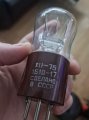
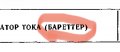
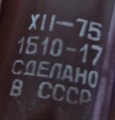
it says "stabilizator toka (baretter)"
means "regulator/stabilizer of current (baretter)"
1B10-17, sdelano v SSSR (made in SSSR)
i don't speak Russian but i can sort of read:
storage life 70 year
ELECTRICAL DATA
voltage where regulation starts 10V
voltage where regulation ends 17 V
current regulation 960-1040mA
time to reach working regime, not more than 5min
operating life 4000h
criteria for operating life 950-1050mA
...
environment temperature max 70degC, min -60degC
tolerable humidity at 20deG 95-98%
vibrations and shock 50Hz, 5g
guaranteed storage life in suitable condition 4 years
instruction No 54, January 1980, VNII page 1
graph shows VI curve,
X = voltage (V)
Y = current (mA)
instruction no 13, December 1969, NII page 2 (list 2)
hmm... maybe i should learn Russian. but then, with guys its all about having fun and drinking or fighting. and wife would never approve to spend a lot of time with a woman, specially if it involves using language she can't read. i guess drinking it is,..
I remember back in the early '70's in the Physics lab at my Uni we built some equipment using a bank of 6 or 8 barretters. If memory serves they were used in the emitters of 2N3773 power transistors being used to supply selectable constant current to a large electromagnet for an experiment. The filament strings in those were each about 4 inches long.
In 1942, Bill Hewlett patented a variable frequency audio oscillator that used a light bulb (barreter) in the negative feedback path to stabilize the output level without introducing distortion. It became the first manufactured product of the Hewlett Packard company - the model 200A.
@panic mode; this actually happened to an acquaintance. He had gone a few times to Russia, pre-SMO on business to large cities and loved the country. After reading Ian Frazier’s Travels in Siberia book, (actually an engaging book) he decided he would do the same.
Of course Frazier’s primary strategy was to learn enough Russian to be able to maintain a conversation. A wise decision.
My acquaintance decided to do the same, but the only person living nearby who was a native Russian and willing to do private Russian language tuition, was a young, athletic and needless to say very attractive registered nurse.
Everything was going well, my acquaintance not missing a single lesson, until his wife met the tutor. That was the end of his Russian lessons.
my wish was always to learn as many languages as possible. conversational is enough - mastering them would take too much time / effort. my focus was always on European languages and writing systems but i can see how for someone working with electronics, Chinese could be rather handy these days.
Back to Barreters. , which are a special case of positive temperature coefficient devices that were quite expensive 60 years ago. And also rather rare in circuits. When tube type audio oscillators were what was available they were certainly less complex than an AGC circuit with at least one diode tube section and a couple multi-grid tubes, in addition to the actual oscillator tube section. . The fourth edition of the "Radiotron Handbook" mentions them and provides a graph. But it only presents them as used to limit inrush currents. Langford-Smith does not seem to find much use for them.

 Facebook
 Google
 GitHub
 Linkedin