A thought experiment on the finding self resonate frequency in large coils.

Thread Starter

Wendy

Joined Mar 24, 2008
23,797
Our experienced members will easily identify the likely application for this, I am asking people to not speculate on it and focus on the problem given.

I have a coil I sketched up using a toilet paper roll tube as a basis The inductance is not important to this discussion. If I ever do this experiment I would 3D print the tube.
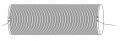
Coil Illustration.png

...........................................................................Figure 1

The following schematic shows a LC oscillator.
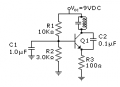

Figure 2.png
.............................Figure 2

My thought is to remove the capacitor if I’m right it should oscillate at the coils self resonate frequency.
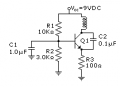

Figure 3.png
............................Figure 3

If anyone wants to try this for themselves knock yourself out.
 
Last edited:

ronsimpson

Joined Oct 7, 2019
4,646
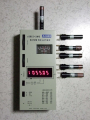
Fifty + years ago I used a grid dip meter to do this job.
1732682716351.png
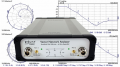
Now I use a vector network analyzer. At work they are $30,000 and up. At home it is about $100.
1732682673818.png
 

DickCappels

Joined Aug 21, 2008
10,661
That would make something close to the self resonant frequency. The oscillator component values will have an effect on oscillation frequency.

You will likely have to greatly reduce that 0.1 uF capacitor between the collector and emitter unless you are looking for a low self-resonant frequency, like that I imagine you might find with a very large inductance.!

Perhaps a better way is the old Grid Dip Meter method as @ronsimpson mentioned. That way you can reduce the coupling to the coil so your circuitry has less effect than in a classic oscillator circuit.
 

KeithWalker

Joined Jul 10, 2017
3,603
The transistor circuit will not give the real self resonant frequency of the coil because there are other capacitances in parallel with it, e.g. C2+R3, junction capacitance between base-collector, base-emitter and collector-emitter, plus C1 and stray capacitance in the wiring.
 

Thread Starter

Wendy

Joined Mar 24, 2008
23,797
I've never used a grid dip meter. I'm not sure how to use one even if I had one in front of me. Are there any other ways to do this?
 

ronsimpson

Joined Oct 7, 2019
4,646
A grid dip meter is a RF signal generator. It couples to the LC you made. (the C might be internal to the L) The meter reads when the unknown coil resonates.

You could use a RF signal generator, but you don't have a meter. I use a scope to see signal strength.

At the end of the video he talks about a vector network analyzer. (uses different words) It is also a RF signal generator. It includes a "scope". The analyzer can measure many different things. For testing coils I want to see the impedance of the coil at different frequencies. At first test I would set the generator to scan from 10khz to 2ghz several time a second. Vertically I don't set it for volts but db. At 10khz the impedance is very low. At higher frequencies it climes. You can adjust the reading to find at what frequency it reaches 50 ohms. At some high frequency the inductor resonates. Then you can zoom in and scan from 40mhz to 60mhz and see exactly what frequency it resonates at.

In another mode you can generate a Smith graph of an antenna. Frequency vs impedance

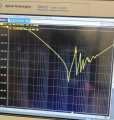
Here I am measuring the impedance of a capacitor bank. A coil will look like the inverse of this. (upside down)
At the left side of the graph is low frequencies and the capacitors look almost open. The first resonant is at 10mhz, The marker is at 19mhz. You can see a series of frequencies. The C bank has many large PP caps. Then many medium sized, then small caps. Next are large ceramic caps, then several different groups of smaller caps. I am trying to make a "ten pound" capacitor with low impedance from 1mhz to 200mhz. (2kv capacitors)
1732761447064.png
Vertically I am measuring 1.5db to 101.5db which is a very large range.
Horizontally is frequency (log scale)
A grid dip meter will just tell you where the bumps are and not much more.
 
Top