Thevenizing a leaky capacitor

WBahn

Joined Mar 31, 2012
32,840
I remember that very well from going through Grob's.
I tried a different method that also did not work. Using the series Requivalent for C and Rleak.

OK still working over the notes from your last post, more later.

Thanks, Sam
You've got a few things going wrong here. The big one is that, after attempting to convert the parallel RC pair to an equivalent series RC pair, you are ignoring the capacitor and assuming that the 5 V is applied across just the resistive portion of the circuit. Does that make sense?
 

WBahn

Joined Mar 31, 2012
32,840
OK from your notes I do see what you are doing, but it is outside of the material being presented in this introductory chapter to RC. Which is why using the information given in this chapter I am unable to match the output from LTS. The closest I can come seems to be the conversion of the R||C to it's Requivalent for a series voltage divider. And that is not close to being correct.

Time to pigeonhole this problem and move on... I may revive it after Floyd covers complex equations.
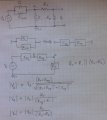
You are closer than you think. Perhaps the following road map might help:

2020-03-26-194559.jpg
 

Thread Starter

SamR

Joined Mar 19, 2019
5,491
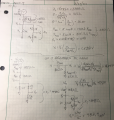
OK last nite I tried this after realizing that I had not fully executed the Req conversion. It didn't work.

So I misstated the V divider by converting Req into impedance...
This is the correction below it.
IMG_0609.png
OK I had to extrapolate from the series equivalent example of a series RC combined with R||C and misinterpreted it. Now I see how it breaks down. The examples given are typically for a single resistor combined with a Capacitor so the multiple resistors had me confused at first as to which were reacting with the cap. Your explanation of the current having to be the same helped there.

Thanks, Sam
 

Thread Starter

SamR

Joined Mar 19, 2019
5,491
There's an old book containing many examples, and working examples is what will increase your skill level. I worked most of the examples in this book decades ago, using a slide rule. You can buy a used copy for under $10:
Thanks, I bought one in near perfect condition (especially for its age) for ~$7 including shipping. Interesting old book. I don't think I will renew my acquaintance with Calculus, but I also found some very good Algebra reviews. https://sccmath.wordpress.com/
All together, they should keep me free from boredom and out of mischief for a while.

Thanks, Sam
 

WBahn

Joined Mar 31, 2012
32,840
Thanks, I bought one in near perfect condition (especially for its age) for ~$7 including shipping. Interesting old book. I don't think I will renew my acquaintance with Calculus, but I also found some very good Algebra reviews. https://sccmath.wordpress.com/
All together, they should keep me free from boredom and out of mischief for a while.

Thanks, Sam
The beauty of complex impedance is that it removes the need for the use of calculus because it turns the differential equations into algebraic ones -- the complex variable stuff is the just small price that is paid.

In actuality, that what reactance is doing, too. But relying on all the formulas that treat reactance separate from resistance in order to avoid working with complex variables is, in my opinion, too crippling and so the price is too high for the benefit received.
 

Thread Starter

SamR

Joined Mar 19, 2019
5,491
I agree, from what little experience I have, complex number equations are much easier to work with. Floyd just hasn't introduced them at this point in his introductory chapter to RC circuits. Most of my Algebra and Trig are still intuitive from many years of usage but it won't hurt to refresh myself. Calculus and Differential Equations were left behind at college and have become faint memories.
 
I agree, from what little experience I have, complex number equations are much easier to work with. Floyd just hasn't introduced them at this point in his introductory chapter to RC circuits.
Complex arithmetic is trivial to deal with if you have a calculator that can perform complex arithmetic calculations (especially compared to how it was with a slide rule). Do you have such a calculator?

Every EE who ever solves a complicated AC network, should, having completed the solution, genuflect toward Schenectady and say "Thank you, Dr. Steinmetz". https://en.wikipedia.org/wiki/Charles_Proteus_Steinmetz (see under the heading "AC steady state circuit theory")
 

Thread Starter

SamR

Joined Mar 19, 2019
5,491
Yes, I use an old TI-83 my kids left behind that handles complex numbers well and also use an online solver for simultaneous linear equations and other such. Much better than doing it the old fashioned way. I still have my big K&E LogLogDuplexDeciLon slipstick around here somewhere (along with some other 10" & 6" and radial rules) but haven't used it since the 70s except to show the kids how it used to be done.
 

Thread Starter

SamR

Joined Mar 19, 2019
5,491
@WBahn, @The Electrician, et al
Well, I am disappointed with the Floyd book. I kept waiting for him to get into complex numbers or linear equations. He doesn't, it is all very intricate algebraic solutions. I did appreciate his bringing real-world problems and solutions into his book but I can't believe he left the easier methods (to me) out. I am trying to leave the calculus out of it. In that area, Grobb did a much better job. Is there a good book out there that covers AC/DC resistive/reactive circuits other than Malvino's "Resistive and Reactive Circuits"? I have been looking but haven't found what I want as yet.

Thanks, Sam
 
@WBahn, @The Electrician, et al
Well, I am disappointed with the Floyd book. I kept waiting for him to get into complex numbers or linear equations. He doesn't, it is all very intricate algebraic solutions. I did appreciate his bringing real-world problems and solutions into his book but I can't believe he left the easier methods (to me) out. I am trying to leave the calculus out of it. In that area, Grobb did a much better job. Is there a good book out there that covers AC/DC resistive/reactive circuits other than Malvino's "Resistive and Reactive Circuits"? I have been looking but haven't found what I want as yet.

Thanks, Sam
Almost any network analysis or circuit theory text should do what you want. A couple of classic texts are:

https://www.amazon.com/Network-Anal...=van+valkenburg&qid=1589481219&s=books&sr=1-1

https://www.amazon.com/Electrical-E...=books&sprefix=skilling,stripbooks,238&sr=1-3
 

Thread Starter

SamR

Joined Mar 19, 2019
5,491
Van Valkenburg is a bit too heavy on the calculus for me but Hildreth-Skilling at least breaks it down into the derivatives so it's more my speed. Thanks for the recommendations.
Sam
 

Thread Starter

SamR

Joined Mar 19, 2019
5,491
Yes I well remember Schaum's from my long-ago college days. Seem to remember using their differential equations study guide among others. I'll take a look.
Thanks, Sam

Edit: Looks like it will do the job nicely. Ordered one from Abe Books for ~$10
 
Last edited:
Top