Thevenizing a leaky capacitor

WBahn

Joined Mar 31, 2012
32,840
I am getting 7.43E-6 for this?


That I know how to do but not sure how it applies here? At this point in Floyd's Electronic Fundamentals, complex numbers have not been brought in as yet.


Still on my to-do list is Malvino's Resistive and Reactive Circuits.

I think I do not completely understand the reactive effect on ALL of the elements of the circuit. I broke the circuit down in the previous solution but in the last branch, there is no reactive element in the solution? Is that the correct solution?
Does your text treat capacitive and inductive reactance as both being positive numbers and then you have things like (Xl-Xc) scattered throughout your formulas?
 

Thread Starter

SamR

Joined Mar 19, 2019
5,491
OK, I got some sleep. New sheet of paper...

Xc = 3388Ω
I have:
1584991555639.png

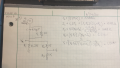
Then I have a capacitor both in series and parallel. So I solve it for Z1 and Z2?

For the parallel I have Z1 = (Rleak*Xc)/√(Rleak^2+Xc^2) = 1722Ω

For the series I have Rt = R1||(R2+R3) = 1/(R1^-1+(R2+R3)^-1) = 1048Ω

.: Z2 = √(Rt^2 + Xc^2) = 3546Ω

So I now have a voltage divider consisting of Z1 & Z2

the voltage across Z2 is Vz2 = (Z2/(Z1+Z2)Vs = 3.37Vz2

.: the voltage across the R2 & R3 in series is 3.37V and Vo is 3.37V/2 = 1.68V
 

WBahn

Joined Mar 31, 2012
32,840
You can't just use the magnitudes of the impedances in things like the voltage divider formula because the angle matters. To be real explicit, when you add Z1 to Z2, the angle makes all the difference and you can get anything from -(|Z1|+|Z2|) to (+|Z1|+|Z2|)

This is why I strongly recommended learning to work with complex impedances -- then the angle information is embedded in the complex impedance and you can use almost all of the normal DC resistance formulas.

Using reactances, especially if capacitive reactance is treated as a positive quantity (which is a cardinal sin that many textbooks commit), is extremely limiting and becomes almost impossible to work with anything but extremely simple circuits (especially if working with an unknown capacitance, inductance, and/or frequency).

Without going into where these relationships come from (and there are a couple of ways that can be approached), you have the following basic impedance formulas:

\(Z_R \; = \; R\)
\(Z_L \; = \; j \omega L\)
\(Z_C \; = \; \frac{1}{j \omega C}\)

where

j = √-1 (we use 'j' in electrical engineering instead of 'i' because 'i' is too widely used as the variable for a time varying current)

and

ω is the radian frequency, which is related to the hertzian frequency by ω = (2π radians/cycle)·f

Most people just write this as ω = 2πf (and it is the one place where I will occasionally let myself get sloppy), but while radians are dimensionless, cycles are not and 1 Hz = 1 cycle/second.

Notice that these relationships give you a very simply way to get the units of L and C into useful form (as do the reactance formulas you have been using).

In order to yield units of Ω for Z_L, inductance must have units of 1 H = 1 Ω·s (ohm-seconds), while capacitance must have units of 1 F = s/Ω (seconds/ohm).

There is no need to memorize these units conversions -- just work them out when you need them. If you were to ask me these units conversions ten minutes from now I doubt I could tell you off the cuff (I'm quite serious); but give me a pencil, paper, and literally ten seconds I can come up with whichever one you asked for, even it I hadn't worked with this stuff for a couple years. Furthermore, I could do so confident that I was correct -- which is a LOT more than I could say for anything I might regurgitate from memory.

Once you have converted all of the components to complex impedances, now you can combine them just like you would combine resistances in a DC circuit.

Vout = Va · [ (R3) / (R2 + R3) ]

R4 = R1 || (R2 + R3)

Va = {(Vs · R4) / [R4 + (Zc||Rc)]} = { (Vs · R4) / [ R4 + ((Zc·Rc)/(Zc+Rc)) ] }

Now it's just plug and chug on the math.

Vout = { (Vs · R4) / [ R4 + ((Zc·Rc)/(Zc+Rc)) ] } · [ (R3) / (R2 + R3) ]

R4 = R1 || (R2 + R3) = [(R1·(R2+R3)) / (R1 + R2 + R3)]

Vout = { (Vs · [(R1·(R2+R3)) / (R1 + R2 + R3)]) / [ [(R1·(R2+R3)) / (R1 + R2 + R3)] + ((Zc·Rc)/(Zc+Rc)) ] } · [ (R3) / (R2 + R3) ]

Zc||Rc = [(Zc·Rc)/(Zc+Rc)]

Vout = { (Vs · [(R1·(R2+R3)) / (R1 + R2 + R3)]) / [ [(R1·(R2+R3)) / (R1 + R2 + R3)] + (([(Zc·Rc)/(Zc+Rc)]·Rc)/([(Zc·Rc)/(Zc+Rc)]+Rc)) ] } · [ (R3) / (R2 + R3) ]

Hopefully I didn't mess any of that up with all the copy/cut/paste.

Some of the parens are not needed provided order of operations are properly followed, but in text expressions, is to easy to misread the order of ops, so better safe than sorry.

This is a very brute force approach that produced the final equation in just a couple minutes. There are some simplifications that can be made, but it also isn't too hard to just set up a spreadsheet to evaluate it in stages (including the rectangular/polar conversions) and key them to cells containing the component values.

Thanks to @The Electrician for pointing out that there was a paren error that I made. Hopefully I fixed it.
 
Last edited:

Thread Starter

SamR

Joined Mar 19, 2019
5,491
OK, thanks for the detailed answer. I will take the time to go through it and digest it. In the meantime, as to LTS.

Also @crutschow et al...

LTS solves in Vp sine waves for AC and calculating with resistors requires Vrms. Correct? So, to solve for the Vo or the Voltage across a device the resulting voltage is in Vp and needs to be converted to Vrms??? Or did I miss something? I ask because in order to know if I have solved a problem correctly (that an answer is not given for in the book) I often model it in LTS for comparison.
 

WBahn

Joined Mar 31, 2012
32,840
The problem posted in the original post doesn't say whether the 5 V is RMS voltage, peak voltage, or peak-to-peak voltage. It almost certainly means RMS or peak, but no way to tell which unless there is something in the text that tells you how to interpret it when it doesn't specify (and there probably is something in there somewhere). Fortunately, in this case it probably doesn't matter. They almost certainly expect the answer to be expressed in the same form as Vs. So if you simulate it with a 5 V amplitude sine wave (Vpeak = 5 V), then just use the amplitude of the resulting output voltage.
 

Thread Starter

SamR

Joined Mar 19, 2019
5,491
Am I mistaken that Vrms is needed for calculation with resistance? Or is it only in power calculations? And yes, unless stated otherwise V should be in rms and that's how I interpret it.
 

WBahn

Joined Mar 31, 2012
32,840
Am I mistaken that Vrms is needed for calculation with resistance? Or is it only in power calculations? And yes, unless stated otherwise V should be in rms and that's how I interpret it.
If you have a voltage of Vpeak = 10 V across a 10 Ω resistor, then the current in that resistor will have an Ipeak of 1 A.

If you have a voltage of Vpp = 10 V across a 10 Ω resistor, then the current in that resistor will have an Ipp of 1 A.

If you have a voltage of Vrms = 10 V across a 10 Ω resistor, then the current in that resistor will have an Irms of 1 A.

You just need to be consistent.

If you are talking about power, then you need to be asking yourself if you are talking instantaneous power, peak instantaneous power, or average power. The whole RMS thing comes about from finding the "effective value" of a waveform, which is the value that a DC waveform would need to have to deliver the same average power to a purely resistive load.
 
Last edited:

Thread Starter

SamR

Joined Mar 19, 2019
5,491
Without going into where these relationships come from (and there are a couple of ways that can be approached), you have the following basic impedance formulas:

ZR=RZR=RZ_R \; = \; R
ZL=jωLZL=jωLZ_L \; = \; j \omega L
ZC=1jωCZC=1jωCZ_C \; = \; \frac{1}{j \omega C}
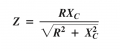
Hmmm... Don't you mean Reactance here? For Impedance, I have it Zc = √(Xc^2 + R^2)

Edit: That didn't copy and paste very well...
 

WBahn

Joined Mar 31, 2012
32,840
Hmmm... Don't you mean Reactance here? For Impedance, I have it Zc = √(Xc^2 + R^2)

Edit: That didn't copy and paste very well...
Nope, I mean impedance.

Impedance is the combination of resistance and reactance, but to be complete it must capture them both, as represented by the phase relationship between the voltage across the impedance and the current through it.

Z = R + jX

The resistance is the real part of the complex impedance, Re(Z) = R, and the reactance is the imaginary part, Im(Z) = X.

Z_R = R : So for a resistor, there is no reactive component and you have R = R and X = 0.
Z_R = jωL : So for an inductor, there is no resistive component and you have R = 0 and X = ωL
Z_C = 1/(jωC) = j(-1/(ωC)) : So for a capacitor, there is no resistive component and you have R = 0 and X = -1/(ωC)

This is why capacitive reactance is a negative quantity.

The formula you have only gives the magnitude of the impedance. But to do most meaningful calculations you also need the phase angle, which is the four quandrant arctangent of X/R, which again underscores the importance of properly keeping the sign of the reactance.
 
Vout = {Vs · [(R1·(R2+R3)) / (R1 + R2 + R3)] / ( [(R1·(R2+R3)) / (R1 + R2 + R3)] + ((Zc·Rc)/(Zc+Rc)) ) } · {R3 / (R2 + R3)}

Hopefully I didn't mess any of that up with all the copy/cut/paste.
You got some parentheses in the wrong places, which caused the final multiplication by R3/(R2+R3) to not be done correctly.
 

Thread Starter

SamR

Joined Mar 19, 2019
5,491
1585067124496.png1585067124496.png
Did I miss something? The only reactive effect is on the parallel Rleak resistor. There is no reactive effect on the series resistors? Am I misinterpreting your Zc as being my Xc? Your R4 is my Rt. Your Rc is my RL and Zc is Xc||RL. I used the expressions I was used to.

EDIT: For Zc this is what I would expect to use:
1585070299191.png

Here are what I came up with: Vo = 1.136V
IMG_0603.png

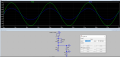
Here is what I am getting from LTS: Vo = 977mVp * 0.707 = 690.739mVrms Doesn't fit either way.
1585068106652.png
 

Attachments

Last edited:

Thread Starter

SamR

Joined Mar 19, 2019
5,491
I went ahead and resolved Zc but still unsure about the reactive effect on Rt. Closer but still no match with LTS.

IMG_0604.JPG
 

Thread Starter

SamR

Joined Mar 19, 2019
5,491
Here is my basic confusion. Which Z prevails? Or do you use both?
IMG_0605[1].JPG.png

I went back and reviewed Grob because I did not remember encountering this. I didn't, it's not in Grob.
It is also not explicitly done in Floyd either. Does one Z prevail over the other or...???
 

WBahn

Joined Mar 31, 2012
32,840
Did I miss something? The only reactive effect is on the parallel Rleak resistor. There is no reactive effect on the series resistors? Am I misinterpreting your Zc as being my Xc? Your R4 is my Rt. Your Rc is my RL and Zc is Xc||RL. I used the expressions I was used to.
I'm not sure exactly what you mean when you talk about "reactive effect".

My Zc is the impedance of just the capacitive portion of the capacitor. So it is CLOSE to your Xc, but your Xc is the absolute value of the reactance. It does not take into account the proper sign of the reactance, or the phase angle information captured by the complex impedance. Yes, my R4 is your Rt.

EDIT: For Zc this is what I would expect to use:
View attachment 202266
That yields the magnitude of the impedance of a pure resistance in parallel with a pure reactance. But it does NOT give you the phase information.

If ALL you want is the magnitude of the impedance of those two components in parallel, then this is fine. But if you want to then do just about anything further, such as add that impedance to something else, you are stuck because you have thrown away necessary information.

Think about that formula a little bit. Does the denominator look familiar? It's the Pythagorean formula and it is for finding the length of the hypotenuse of a right triangle given the length of the two sides. In other words, it requires that the two sides be exactly 90° apart, which is the case for a pure resistance and a pure reactance. But if you then want to add the result to some other value, you no longer are working with a right triangle and so that formula simply doesn't apply. It ONLY works when you are dealing with two quantities that are exactly 90° apart.

Here are what I came up with: Vo = 1.136V


Here is what I am getting from LTS: Vo = 977mVp * 0.707 = 690.739mVrms Doesn't fit either way.
Here's the spreadsheet I threw together.

Z4 is Z1 || (Z1+Z3)
Zct is Zc || Zleak
Ztot is Zct + Z4

1585077712676.png

As you can see, the value of Vo is 978 mV, which is in very close agreement with your simulation results.
 

WBahn

Joined Mar 31, 2012
32,840
Here is my basic confusion. Which Z prevails? Or do you use both?
View attachment 202281

I went back and reviewed Grob because I did not remember encountering this. I didn't, it's not in Grob.
It is also not explicitly done in Floyd either. Does one Z prevail over the other or...???
This is probably because both of those texts (I've never seen either one, so I'm speculating) are having to live within the limits imposed by relying on a slew of formulas to work circuits of different types.

I don't know what you mean with the left hand Z. Is it supposed to be a series combination of C and R2? If so, then that would be wrong because C is not in series with R2. To be in series, whatever current flows in one component MUST flow in the other.

The top two components, C and R1, are in parallel since whatever voltage is appears across C MUST appear across R1.

So let's define Z1 (your right hand Z) as follows

Z1 = (Zc || R1) where Zc is the IMPEDANCE of the capacitor (i.e., 1/(jωC) )

To find the voltage at the middle node, we then just use the voltage divider formula:

Vout = Vin * R2/(R2 + Z1)

But we can't just throw equations that have Pythagorean sums in them because Z1 is not a pure reactance and so it is not at 90° ti R2,
 

Jony130

Joined Feb 17, 2009
5,598
Maybe the Authors did not expect from the reader to do exact calculations, maybe the ballpark calculation is enough for them? Do you know the answer given by a book?
 

WBahn

Joined Mar 31, 2012
32,840
1585079259327.png

You CAN'T do this!!!

Xc and Rl are not in phase with each other -- they are 90° out of phase -- so there magnitudes don't simply add together.
 

WBahn

Joined Mar 31, 2012
32,840
Maybe the Authors did not expect from the reader to do exact calculations, maybe the ballpark calculation is enough for them? Do you know the answer given by a book?
I had the impression that this problem is not from the textbook(s) he's referring to. But I don't see where that's actually stated.

@SamR : Where did this problem originate from? Is it from one of the texts you've been using?
 
Top