Thevenin Equivalent

  • Thread starter Deleted member 983787
  • Start date

Thread Starter

Deleted member 983787

Joined Dec 31, 1969
0
1715220932858.png
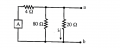
I need to calculate the Thevenin equivalent in A, supposing that A is a current source with I=5A (towards the 4 Ohm resistor) or it is a voltage source with V=50V (the + is towards the 4 Ohm resistor).

My questions are, can I say 80//20 and find the equivalent resistor and then work with that? If I do that, then the Thevenin resistor will be equal to this new equivalent reisistor?

What is going on with Rload?

I apologize if I have misunderstood lots of stuff, I just got introduced to Thevenin Theorem.
 

WBahn

Joined Mar 31, 2012
32,703
If I'm understanding you correct (and I'm not sure I am), then you are being told the following:

The Thevenin equivalent of A is either an ideal 5 A current source (in parallel with some Thevenin (actually Norton) resistance), or it is a 50 V source (in series with some Thevenin resistance).

If that's the case, then you don't need to do any analysis at all of the circuit, just look at how you transform between Thevenin and Norton equivalent circuits.

But, unless they are intentionally giving extraneous information to see if you can filter it out (which is sometimes the case), I suspect that is not what they are asking.

It would probably help if you copied that actual problem statement, so that we can see the fine print in it.
 

Thread Starter

Deleted member 983787

Joined Dec 31, 1969
0
If I'm understanding you correct (and I'm not sure I am), then you are being told the following:

The Thevenin equivalent of A is either an ideal 5 A current source (in parallel with some Thevenin (actually Norton) resistance), or it is a 50 V source (in series with some Thevenin resistance).

If that's the case, then you don't need to do any analysis at all of the circuit, just look at how you transform between Thevenin and Norton equivalent circuits.

But, unless they are intentionally giving extraneous information to see if you can filter it out (which is sometimes the case), I suspect that is not what they are asking.

It would probably help if you copied that actual problem statement, so that we can see the fine print in it.
The Original problem is not in English. I will try to translate it in the most accurate way I can:

"Find the Thevenin equivalent, if Element A is: a) a current source is=5A with upward direction, b) a voltage source Vs=50V with the higher potential terminal upwards"

No, I do not mean that the Thevenin Equivalent of A is either a Current or a Voltage source. I want to find the Thevenin equivalent provided that A is a Current or a Voltage source.

I watched this video where the Thevenin Equivalent of a Current source in a similar circuit is found, but I have not fully understood it, especially when the Thevenin Resistance is found and I am not sure if I am applying well the method provided there.

 
Last edited by a moderator:

crutschow

Joined Mar 14, 2008
38,316
I believe you first want to calculate the voltage between a and b if A is a 5A current source, to get the Thevenin equivalent voltage source, and then calculate the equivalent resistance between a and b (remembering that the resistance of a current source is infinite), to get the Thevenin equivalent resistance.

You then do similar calculations if A is a 50V voltage source.
What is going on with Rload?
What Rload?
 

WBahn

Joined Mar 31, 2012
32,703
Okay, so it's actually two different problems.

One point of ambiguity is whether the 20 Ω resistor is part of the circuit you are finding the Thevenin equivalent of, or whether it is supposed to be treated at the load. As drawn, it is implied that you want the Thevenin equivalent of the whole thing as see looking into terminals a-b. But that begs the question of what the meaning is of the i1 designator. Are you tasked with finding i1 in each case? If so, then you need to treat that resistor as the load for the Thevenin equivalent of everything to the left of it.

Let's assume that you want the Thevenin equivalent of everything.

So pick one of the two problems and draw the circuit. Then use whatever analysis technique you want to find the voltage across a-b. Then turn the source off (i.e., if it's a voltage source, make the voltage across it 0 V, which is the same as replacing it with a short circuit or, if it's a current source, make the current through it 0 A by replacing it with an open circuit). Then calculate the resistance as seen between between a and b.

Show your work, as far as you can go, and we can help you identify and push past wherever you are getting hung up.
 

crutschow

Joined Mar 14, 2008
38,316
Yes, it's not clear if the 20Ω resistor is part of the Thevenin circuit or the load on the circuit.
It would seem to be the load, given its i1 designator.
 

Thread Starter

Deleted member 983787

Joined Dec 31, 1969
0
I made a question to the person that gave me these exercises, he said that the Load is already removed, just the same schematic is used to another problem.

I solved the problem, no more questions from me.
 

WBahn

Joined Mar 31, 2012
32,703
Thanks for the update, and glad you were able to solve it.

Hopefully, by asking the question, the person that provided the exercise realizes that using parts of other problems runs the risk of causing confusion and that that should be taken into account (which is not to say that this is always an easy thing to do).
 
Top