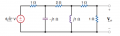
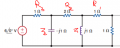
the thevenin resistance is \( R_th = 1\Omega + [ (-j)\Omega // [2\Omega + (j \Omega // (1 \Omega))]] \\ \)The Thevenin resistance is done by setting the source to 0 V and calculating the resistance looking into the output.
You haven't quite done that.
Also, track your units properly!
To calculate the Thevenin voltage, you just find Vo for the circuit as shown -- not modification needed since you aren't treating any of it's components as a load.
What is it that you are finding the Thevenin equivalent for? The entire circuit? Or are you treating the right-most resistor as a load and only finding the Thevenin resistance of everything to the left of it?the thevenin resistance is \( R_th = 1\Omega + [ (-j)\Omega // [2\Omega + (j \Omega // (1 \Omega))]] \\ \)
but \( V_o = \frac{1 \Omega }{1\Omega+R_th} V_th \)
The last equation you gave for Rth (should really be Zth) wasView attachment 309295
Okey im terribly sorry i cause you confusion, okey well im trying to find \( V_o \) which is the right most resistance, so the updated thevenin resistance which i gave is valid, all i need to do is find the thevenin voltage , so i can do source transformation?
im sorry i dont really understand wym by impedance seen by the load, you mean V_o? that mean the equivalent impedance of all the components behind the load, no?salhi, the Thevenin impedance is the impedance seen looking into the output of the network without the load connected (and with the 6 V source replaced with a short), not the impedance at the input of the network seen by the 6 V source.
The expression for Req given in post #1 is for the impedance seen by the 6 V source. The expression for RTh given in post #3 is almost identical to the Req expression with a small change.
The load is the rightmost resistor. Vo is the voltage across that resistor. Vo is a voltage, not a resistor. With the rightmost resistor removed, what is the impedance that would be measured at the place where it was connected.im sorry i dont really understand wym by impedance seen by the load, you mean V_o? that mean the equivalent impedance of all the components behind the load, no?
it would be \( R_{eq} = (R_1 + Z_1 || [(Z_2||R_3) +R_2] ) \) right?The load is the rightmost resistor. Vo is the voltage across that resistor. Vo is a voltage, not a resistor. With the rightmost resistor removed, what is the impedance that would be measured at the place where it was connected.
You must replace the 6 volt source with a short circuit, so the first calculation is R3||Z2, then that is in series with R2. Can you continue on at that point?it would be \( R_{eq} = (R_3 + Z_2 || (R_2 +Z_1) ) \) right?
You are still finding the impedance as seen by the supply voltage on the left.it would be \( R_{eq} = (R_3 + Z_2 || (R_2 +Z_1) ) \) right?

look i've edited my answer previously, what about V_th now?You are still finding the impedance as seen by the supply voltage on the left.
But you looking for the Thevenin equivalent impedance as seen by the load.
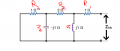
I've suggested several times that you redraw the circuit with the source set to zero and the load removed. Then find the resistance that would be seen if a meter were places across the terminals where the load was previously connected.
This is what you would have if you did that:
View attachment 309735
If you were given this problem, could you find Zth?
This is correct. Now you need put the source back in place and calculate the voltage Vo at the terminals where the load resistor used to be (load resistor still not there).it would be \( R_{eq} = (R_1 + Z_1 || [(Z_2||R_3) +R_2] ) \) right?
I would recommend against editing prior posts in such a way that it changes the meaning (grammar errors or typos is fine).look i've edited my answer previously, what about V_th now?