Facebook
 Google
 GitHub
 Linkedin

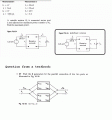
A "resistive network" can consist only of resistors and ideal voltage and current sources. That definition is widespread.I think that is taking it too far. I think "resistive" means that there are not just ideal inductors and capacitors, but that there are some losses. It could include transformers, inductors and capacitors and active devices but not necessarily even actual resistors. For a transistor alone which I think this problem was about, note that h11 (or hie as it is sometimes designated) and h22 (or hoe) are resistive parameters--they're lossy.
Like I said, had the description been "Resistor network" there could be no argument about what that meant. Saying "Resistive network" leaves room for the possibility that it's not just a bunch of resistors (and I would rule out negative resistors if it had said "Resistor network"). It's possible the instructor could have defined "Resistive network" to be distinct from "Resistor network".
I was reading it as a resistor network and missed the distinction. Since a resistive network can contain controlled sources, it can model the simple behavior of a transistor. So my objection to that label was misplaced.