Thevenin equivalent of two-ports network

WBahn

Joined Mar 31, 2012
33,047
Hi,

The thing i did not like was that they had shown the current arrow as being the current through the resistor Ro, so if you short V2 then I2 must equal zero. This led me to believe that the schematic was a little deceiving.
Yours is also the current through the resistor Ro. You just moved an arrow to a different place on the same wire. The current through the your arrow is the current through Ro to the exact same degree that the current through the original arrow was.

You have the same issue with the short.

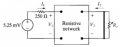
Let's short the original drawing:
short1.png

The current in Ro is zero but the current I2 is the current coming up through the short. The voltage V2 is zero.

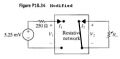
Now let's short your drawing:
short2.png

Gee, the current I2 must be zero since it is still the current going through Ro.

It all depends on where you draw the short.

Since open-circuit and closed-circuit network parameter measurements are well defined, there is no problem. If there is a problem, then it is probably indicative of a deeper lack of comprehension on the student's part, so better to get it out into the open and resolved.
 

MrAl

Joined Jun 17, 2014
13,751
Yours is also the current through the resistor Ro. You just moved an arrow to a different place on the same wire. The current through the your arrow is the current through Ro to the exact same degree that the current through the original arrow was.

You have the same issue with the short.

Let's short the original drawing:

View attachment 140325

The current in Ro is zero but the current I2 is the current coming up through the short. The voltage V2 is zero.

Now let's short your drawing:

View attachment 140326

Gee, the current I2 must be zero since it is still the current going through Ro.

It all depends on where you draw the short.

Since open-circuit and closed-circuit network parameter measurements are well defined, there is no problem. If there is a problem, then it is probably indicative of a deeper lack of comprehension on the student's part, so better to get it out into the open and resolved.
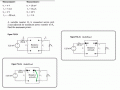
No that is not where the short is applied. When a short is applied, it must be outside of I2. I specifically gave instructions with my schematic on where to place the short, which was from the V2 plus to the V2 minus through the symbol "V2". That should be clear.

If you really do want to place the short there then you must place I2 even farther inside. That should be valid too, but the original argument was not that "something is not wrong", it was that "something is wrong". You've proved what i was saying a second time so you should be able to see my point now.

See attachment.
One of the points was that I2 must always be INSIDE the network, never outside of it.
I2 must be a measure of either V2 or Ro current always.
 

Attachments

Last edited:

WBahn

Joined Mar 31, 2012
33,047
No that is not where the short is applied. When a short is applied, it must be outside of I2. I specifically gave instructions with my schematic on where to place the short, which was from the V2 plus to the V2 minus through the symbol "V2". That should be clear.

If you really do want to place the short there then you must place I2 even farther inside. That should be valid too, but the original argument was not that "something is not wrong", it was that "something is wrong". You've proved what i was saying a second time so you should be able to see my point now.

See attachment.
One of the points was that I2 must always be INSIDE the network, never outside of it.
I2 must be a measure of either V2 or Ro current always.
It seems like you are sayiing that the problem with the original rendition is that someone has to tell you what to do in order to get the correct results (namely place the short outside the arrow). Yet to get the correct results with your rendition, people have to follow what you tell them in order to place the short (namely, outside the arrow).

So what's the difference? In both cases, if the arrow is interpreted as being the current at THAT spot in that wire, the person has to be told to place the short outside of it (relative to the terminals).

But long-established standard practice is that the specified current is understood as being the current entering the associated port terminal and the voltage is understood as being the voltage across the port terminals. Showing both designators on the wires is merely long-accepted convention to keep the diagram neat. You could connect additional wires to directly to the terminal and it should still be understood that I2 is the total current entering the terminal.
 

MrAl

Joined Jun 17, 2014
13,751
It seems like you are sayiing that the problem with the original rendition is that someone has to tell you what to do in order to get the correct results (namely place the short outside the arrow). Yet to get the correct results with your rendition, people have to follow what you tell them in order to place the short (namely, outside the arrow).

So what's the difference? In both cases, if the arrow is interpreted as being the current at THAT spot in that wire, the person has to be told to place the short outside of it (relative to the terminals).

But long-established standard practice is that the specified current is understood as being the current entering the associated port terminal and the voltage is understood as being the voltage across the port terminals. Showing both designators on the wires is merely long-accepted convention to keep the diagram neat. You could connect additional wires to directly to the terminal and it should still be understood that I2 is the total current entering the terminal.

Well that is one of the other things i should have mentioned, is that the two dots are drawn inside the block so it is already unclear because the symbol "V2" is OUTSIDE the block and that is customary to short, while the two "dots" on the right (and left) are drawn inside the block. So where to place the short is also a question. Do we place the short outside the block or inside the block? Since V2 is outside the block that's where i placed my short and therefore drew the arrow for I2 inside the block. Where you draw your arrow would have to be even farther inside the block.

What you are saying is good i think because we traditionally "know" how to handle this, but newcomers could be confused when we try to say, "we know how to do it because we know how to do it, too bad if you dont".

Note also that the plus and minus symbols for V2 are drawn outside the block, so why would you short the V2 inside the block?

And you see now no matter how we interpret it, there is a problem in the diagram itself. In other words, a better diagram would help.

Dont you at least agree that a better diagram would help?
 

JoeJester

Joined Apr 26, 2005
4,390
If one takes the "resistive network" as valid, the question is improper.

I'd throw it back to the professor to clarify the question. Let them OWN it and decide on changing it to a 2 port network. Is it our job to interpret poor work by the professor?

This reminds me of those multipage tests that start out with "read the whole test before beginining" with the last question stating "sign your name and turn the test in."

I think it's about time to hold the professors accountable for any and all errors on their product. And yes, once they "procured or stole" a question from a book, they OWN it and all errors within.

I seriously doubt WBahn would produce sloppy work without correcting it upon notification. I would think those professors who visit here would be of the same character.

Analysis aside, build the resistive network that satisfies those readings.
 
Last edited:

WBahn

Joined Mar 31, 2012
33,047
And you see now no matter how we interpret it, there is a problem in the diagram itself. In other words, a better diagram would help.

Dont you at least agree that a better diagram would help?
Yes and no. Almost any diagram can be misinterpreted in seemingly reasonable ways if you try hard enough. So you could go through and make the diagrams pretty much bulletproof so that it is very difficult to misinterpret them without becoming unreasonable in the process.

But is that necessarily good?

If ALL diagrams were drawn that way without fail, then there would be little downside. But all diagrams, particularly out in the read world, AREN'T drawn that way. Diagrams like this are not at all uncommon. So it is probably just as well that students get exposure to less-than-stellar diagrams early on. Not only does it prepare them to better interpret what they will see once an instructor is no longer there to guide them, but it also helps them develop the reasoning skills to ask themselves what is and isn't a reasonable interpretation early on in their education, which will benefit them more than being able to play trained monkey until they graduate because everything was carefully packaged up so nice and neat for them while in school.
 

JoeJester

Joined Apr 26, 2005
4,390
@WBahn,

So, if this was your work and the student came back to you stating the problem with the drawing ... would you send them away, telling them to get use to it?

Of course, I'm assuming the student would have the wherewithall to approach you. Some professors will display the aire of being unapproachable, making it more difficult for a student to approach them.
 

WBahn

Joined Mar 31, 2012
33,047
@WBahn,

So, if this was your work and the student came back to you stating the problem with the drawing ... would you send them away, telling them to get use to it?
Absolutely not!

As I've said, the value of using drawings like what they will see in practice, even if they aren't squeaky clean, is precisely so that if students are going to have problems with them they get to do so in an environment in which, if it becomes an issue, it can get addressed.

Of course, I'm assuming the student would have the wherewithall to approach you. Some professors will display the aire of being unapproachable, making it more difficult for a student to approach them.
I try not to be one of those. Students that just want me to give them the answer to problems without them having to put forth any effort complain about me. But students that are willing to work a bit quickly discover that I will spend literally hours working with them, at whatever pace is needed, to move them along.
 

JoeJester

Joined Apr 26, 2005
4,390
@WBahn,

If you were unapproachable, I truly would be shocked. You demonstrated here your concern for those seeking help.

My problem with "bad" documents is they have little value in the initial training phase. It demonstrates bad habits. If the professor has bad habits, so will the students. I don't mean making mistakes now and then as everyone is susceptible to those errors. Now, if the TS were in their final year, I would assume a little more experience than one in their first year and they should be able to discriminate between good and bad documentation because by that time, they will experience both.

I'm sure your days in college after your stint in the AF, you probably had TAs giving out bad information that caused you grief. A friend of mine called me a few times during my final years in the service to complain about some adjunct professor at a community college with poor instructor abilities, whether it was caused by lack of preparedness or just outright in the don't give a shit mode, we could never ascertain. My friend was a former instructor as well.

I would be the cynical sob who would write the problem was invalid and turn it in. My ducks would be in a row for the eventual appeal of a lousy grade as well.

Accepting substandard work is one thing I avoid.

I'm thinking the TS, upon seeing that "Resistive Network" label was racking their brains on "how in the world were those results possible." I know those were my thoughts.

I hold poor documentation with respect to questions in the same vein that you hold "tracking the units" Tracking your units tells me a lot about your standards as an instructor.
 
I can imagine how the problem author might say something like this:

The descriptive phrase on the two-port says "Resistive network", not "Resistor network". Saying "Resistor network" is the same as "Network composed of resistors", whereas "Resistive network" doesn't necessarily mean that the network is composed of only resistors, but that it is lossy in the sense that some power will be dissipated in the network, unlike a matching network composed of only L and C.

The student has probably been studying transistors and their two-port representations and might be expected to recognize that a two-port with gain is likely a transistor, which is a circuit element whose two port representation has some resistive parameters.

And, of course, there's always the old fallback of teachers everywhere when a student complains that a question is unclear--"Give the best answer".
 
Last edited:

WBahn

Joined Mar 31, 2012
33,047
@WBahn,

If you were unapproachable, I truly would be shocked. You demonstrated here your concern for those seeking help.

My problem with "bad" documents is they have little value in the initial training phase. It demonstrates bad habits. If the professor has bad habits, so will the students. I don't mean making mistakes now and then as everyone is susceptible to those errors. Now, if the TS were in their final year, I would assume a little more experience than one in their first year and they should be able to discriminate between good and bad documentation because by that time, they will experience both.
I agree. The care taken on everything in a first-year course needs to be higher than in a final-year course. But I'd point out that they will only be able to discriminate between good and bad documents in their later courses only if we allow them to experience both in their earlier courses.

That doesn't mean that we have to intentionally make bad materials to get this across -- there is plenty of it that will come about naturally, either in the prepackaged stuff we give out or the stuff we develop ourselves. But in earlier courses we should examine the material and see if we can spot weaknesses and then point it out explicitly to the class and mention the different ways it could be interpreted, what the most reasonable way(s) to interpret it are, and how it might be changed to improve it. Regardless of what level the course is at, when I find such a weakness in an item I've prepared, I try to improve it before using it again. In later year courses, I'm much more likely to not mention issues I'm aware of if I think that the intent should be readily discernible. Also, when a student approaches me about a point of confusion, I'll generally just tell the student my observations if they are early in their courses but expect them to walk me through their observations if they are later on.

I'm sure your days in college after your stint in the AF, you probably had TAs giving out bad information that caused you grief. A friend of mine called me a few times during my final years in the service to complain about some adjunct professor at a community college with poor instructor abilities, whether it was caused by lack of preparedness or just outright in the don't give a shit mode, we could never ascertain. My friend was a former instructor as well.

I would be the cynical sob who would write the problem was invalid and turn it in. My ducks would be in a row for the eventual appeal of a lousy grade as well.
Depending on the specifics, we might have a difference of opinion, here. My comeback would likely be along the lines of asking you if that is the approach you plan to take with your customers in a few months after you graduate. If they give you an ambiguous specification, are you just going to tell them it's invalid but still demand payment of the agreed upon price? Or are you going to consider it sufficiently to be able to explain why it is ambiguous and ask them which, if any, of the different reasonable interpretations they meant? I can't count the number of times I've had to do this on real-world projects -- in fact, I'm not sure I've ever worked on a real-world project where this hasn't had to be done at several points. I don't think it's too unreasonable to expect similar behavior from students -- particularly final year or graduate students.

Or, if that is not possible for some reason, would you proceed by choosing the interpretation you believe to be most reasonable, performing the work (to a reasonable point), and submitting it along with and explanation of the ambiguity and the interpretation you chose? I'm thinking of a proctored exam situation in the academic world (or homework being done the night before it's due), but I've had to do this on a number of real-world projects, too. Sometimes deadlines could only be met if we proceeded while waiting for a response from the customer (which often involved them communicating with THIER customer). We would hedge our bets as much as possible and try to make the design adaptable to different interpretations. Usually the amount of rework that needed to be done was fairly minor compared to the bulk of the effort and so we could still meet schedule. Sometimes we had to proceed this way because it was the only way we could figure out how to identify and convey the concerns to the customer.

When grading the work, I will always grade it based on their stated interpretation. Now, I will also grade the reasonableness of the interpretation, too, but I give the benefit of the doubt to the student as much as reasonable.

Accepting substandard work is one thing I avoid.

I'm thinking the TS, upon seeing that "Resistive Network" label was racking their brains on "how in the world were those results possible." I know those were my thoughts.
I don't know if the "Resistive Network" bothered them at all. Notice that they made no mention of what might or might not be in the box or that they thought that the results were impossible. They had simply plugged and chugged and got an answer that was different from the author's.

Having said that, I consider the "Resistive Network" label a far more serious flaw than where the current labels are placed. It conveys information that, if considered thoughtfully, makes it impossible to accept the measurement data provided as consistent with that explicit information. If a student spotted it and couldn't ask for clarification on it, I would still expect them to not just through up their hands, but rather note the issue and proceed as best they can. The most reasonable thing to do there is to accept the measurement data as valid, work the problem, and put a caveat on the answer that the results are inconsistent with the claim of a resistive network. That student would get a significant patch of extra credit. The student that just noted that it was invalid and didn't make any attempt to work the problem would likely get a fair spot of partial credit for being able to spot the discrepancy. How much would depend on my take on that particular student, though.

Also, since the student has presumably been taught what two-port networks are, how the parameters are defined, and how they are measured, making the correct interpretation about how to proceed should be within their grasp.

I hold poor documentation with respect to questions in the same vein that you hold "tracking the units" Tracking your units tells me a lot about your standards as an instructor.
Thanks. Unfortunately, the quality of documentation is a continuous sliding scale. It is hard to get it perfect, even at the scale of problem statements. The real question is where does it cross the line between "acceptable" and "not acceptable"?
 

MrAl

Joined Jun 17, 2014
13,751
Yes and no. Almost any diagram can be misinterpreted in seemingly reasonable ways if you try hard enough. So you could go through and make the diagrams pretty much bulletproof so that it is very difficult to misinterpret them without becoming unreasonable in the process.

But is that necessarily good?

If ALL diagrams were drawn that way without fail, then there would be little downside. But all diagrams, particularly out in the read world, AREN'T drawn that way. Diagrams like this are not at all uncommon. So it is probably just as well that students get exposure to less-than-stellar diagrams early on. Not only does it prepare them to better interpret what they will see once an instructor is no longer there to guide them, but it also helps them develop the reasoning skills to ask themselves what is and isn't a reasonable interpretation early on in their education, which will benefit them more than being able to play trained monkey until they graduate because everything was carefully packaged up so nice and neat for them while in school.
Yes you are right, so from now on we need to change all the circuit diagrams that come through here so we can make the student guess where the current is supposed to be. Why draw it correctly right? That will make it too easy for the student who barely understands the subject material itself yet.

I asked:
"dont you think a better diagram would help"

you answered:
"yes and no".

So it looks like you could not answer "yes" because something is stopping you from agreeing with some things that are perfectly reasonable. A "better thing" is by definition "better", therefore you can not say that a better thing is not better.

The most amazing thing about your reply though is that you are saying that a misdrawn schematic is better because it makes the student work harder.

If you look at the other thread where i posted a "side note" you can see that drawing is correct and very hard to misinterpret, yet i caught the problem with this threads circuit diagram almost right away as soon as i saw it. The other drawing isnt perfect either, but harder to take wrong because the head of the arrow is INSIDE the network to the LEFT of the voltage source on the right.

The other question about the "resistive" part is also interesting.
 
Last edited:

MrAl

Joined Jun 17, 2014
13,751
@WBahn,

So, if this was your work and the student came back to you stating the problem with the drawing ... would you send them away, telling them to get use to it?

Of course, I'm assuming the student would have the wherewithall to approach you. Some professors will display the aire of being unapproachable, making it more difficult for a student to approach them.
Hi,

I was as shocked as you are by the reply by WBahn. I just think he's in a disagreeable mood :)
If not, maybe we should start drawing our current arrows anywhere we feel like it, then telling the student to guess where it goes :)
If it's one thing i hate to see, it's a "better" schematic :)
I really hate that :)
 

MrAl

Joined Jun 17, 2014
13,751
I can imagine how the problem author might say something like this:

The descriptive phrase on the two-port says "Resistive network", not "Resistor network". Saying "Resistor network" is the same as "Network composed of resistors", whereas "Resistive network" doesn't necessarily mean that the network is composed of only resistors, but that it is lossy in the sense that some power will be dissipated in the network, unlike a matching network composed of only L and C.

The student has probably been studying transistors and their two-port representations and might be expected to recognize that a two-port with gain is likely a transistor, which is a circuit element whose two port representation has some resistive parameters.

And, of course, there's always the old fallback of teachers everywhere when a student complains that a question is unclear--"Give the best answer".
Hi,

Yes that question is interesting too. I take "resistive" to mean that there are no inductors or capacitors so we do not get any exponential or sinusoidal response part. In other words, a static network that essentially responds immediately to any stimulus. I did not specifically think about any DC gain though and figured that just becomes implied and may not need to be addressed separately unless we get curious.
 

JoeJester

Joined Apr 26, 2005
4,390
Unfortunately, the quality of documentation is a continuous sliding scale.
That does not relieve one of the responsibility of pointing it out and contacting the offending party. Irrespective of the source, once an instructor or professor decides to use it, they own it, warts and all, and should correct the same if they continue to use it. It does not bode one's professional appearance to be so damn sloppy.

Now if it is a textbook problem, the students need to know where the publisher posts the errata sheets for that textbook and the methodology for submitting errors.

Accepting substandard performance is not the proper protocol.

There is a reason the "rules" of the homework section asks for the "source" of diagrams.

Copy and pasting, anything, can lead to problems and due diligence must be exercised. The professors failure to exercise due diligence speaks volumes of their standards. Being too busy is not an acceptable response to that failure.

I once notified the FCC that one of the questions in their pool had some errors with diodes specifications. That pool has been superseded well after my notification, but I did determine the source were copy and paste errors. Their response was the end user owns the question pool if they use it. The FCC wasn't going to take any action.
 

WBahn

Joined Mar 31, 2012
33,047
Yes you are right, so from now on we need to change all the circuit diagrams that come through here so we can make the student guess where the current is supposed to be. Why draw it correctly right? That will make it too easy for the student who barely understands the subject material itself yet.
If that is your takeaway from my response, then there is no point even attempting to discuss it with you further.
 
Hi,

Yes that question is interesting too. I take "resistive" to mean that there are no inductors or capacitors so we do not get any exponential or sinusoidal response part. In other words, a static network that essentially responds immediately to any stimulus. I did not specifically think about any DC gain though and figured that just becomes implied and may not need to be addressed separately unless we get curious.
I think that is taking it too far. I think "resistive" means that there are not just ideal inductors and capacitors, but that there are some losses. It could include transformers, inductors and capacitors and active devices but not necessarily even actual resistors. For a transistor alone which I think this problem was about, note that h11 (or hie as it is sometimes designated) and h22 (or hoe) are resistive parameters--they're lossy.

Like I said, had the description been "Resistor network" there could be no argument about what that meant. Saying "Resistive network" leaves room for the possibility that it's not just a bunch of resistors (and I would rule out negative resistors if it had said "Resistor network"). It's possible the instructor could have defined "Resistive network" to be distinct from "Resistor network".
 

WBahn

Joined Mar 31, 2012
33,047
That does not relieve one of the responsibility of pointing it out and contacting the offending party. Irrespective of the source, once an instructor or professor decides to use it, they own it, warts and all, and should correct the same if they continue to use it. It does not bode one's professional appearance to be so damn sloppy.

Now if it is a textbook problem, the students need to know where the publisher posts the errata sheets for that textbook and the methodology for submitting errors.

Accepting substandard performance is not the proper protocol.

There is a reason the "rules" of the homework section asks for the "source" of diagrams.

Copy and pasting, anything, can lead to problems and due diligence must be exercised. The professors failure to exercise due diligence speaks volumes of their standards. Being too busy is not an acceptable response to that failure.

I once notified the FCC that one of the questions in their pool had some errors with diodes specifications. That pool has been superseded well after my notification, but I did determine the source were copy and paste errors. Their response was the end user owns the question pool if they use it. The FCC wasn't going to take any action.
I don't disagree with anything you are saying here, but I also don't see how it changes the fact that the quality of documentation that we have to deal with spans a continuous spectrum.

I've notified numerous authors of errors in their texts and have been acknowledged in the next editions on several occasions.

Once I was looking for information on the IRS website and was looking through their spreadsheets and found a column that was calculated incorrectly in the data from a few years prior. I sent them feedback expecting that it would never get dealt with. I was very pleasantly surprised when I went back a couple weeks later and it had been fixed.
 

JoeJester

Joined Apr 26, 2005
4,390
The student has probably been studying transistors and their two-port representations and might be expected to recognize that a two-port with gain is likely a transistor, which is a circuit element whose two port representation has some resistive parameters.
We don't know what the student knows. I could say he probably was studying nuclear physics, but that doesn't make it so. If there was a source of the question, assuming it was taken from a text book, we might be able to validate the hypothesis about the student studying transistors.
 

MrAl

Joined Jun 17, 2014
13,751
If that is your takeaway from my response, then there is no point even attempting to discuss it with you further.
Hello again,

I was being sarcastic so as to hopefully get through to your basic sense of reason.
Sometimes we dont agree on things that other people say right away but then later we think about it and realize there is a lot of sense in waht was said, but when we disagree on the first take sometimes it is tempting to try to support that even when the facts change. We have to be ready to change when the facts change.

We can discuss in PM's if you like rather than take any more room here.
 
Top