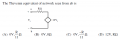
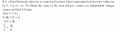
I assumed a test voltage of 1 V applied across ab.
That makes Vx=+1V.
So the equation turn out to be
-1+R*I+12=0
I=-(11/R).
Rth will be Vx/I=-(R/11). Here I am having a doubt. How can we have a negative resistance. I have never encountered a negative resistance until now.
I am assuming that the direction of current is the reverse of what I took hence the resistance should be R/11 instead of it being negative.
Please help me out!!
It's good that you are asking whether your answer makes sense. So few people do. But if you conclude that your answer doesn't make sense, then all you can conclude is that your answer is wrong. You can't just change your answer to patch what doesn't make sense because your answer is your answer and if it is wrong then it is wrong. You have to go back and figure out what is wrong. There is absolutely no basis for believing that multiplying a wrong answer by -1 is going to somehow magically make it right.
So you go back and work the problem again more carefully and come up with the same answer. So then you should go back and work the problem again via some different route and if you still get the same answer then it is definitely time to start considering whether the answer really does make sense and the problem is just your understanding of what does and doesn't make sense.
What would a negative resistance mean? All it would mean is that if you apply a positive test voltage to the circuit using a test source that current is driven back into the source. Is that possible? Sure, provided the circuit you are connecting the source to has a way to deliver power to the test source and that the more voltage you apply the more current is driven into the test source, which usually means that you have some kind of dependent source in the circuit.
But if you conclude that your answer doesn't make sense, then all you can conclude is that your answer is wrong. You can't just change your answer to patch what doesn't make sense because your answer is your answer and if it is wrong then it is wrong. You have to go back and figure out what is wrong. There is absolutely no basis for believing that multiplying a wrong answer by -1 is going to somehow magically make it right.
But isn't it the way we are taught networks. I have always used this procedure of multiplying current by -1. Yes, you do sound logical when you talk about other approaches yielding the same result.
What would a negative resistance mean? All it would mean is that if you apply a positive test voltage to the circuit using a test source that current is driven back into the source. Is that possible? Sure, provided the circuit you are connecting the source to has a way to deliver power to the test source and that the more voltage you apply the more current is driven into the test source, which usually means that you have some kind of dependent source in the circuit.
Can we practically make a negative resistance without the help of tunnel diode (I have very little knowledge about both negative resistance and tunnel diode) as is the case here?
Can we practically make a negative resistance without the help of tunnel diode (I have very little knowledge about both negative resistance and tunnel diode) as is the case here?
One way to interpret a negative sign is to look at the current. In the beginning you assumed that the current is going in one direction, you gave that direction a positive sign, you have a positive current. Now you solved the equations and you have negative sign. You can give that negative sign to the current, you now have negative current. What does that mean? It means that your earlier assumption was wrong. You assumed that current is going to direction A, when in fact the current is going in direction B. So just switch current direction and the negative sign will go away.
In your specific example you don't say in what direction the current I is. I will assume that the current I is leaving terminal a. That makes current I in clockwise direction. Your solution is: V=(R/11)(-I). So just switch the direction of current I. The new direction of current I is counter clockwise, now I is positive and solution becomes: V=(R/11)(I)
V/I=R/11
I don't follow. Are you saying that you are taught that if your answer is doesn't make sense to multiply it by -1 in order to correct it? Does THAT make sense?
Can we practically make a negative resistance without the help of tunnel diode (I have very little knowledge about both negative resistance and tunnel diode) as is the case here?
Yes, although because a tunnel diode is a passive component we don't get a large-signal negative resistance but only a small-signal negative resistance around a certain large-signal operating point. Basically, as we start increasing the signal voltage our signal current increases. But at some point it peaks and after that, as we continue to increase the signal voltage, the signal current actually decreases for a while. Then we get a minimum and, as we continue increasing the signal voltage the signal current once again increases. Within the region where the signal current decreases with increasing signal voltage we can model the device as having a negative resistance.
One way to interpret a negative sign is to look at the current. In the beginning you assumed that the current is going in one direction, you gave that direction a positive sign, you have a positive current. Now you solved the equations and you have negative sign. You can give that negative sign to the current, you now have negative current. What does that mean? It means that your earlier assumption was wrong. You assumed that current is going to direction A, when in fact the current is going in direction B. So just switch current direction and the negative sign will go away.
In your specific example you don't say in what direction the current I is. I will assume that the current I is leaving terminal a. That makes current I in clockwise direction. Your solution is: V=(R/11)(-I). So just switch the direction of current I. The new direction of current I is counter clockwise, now I is positive and solution becomes: V=(R/11)(I)
V/I=R/11
We are not talking about arbitrary choices of signal polarities (basically taking an initial guess) and then changing them later based on whether we guessed wrong or not. Resistance is defined according to the passive sign convention meaning that positive current flows into the positive voltage terminal. He assumed that Ix (the test current) was leaving the positive terminal of Vx (the test voltage), which is consistent with the passive sign convention (though I agree that he should have stated this or annotated the diagram). Your definition of I violates the passive sign convention and so if you are using it to find R, you are actually finding (-R).
I don't follow. Are you saying that you are taught that if your answer is doesn't make sense to multiply it by -1 in order to correct it? Does THAT make sense?
One way to interpret a negative sign is to look at the current. In the beginning you assumed that the current is going in one direction, you gave that direction a positive sign, you have a positive current. Now you solved the equations and you have negative sign. You can give that negative sign to the current, you now have negative current. What does that mean? It means that your earlier assumption was wrong. You assumed that current is going to direction A, when in fact the current is going in direction B. So just switch current direction and the negative sign will go away.
In your specific example you don't say in what direction the current I is. I will assume that the current I is leaving terminal a. That makes current I in clockwise direction. Your solution is: V=(R/11)(-I). So just switch the direction of current I. The new direction of current I is counter clockwise, now I is positive and solution becomes: V=(R/11)(I)
V/I=R/11
I think you mentioned diode... I assumed that we were looking at material from second year circuits analysis class, no diodes. What material are we looking at? Are you studying diodes and are we looking at the material that is teaching you about modeling diode in some specific case?
I think you mentioned diode... I assumed that we were looking at material from second year circuits analysis class, no diodes. What material are we looking at? Are you studying diodes and are we looking at the material that is teaching you about modeling diode in some specific case?
Yes this is very much simple network analysis no diodes involved. I was just curious about the practical significance of this negative resistance thing. Yes I have a little knowledge about diodes but this particular problem is not remotely related to diode.
Only if he is satisfied with having the wrong answer.
There is more than a minor difference between having an equivalent resistance of (R/11) and having an equivalent resistance of (-R/11).
Don't believe me?
Set R=22Ω and then connect your Thevenin equivalent circuit consisting of Rth=22Ω/11=2Ω and connect it to a 10V source connected in series with a 1Ω resistor. How much power is dissipated in the 1Ω resistor. Now do the same but use a Thevenin equivalent circuit consisting of Rth=-22Ω/11=-2Ω.
Makes a different, doesn't it?
But which is right?
Well, plug the same source and resistor into the original circuit and do the analysis. Which is right?
Only if he is satisfied with having the wrong answer.
There is more than a minor difference between having an equivalent resistance of (R/11) and having an equivalent resistance of (-R/11).
Don't believe me?
Set R=22Ω and then connect your Thevenin equivalent circuit consisting of Rth=22Ω/11=2Ω and connect it to a 10V source connected in series with a 1Ω resistor. How much power is dissipated in the 1Ω resistor. Now do the same but use a Thevenin equivalent circuit consisting of Rth=-22Ω/11=-2Ω.
Makes a different, doesn't it?
But which is right?
Well, plug the same source and resistor into the original circuit and do the analysis. Which is right?

 Facebook
 Google
 GitHub
 Linkedin