thevenin diode calculation

Thread Starter

fran1942

Joined Jul 26, 2010
58
Hello, can someone please help with this.
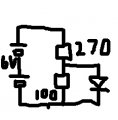
I have a diode circuit and my lecturer has explained how using a Thevnin calculation we can get the current value of 12mA.

The two resistors are 100 and 270 Ohm.
The diode has 10 Ohm dynamic resistance

As I understand, the:
Thevenin resistance is 1/Rt = 1/R1 + 1/R2 = 73 Ohm
Thevenin voltage is 100/370 x 6V = 1.62 - 0.6(diode voltage) = 1.02V.

= 1.02/73+10(Diode dynamic resistance)

= 12mA

My questions are:

- does this mean the current through the diode is 12mA ?
- how would you calculate this using standard Ohms laws rather than a Thevenin equivalent, or would you not ?
 

Attachments

hobbyist

Joined Aug 10, 2008
892
Your thevenin voltage would be the voltage drop across the 100 ohm resistor.

(6v. x 100) / (100 + 270)

When you thevenize, you remove the output in question (diode this case), then solve for the thev. res. and thev. volt.
Then redraw this config, as a thev.voltage source in series with thev res, then place across thiese terminals the output device, (diode). Then you could use ohms law, or any other theorem to solve for volts. and currents. etc...
 
Last edited:
I imagine you would need to use the Schottky equation to find that value without thevinising the circuit, but to do that you would need to know the saturation current value, which you havent been given.
 

Thread Starter

fran1942

Joined Jul 26, 2010
58
thanks kindly for your help, but can you explain why the Thevenin voltage would be the drop across the 100 ohm resistor rather than the drop across the 270 ohm resistor.

Thanks


Your thevenin voltage would be the voltage drop across the 100 ohm resistor.

(6v. x 100) / (100 + 270)
 

JoeJester

Joined Apr 26, 2005
4,390
thanks kindly for your help, but can you explain why the Thevenin voltage would be the drop across the 100 ohm resistor rather than the drop across the 270 ohm resistor.
Your diagram shows the load connected across the 100 ohm resistor. As such, that will be the Thevenin voltage seen by the diode. When you connect the diode to that potential, it will conduct with a maximum current allowed by the Thevenin resistance.

Your instructor was correct.
 

joejoenikk

Joined Nov 23, 2011
9
I was looking for a method of calculating the Tv impedance of a zener circuit when I bumped into this page. I've just started back into electronics, and I liked the idea of it. I obviously need help, so I registered.


To help the students that bum into this post, while I'm fresh at remembering what the teachers and engineers taught me years ago.....

Because we are only using mathematics as a tool, and Ohms law is the root of all of our instruments, we all agreee to always find the algebraic solution. It is our only communications with those guys that sell Diodes, worship Einstein's Tensor geometry and passed calculus. By that method, we already know all of the possible the Roots of the equation.

Awnser: First use the process of elimination and ohms law. The voltage is the same in all the parallel circuits..... (In remembering the way that the question was designed from years ago, I'm quite happy that teachers still copy curriculums from the instument manufacturer's. You would only have a practical need to do that if you were to test the quality contoll of the diode.)

Anyone ever try to design a NPN Quasi LDO based on the Tv impedances? One thing that I'm certain of is that the manufacturer of my project power supply only calcualted the Tv equivalent of a good design.(Trio Instruments of Japan. AKA Kenwood and the very reason why I bought it.) It may seem to be a foolish question to ask at a school forum, but if there is an accepted method, then I prefer to using it rather than impose on the guys that design valve power supplies.
 
Top