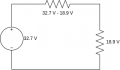
Question 7 from Thevenin worksheet

Thread Starter

Ldaxar

Joined Feb 27, 2025
14

ericgibbs

Joined Jan 29, 2010
21,432
Hi LD,
One reading 18.9v is when the PSU is loaded and the 32.7V is the off load open circuit voltage of the PSU.
E
QUOTE: for example these measurements, under loaded and no-load conditions
 

Thread Starter

Ldaxar

Joined Feb 27, 2025
14
Hi Eric,

Yeah but load shouldn't change the voltage at the terminals of a PSU right? Maybe I just don't understand how voltage works.

I get why there's no current when the load is disconnected - there's no viable path for electrons to flow.

But when we talk about voltage, if load is connected then it should drop the whole voltage so the reading at the terminals will be 32.7V. If load is disconnected and we assume that the other terminal is at 0V, then the voltage will still be 32.7V.

- LD
 

ericgibbs

Joined Jan 29, 2010
21,432
hI Ld,
Using the voltages of the PSU, on load and off load, and the on load current what do you calculate the internal impedance of the PSU.?
E
 

BobTPH

Joined Jun 5, 2013
11,498
Hint: What if the voltage source has a resistor in series with it? A resistor internal to it. Would the voltage at the terminal drop then when a current is drawn?
 

MrAl

Joined Jun 17, 2014
13,696
I'm talking about question 7 from this worksheet: https://www.allaboutcircuits.com/worksheets/thevenins-nortons-and-maximum-power-transfer-theorems/

I'm confused as to why voltmeter readings on both graphics are different (18.9V vs 32.7V). The way that I see it, when metal is welded circuit gets closed and welded area acts sort of like a resistor:
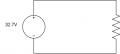
View attachment 345905

Loaded or not, if we measure at the terminals of power source whole voltage should be dropped right?
Hi,

As others have said, when you load a voltage source sometimes it decreases. The amount it decreases tells you if it is working correctly or not. If it drops too much then it is not working right or the applied load is just too heavy.

The only kind of voltage source that does not load at least a little is a purely theoretical voltage source. That would be said to have zero output impedance. All other sources will have some decrease in voltage when a load is applied. If it is a good power supply it will not load too much with a load it is meant to be able to handle, but if you overload it the voltage will drop anyway.

What is that 32.7v source, is that a battery, a set of batteries, or a power supply of some sort? If it is a power supply what kind of power supply is it.
 

Thread Starter

Ldaxar

Joined Feb 27, 2025
14
Sorry for perhaps a silly question, but how do you know that internal resistance of PSU is in series with the load? Is it solely based on voltmeter readings? I guess it makes sense, since had they been in parallel, voltage would read the same with and without load.

Solution for completeness:
Circuit with load attached and voltages being dropped by each of the resistors:
wel_sol1.png
Current is 135A so we can use Ohm's law to calculate the resistance of a first resistor in series:
\[ R = \frac{32.7 - 18.9}{135} = 102.2 m\Omega \]
This is actually a Thevenin circuit. Single voltage source, single "internal resistor" and single load - all in series.

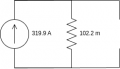
All that's left to do is to transform it into Norton's circuit. Thevenin and Norton resistances are the same so resistors stay the same. We just re-wire them in parallel. All that's left is to transform Thevenin voltage into Norton current:
\[ I_{\textit{Norton}} = \frac{32.7}{0.1022} = 319.9 A \]
Final circuit:
wel_sol2.png

As always - thanks for the tips guys!

- LD
 

Jony130

Joined Feb 17, 2009
5,596
Sorry for perhaps a silly question, but how do you know that internal resistance of PSU is in series with the load?
If we put our PSU or any device in the black box and only have access to A and B terminals. We can try to guess what's inside the black box.
We can measure the open circuit voltage (Vth). Also, we can connect a load and measure the voltage. And now, if the output voltage is dropping we know from circuit theory that "only" in a series circuit voltage can drop (split). This means that we can "model" (find the equivalent circuit) our device that is locked inside a black box using an ideal voltage source in series with a resistor. Thanks to these measurements.
And from our point of view it doesn't matter what's inside the back box From our point of view, our black box behaves like an ideal voltage source connected in series with a resistor.
 

Art Vandelay

Joined Nov 1, 2024
140
The voltage dropped by a voltage source's internal resistance depends on how much current is being drawn by the load and how much internal resistance there is.

A simplified equation is:

Vload = Vsource - (I x Rinternal)

This says that as more current is drawn, more voltage is dropped across the internal resistance and is not available to the load.

So for nearly zero current, the voltage at the load will be near the full supply voltage.

This is why power supplies are rated in terms of their voltage at a specific current.

Any more current drawn will either put the voltage source into fault mode (if available) or reduce the output voltage in proportion to the increased current.
 
Last edited:

WBahn

Joined Mar 31, 2012
32,783
Sorry for perhaps a silly question, but how do you know that internal resistance of PSU is in series with the load? Is it solely based on voltmeter readings? I guess it makes sense, since had they been in parallel, voltage would read the same with and without load.
The notion of an internal resistance in series with an ideal voltage source is just a mathematical model that is a useful approximation for how many voltage sources behave over a significant portion of their range of operation. The one thing that you can pretty much count on is that it is not a perfect representation of how any actual power source behaves, but it is "close enough" for most purposes. For purposes for which it isn't close enough, we simply put in more time and effort to develop a more complex model until we get one that IS good enough. This is true for any circuit or component -- even a lowly resistor. Once, when I was designing an IC on an IBM 130 nm process, I wanted to tweak their transistor model to try to take into account something that was important for our project since we were running the chip outside the normal range of parameters for the process. I looked at the transistor model and it was a circuit containing over three hundred components. That immediately explained a couple of things -- why our simulations matched the actual chip performance so well, and why our simulations took so damn long to run. But it also made it pointless to try to tweak the model for this design, so we went about things a different way.
 
Top