Thermoelectric wine cooler PCB replacement.

Thread Starter

Gabeandyogi

Joined Jul 16, 2025
7
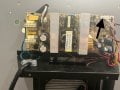
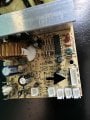
Greeting all. New to the site. Looking for some suggestions/help on trying to replace a thremoelectric wine cooler PCB. This board is from Cuisinart cwc3200, wine cooler, which is no longer in production and parts can not be found. The board was working for awhile, but is not dead. I'm trying to find a replacement which comes close to all the connections from the old board (model # PCB160531F3). I can not find anything close, specifically the black arrow to a 5 pin connection for PWM, NTC and +12v. The wine cooler has 4 fans, 2 internal and 2 external (Peltier system). Besides the 5 pin connection, it has 6 other connections. From all of my searches to find a close replacement, the biggest issue is trying to replace the 5 pin connector.
The other 6 connections I might be able to come close to on a replacement board. The old board also has 4 grd spade connections, I can find a board that has 2 spade grounds, but not 4. Assuming i can not find a 5 pin replacement on a new board, is my only option to somehow separate/rewire the 5 pin connections to individual connections on the new board. I'm assuming the new board may/should have separate PWM and NTC connections.

I'm open to any ideas to get this cooler to work. It's so old that it may require rewiring and searching for a new board that will fit everything i need with 4 Peltier system. Of course, it may not be worth fixing because of the cost to get it up and running vs buying a new one.

The cooler has a temp LED display and two LED controls to raise and lower the temp and an internal light (which i don't need).

Thanks to all for any suggestions you have, including putting it in the dump :)
 

Attachments

wayneh

Joined Sep 9, 2010
18,087
Do you have any interest in possibly repairing that board? It's different than the typical one but may have suffered the same, very common mode of failure - a bad capacitor. The infamous one is C8 for the common board but that likely doesn't carry over to yours. I'd consider a shotgun replacement of every single electrolytic capacitor on the board. Pay attention to the polarity as you remove them, if you go that route.

There is such a thing as an ESR tester and with that device it would be possible to find a failed cap in a rifle-shot way, but for many it's just simpler to replace them all. You skip the cost of the tester and the time to use it.
 

MisterBill2

Joined Jan 23, 2018
27,164
This is an interesting problem. First, while I understand keeping wines at some cool temperature, I have no clues as to the details relative to this model. What functions does it have other than basic cooling to some temperature?? On the photo of the control board I am unable to read the legends for most of the connectors. The PCB looks mostly like a switching power supply, and the common failure in other brands has been the Various filter capacitors. AND really, most electronic parts are available , either exactly or equals. So the PCB should certainly be repairable. And replacing capacitors does require some soldering skills, and the ability to read, and order parts. Replacing EVERY large, and medium sized, polarized capacitor on the circuit board will cost less than $50, and it should not be difficult if you know how to solder.
 

Thread Starter

Gabeandyogi

Joined Jul 16, 2025
7
Thanks for the reply. The wife got the cooler from facebook marketplace. It had issues the first time we got it, but after leaving it unplugged for 24 hours, it actually worked to the set temp, so we thought all was well, but the temp display start showing 2 dashes instead of the temp and then eventually, no fans and did not keep the set temp. I did some testing with a multimeter and possibility shorted the board, now it's completely dead. At this point God knows what capacitor/fuse is dead. My first thought was to just replace the whole board. Testing and replacing most or all of the capacitors is a bit out of my comfort zone. Knowing now that a board replacement is a difficult find, so as much as I would love to get it working, I don't know what route I'm going to go. Thanks again for the ideas...
 

Thread Starter

Gabeandyogi

Joined Jul 16, 2025
7
This is an interesting problem. First, while I understand keeping wines at some cool temperature, I have no clues as to the details relative to this model. What functions does it have other than basic cooling to some temperature?? On the photo of the control board I am unable to read the legends for most of the connectors. The PCB looks mostly like a switching power supply, and the common failure in other brands has been the Various filter capacitors. AND really, most electronic parts are available , either exactly or equals. So the PCB should certainly be repairable. And replacing capacitors does require some soldering skills, and the ability to read, and order parts. Replacing EVERY large, and medium sized, polarized capacitor on the circuit board will cost less than $50, and it should not be difficult if you know how to solder.
Thanks for the reply. I have not ventured in the capacitor replacement/soldering field, so it would be a new adventure for sure. I thought finding a replacement board would be easy, but the board is just so old. It sounds like from a previous reply and your reply, my best and maybe only option is to repair the board. I'll have to figure out what to do. There are a lot of capacitors and since the board is completely dead, I'm thinking I'll have to test pretty much most of them.
 

wayneh

Joined Sep 9, 2010
18,087
If you don't already have soldering tools and a comfort level using them, I wouldn't bother. If you can't find a replacement board, you're better off conceding defeat and moving on. I know that can be hard but you have know when to hold 'em and when to fold 'em. Choose your battles.
 

MisterBill2

Joined Jan 23, 2018
27,164
OK, soldering is not only a science but also an art. There are a lot of detailed descriptions on how to do it well, and years ago I wrote an educational paper that explained soldering and compared it to welding and brazing, for a friend of mine who had taken a welding class and was able to weld quite well for one with training but no experience.
I have been soldering for many years, and know that aside from the instructions it is also an art.

Now back to your cooler: Peltier cooling is about as close to actual magic as most of us can get: It works by passing a current thru a diode that somehow transports heat energy across that junction also.
In your system there is a power supply that forces a current across a junction, causing heat to be transported across as well. Even after studying the mechanism for that to happen in a physics course, I say it is magic.
But now the power supply that drives it has failed. One option is to replace that whole assembly with a different power supply, and use an actual thermostat switch to control the temperature. The challenge in that scheme is knowing what current the supply must deliver and at what voltage it must provide. If you are able to spot any markings or label on the actual cooling junction that could be a start. And if somebody else has measured the voltage on their thermoelectric cooler and can share that information that could be useful. Driving the junction is not any magic, it is a matter of volts and amps. And a suitable supply should be possible. The challenge will be in the temperature control.
 

Thread Starter

Gabeandyogi

Joined Jul 16, 2025
7
If you don't already have soldering tools and a comfort level using them, I wouldn't bother. If you can't find a replacement board, you're better off conceding defeat and moving on. I know that can be hard but you have know when to hold 'em and when to fold 'em. Choose your battles.
Yep, I hear you and I'm getting to that point for sure.
 

MisterBill2

Joined Jan 23, 2018
27,164
You can operate a Peltier cooling device with just a DC power supply. The real hard part is knowing what voltage to apply and how much current should be provided. Does the failed unit have a label some place that lists the mains power rating?? That will be a start, because you will need to subtract the fans power to get the Peltier power.And that will be a start, knowing the watts, when you find the voltage.
An alternative is to use an adjustable supply, and start with a lower voltage. Increasing the voltage will increase the current and at some point the relationship will flatten, and more voltage will drive a lot more current. THAT is too far, so back off some. That is where knowing the POWER will be useful.
 

digley

Joined Mar 15, 2016
3
Peltier devices will run directly from a D.C. supply , but they don't like it. If you know or can find the voltage/current specifications of your Peltier device , then both Oatley Electronics and Silicon Chip magazine [ both in Australia] have published projects and provided kits to make your own simple/cheap driver board.
 

MisterBill2

Joined Jan 23, 2018
27,164
Peltier devices will run directly from a D.C. supply , but they don't like it. If you know or can find the voltage/current specifications of your Peltier device , then both Oatley Electronics and Silicon Chip magazine [ both in Australia] have published projects and provided kits to make your own simple/cheap driver board.
CERTAINLY the DC supply must be adjusted to supply the correct voltage!! AND, if there are no errors in the specification, then the current should be correct. Randomly connecting a power supply could certainly be a problem, no doubt. In addition, the peltier device, like all other diodes, does vary the forward voltage drop as the temperature changes. So the DC supply will also need to be able to regulate the current a bit. OR use a series resistor. That will not be quite as efficiet, but cheap and easy.
 

Thread Starter

Gabeandyogi

Joined Jul 16, 2025
7
CERTAINLY the DC supply must be adjusted to supply the correct voltage!! AND, if there are no errors in the specification, then the current should be correct. Randomly connecting a power supply could certainly be a problem, no doubt. In addition, the peltier device, like all other diodes, does vary the forward voltage drop as the temperature changes. So the DC supply will also need to be able to regulate the current a bit. OR use a series resistor. That will not be quite as efficiet, but cheap and easy.
Thanks for all of the ideas and replies. I may be at the point of having to surrender and cut my looses. The board was alive at one point, now it doesn't have any life, no LED lights at all to let me know it's at least working. I tested the volts coming in from the outlet, and it was good, the power being delivered to the other 7 connectors had a reading of less than 2 volts. I tested the three fuses and all tested ok. A visual inspection of all the capacitors didn't reveal anything that sticks out, but I know that's not a very accurate test. I would have to spend more time to figure out why the board is dead, I would have to probably replace most or all of the capacitors and God knows what else needs to be replaced. The heatsink modules in the Peltier would most likely need to be replaced and possibility why the cooler wasn't working in the beginning. It's a possibility the whole module, fans included would need to be replaced, with the age of the cooler the fans may work today, but their life expectancy is probably not very long. If i have to run this on DC, it's just not worth it. I exhausted my search to find a suitable board replacement, but can't seem to get close without the possibility of needing to rewire. My thought is the LED Ground (picture) is the issue. My uneducated guess is this guy feeds the other connectors on the board. I tested this and the volts were very low. The LED ground connector as it is on this board is what I can't seem to find anywhere else.

Humans are the most perfect complete computer and we don't last for every, so I shouldn't expect a computer board to last forever. Maybe someday I'll get motivated or find something or get a idea from somewhere and figure it out, it's a good challenge for sure. I thank you for your creative ideas and suggestions.
 

Attachments

MisterBill2

Joined Jan 23, 2018
27,164
There is a whole lot that the picture does not show.
It is not likely that the fans need replacement, since all three are not running it is much more likely that there is no power. If the TS did accidentally short-circuit something while probing, one or more parts might have been damaged.
Random guessing based on no information is unlikely to be accurate.
 

Thread Starter

Gabeandyogi

Joined Jul 16, 2025
7
Correct.... When the cooler finally stopped working I did have power, but the 4 fans never did spin. I had the temp set to 50 and my thermostat i put in, just stayed at 75, so I knew it wasn't doing anything for days. I test the 4 fans with a 9v battery to see if they were ok and they did at least spin. So the problem(s) can be a bad temp sensor, the Peltier modules are dead, maybe not enough voltage going out, probably a few other scenarios that I'm missing. My plan, since the parts were inexpensive, was to replace the fan/Peltier modules if eventually I did get it to work. I figured, since I had it apart and it was over 10 years old, why not replace the guts and I had originally thought it would not be a big issue finding a replacement board, we all know how that worked out.
 

DanB35

Joined Nov 12, 2021
1
Greeting all. New to the site. Looking for some suggestions/help on trying to replace a thremoelectric wine cooler PCB. This board is from Cuisinart cwc3200, wine cooler, which is no longer in production and parts can not be found. The board was working for awhile, but is not dead. I'm trying to find a replacement which comes close to all the connections from the old board (model # PCB160531F3). I can not find anything close, specifically the black arrow to a 5 pin connection for PWM, NTC and +12v. The wine cooler has 4 fans, 2 internal and 2 external (Peltier system). Besides the 5 pin connection, it has 6 other connections. From all of my searches to find a close replacement, the biggest issue is trying to replace the 5 pin connector.
The other 6 connections I might be able to come close to on a replacement board. The old board also has 4 grd spade connections, I can find a board that has 2 spade grounds, but not 4. Assuming i can not find a 5 pin replacement on a new board, is my only option to somehow separate/rewire the 5 pin connections to individual connections on the new board. I'm assuming the new board may/should have separate PWM and NTC connections.

I'm open to any ideas to get this cooler to work. It's so old that it may require rewiring and searching for a new board that will fit everything i need with 4 Peltier system. Of course, it may not be worth fixing because of the cost to get it up and running vs buying a new one.

The cooler has a temp LED display and two LED controls to raise and lower the temp and an internal light (which i don't need).

Thanks to all for any suggestions you have, including putting it in the dump :)
Where do you live. As a retired engineer,, I recommend you find a local trade school, tech school even high school science teacher and ask if they want a project to work on. Lots of technicians would gladly work on it.
 
Top