Facebook
 Google
 GitHub
 Linkedin

It's my understanding that:
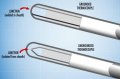
According to some credible sources on the internet, it is acceptable to simply weld the thermocouple junction to the metallic device under test. It seems this is how grounded thermocouples are made; the thermocouple inside is welded to the stainless sheath:
But this introduces a 3rd metal to the mix. Won't it effect the voltage produced?
I have also read (not in whitepapers but in responses to questions asked online) that it is acceptable to solder or braze the thermocouple wires together, and to the device under test. This introduces at least one more (but most likely several more) metals to the mix. Still not a problem? How not?
Finally there is the issue of the terminals at the measurement device. I have dissected several different industrial temperature controllers and found the thermocouple input contacts appear to be made of nothing special. And the MAX31856 breakout boards that I'm using right now also appear to have "ordinary" terminals for the thermocouple input. Both the MAX31856 and industrial controllers support several types of thermocouples, so even if they did use special metals for the input terminals (and for the PCB traces I suppose), it would only be suitable for one type of thermocouple. So I suspect this is just plated copper as usual, and the effect of this dissimilar metals junction this accounted for in whatever Cold Junction Compensation algorithm the device uses. Is that correct? If so, then why is it not OK to use ordinary copper wire as thermocouple extension wire? Unless I'm missing something, all that does is move the dissimilar metals junction further away from the measurement device.
EDIT: please allow myself to answer myself. I remembered. The measurement device measures its own temperature and the cold junction is assumed to be at the same temperature, so the cold junction must be kept as close to the device as possible or else the assumption is wrong.
- A thermocouple is formed any time two dissimilar metals are joined together, but only the joining of certain metals and of known purity, produces a predictable and repeatable voltage that is high enough to easily measure at a given temperature.
- Thermocouple extension wire must be of the same metals that the thermocouple is made of, or else additional thermocouples are generated in series with the measurement thermocouple.
- Terminal blocks used to join thermocouples to thermocouple extension wire must also be made of the these metals. Or else, same.
According to some credible sources on the internet, it is acceptable to simply weld the thermocouple junction to the metallic device under test. It seems this is how grounded thermocouples are made; the thermocouple inside is welded to the stainless sheath:
But this introduces a 3rd metal to the mix. Won't it effect the voltage produced?
I have also read (not in whitepapers but in responses to questions asked online) that it is acceptable to solder or braze the thermocouple wires together, and to the device under test. This introduces at least one more (but most likely several more) metals to the mix. Still not a problem? How not?
EDIT: please allow myself to answer myself. I remembered. The measurement device measures its own temperature and the cold junction is assumed to be at the same temperature, so the cold junction must be kept as close to the device as possible or else the assumption is wrong.
Last edited: