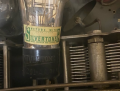
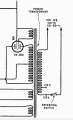
You can series the DC supplies... The service notes show a few battery powered radios and the Radiola 44 came in 2 versions. 105/125V 50/60Hz (only 100W! so less than 1 amp) and same voltage but 25/45Hz. To drop down to ~110 you have to do some surgery on the power cord and splice in a factory supplied wire instead of the 120V lead. There is an internal tap on the primary transformer to shorten it for 110V so they brought the spare wire out and taped it off to be used if needed. They sold them all over the world, not just in the US. From what I've seen in the service notes, the Neutrodyne TRFs are notorious for howling harmonics and lots of service information on taming the howling. Yeah I was wondering if good ole Sears & Roebuck had a hand in the Silvertone tubes even though they are marked RCA. Yep, just looked closely at my boxes and they have both Sears and RCA on the box. So, RCA tubes sold in a Sears & Roebucks box! With a paper Silvertone label pasted onto the RCA tube LOL.
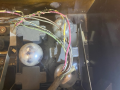
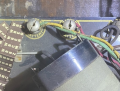
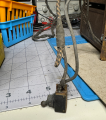
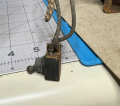
110V lead taped off right at the ON/OFF switch!
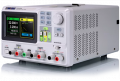
Or 3 30V power supplies in series. I have 3 because I use two to get up to +/-18V for op amps and use the other to power the circuit. Built a bunch of small ones but it's much easier to use my large bench units. I was thinking about your problem last night and wondered about using something like this:
Spend some time shopping around for them and see if they might suit your need. I try to avoid SMPSs wall warts in my bench/radio shack due to noise generation but they do serve a purpose. I do have 2 large ones supplying 12VDC for some of the mobile radios and amps on my bench but they are well shielded and grounded so any noise is well attenuated.
Other possibility is build one using a step down transformer but transformers can get pricey unless you can scrounge one. You should only need a couple of amps. Check your documents and see what they spec for power. This huge radio I'm working on is only 100W @ 120VAC but it weighs in excess of 30 pounds. They were not designed to be portable...
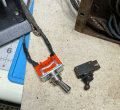
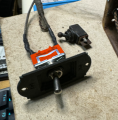
ON/OFF switch is FUBAR (bad internal spring?) so I put a new on one. Surprisingly, in nearly 100 years they haven't changed the mounting threads! So, it mounts perfectly in its escutcheon and could even use the tarnished brass front mounting nut.
You can see on the left the taped off loop for the wire that goes to the internal 110V tap on the primary XFMR.
I'll probably touch the brass escutcheon up with some Brasso later... Can't see it but it's marked On Off. there is an identical one on the opposite end of the cabinet to connect/disconnect the external owner built antenna with specific instructions in the manual. 50', too short and it oscillates and howls, too long and one end of the band is nearly dead. In the disconnect position you will only hear strong locals. There is also an external ground wire that must be connected. Period (but polarized) plug and cloth covered twisted pair wire on order. Original has some bare wire spots and only thing left of the original hard rubber plug are the 2 stabs. Original is ~10-12' long but only ordered 8' of wire as per modern 6' standard length plus what is inside the cabinet.
Or 3 30V power supplies in series. I have 3 because I use two to get up to +/-18V for op amps and use the other to power the circuit. Built a bunch of small ones but it's much easier to use my large bench units. I was thinking about your problem last night and wondered about using something like this: View attachment 325278
Spend some time shopping around for them and see if they might suit your need. I try to avoid SMPSs wall warts in my bench/radio shack due to noise generation but they do serve a purpose. I do have 2 large ones supplying 12VDC for some of the mobile radios and amps on my bench but they are well shielded and grounded so any noise is well attenuated.
Other possibility is build one using a step down transformer but transformers can get pricey unless you can scrounge one. You should only need a couple of amps. Check your documents and see what they spec for power. This huge radio I'm working on is only 100W @ 120VAC but it weighs in excess of 30 pounds. They were not designed to be portable...
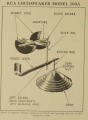
I have identified the remote speaker as the RCA 100A and found the RCA Service Data for 1923-1928 containing it. This was their 3rd electrically driven speaker model. I knew that thing was heavy but turns out the cabinet it is in isn't wood but cast iron! Has a few chips in the paint but RCA knew this was a problem and sold the paint for it back in the 1920s. I'll leave it alone as otherwise (except the grill cloth) it's in good shape except for a good cleaning. It has quite an interesting drive system. Haven't opened it yet for inspection but that can wait to see if the radio can ressurect itself.
I was worried about the ancient "Canned" capacitor bank but I've been doing a good bit of research on several old RCA radio sites. One in particular warned about NOT replacing the canned capacitor due to the nature of just how they were built and that they rarely failed in these early model RCAs. Some leakage, not enough to be a problem, and absolutely never shorted! I can only hope...
Fascinating engineering approach in that speaker, but can't help feeling there's something wrong there with the way the armature and drive pin interact - not enough DoF. Either way, can't see that having much HF response, good for voice maybe, but music?
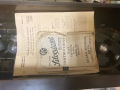
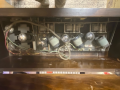
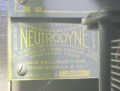
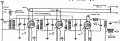
Cleaning out our circa 1860s estate home and under the staircase found this. RCA Radiola 44 Model-594 radio and speaker from 1929. Fully intact and inside the case was a full set, still in their boxes, of unused spare tubes. View attachment 325152 View attachment 325153 View attachment 325154
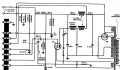
And I was able to find the schematic for it! View attachment 325155
Lots of surface rust inside, dust, dirt, and bug detritus but no rat chewing. This should keep me busy for quite a while.
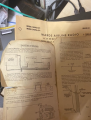
Edit: And! I have located the RCA Service Notes with full disassembly, assembly, alignment, antenna construction, and servicing information!
Sorry to say but that's actually my radio I left that there years ago and forgot about it. Please return it as soon as possible.
Years ago a friend of mine found a Les Paul guitar in his basement. I think it was year 1959 or earlier. He offered it for sale to me for $90 but I turned it down because the neck was cracked. Sometime later, he got the neck fixed by a guitar luthier, all of a sudden it was worth $5000 USD, and that was back in the 1980's. Today it would probably be worth about $20k or more as I have priced guitars like this very recently now and saw how much the value has gone up on these things since way back then.
Cleaning out our circa 1860s estate home and under the staircase found this. RCA Radiola 44 Model-594 radio and speaker from 1929. Fully intact and inside the case was a full set, still in their boxes, of unused spare tubes. View attachment 325152 View attachment 325153 View attachment 325154
And I was able to find the schematic for it! View attachment 325155
Lots of surface rust inside, dust, dirt, and bug detritus but no rat chewing. This should keep me busy for quite a while.
Edit: And! I have located the RCA Service Notes with full disassembly, assembly, alignment, antenna construction, and servicing information!
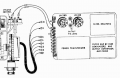
I haven't started on the tuner chassis yet but would expect some kind of potentiometer for the volume control. Between the 2 tube sockets on the power chassis are 2 pin jacks. The speaker unit has a 5' rocloth covered 2 wire cable from it that goes into the bottom of the radio cabinet and plugs into the pin jacks. H
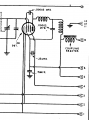
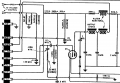
This I don't understand. The volume control is fed by both the 1st and 2nd RF amplifier tubes before they go into the Detector tube?
They then are wired over to the power chassis, go through some resistors, and loop back to the main terminal strip!
From terminals 4 & 6 they are cabled back over to the tuner and through the detector circuit!? And then return to the power chassis on terminals 5 & 9.
Back in the power chassis there is a filter and choke section tied to the volume control and feedin the cathode of the final amplifier tube. Terminal 5 appears to have some filtering as well and feed the final amplifier grid. Terminal 9 is attatched to ground and the filter and choke network? That is the part I do not understand. So the output pins have connections to the red volume control wire, terminal 5 and terminal 9 which is also connected to the green volume control wire. From the tuner to the power chassis terminal strip is a laced up wire harness with a lot of going back and forth between the 2 chassis.
What goes on in the speaker unit is another whole ball of string! I've printed out and skimmed through the speaker service section but not really dug into it yet.
This was long before High Fidelity and I think all they were looking for was loudness. Before this it was Victrola Pneumatic Horns which had very poor audio quality. There was a hand crank Victrola in the house when I was very young child in decent shape. When I saw it again in my 20s it had not been cared for and the cabinet was falling apart after years of some young cousins beating it to death. It's gone now so they probably threw it away...
I have this, it might discuss your question, I'll look later today. Perhaps that volume control is actually adjusting the RF gain? what type of tube is in that front end?

 Facebook
 Google
 GitHub
 Linkedin