The PCB gets damaged after placing it in a developer solution

Thread Starter

Mqtyx

Joined Nov 16, 2018
3
Hello, I've bought a few components months ago to manufacture a PCB at home but it turned out a fail so let me explain below what I've done and hopefully, you help me out. I'm kinda a beginner in such stuff so expect me not to understand very well.

I bought a 'Kinsten' PCB from a shop and a few developer solutions for it months ago. Then some days ago, I planned to design a circuit via EAGLE software and print the designed circuit out via a printer. Everything went fine until I exposed the PCB to a 48WATT UV lamp for 60-90 seconds (last time I've tried was 60 seconds I guess). The UV lamp was placed above the PCB (the PCB had above it a glass sheet) like a distance of 5.5cm. When the exposure time was accomplished, I brought the PCB into a developer solution (poured half the developer solution (DP-50 powder I assume) in a 1/2 liter of water, I don't know how much the developer solution was exactly since I don't have a proper tool to measure it but the website says that the DP-50 powder is 50g so I expect I poured 25g in a 1/2 liter of water). As soon as I placed it in the developer solution, the printed circuit started to appear, however, after a few seconds, the printed circuit that I've just seen started to disappear/be damaged for some reason. I've tried decreasing the exposure time to under 60 seconds, decreasing the concentration of the developer solution by pouring more water multiple times but the same issue occurs. I've actually wasted 2 whole boards trying to figure it out but I have no idea why this happens. May I get help, please? Thanks!

Side-note: I'm not 100% certain this is the right board to post such stuff so please if it is not the right board, may you tell me which board I can post this in? Thanks.

MOD: Deleted links.E
 

jpanhalt

Joined Jan 18, 2008
11,087
Hello, I've bought a few components months ago to manufacture a PCB at home but it turned out a fail so let me explain below what I've done and hopefully, you help me out. I'm kinda a beginner in such stuff so expect me not to understand very well.

I bought a 'Kinsten' PCB from a shop and a few developer solutions for it months ago. Then some days ago, I planned to design a circuit via EAGLE software and print the designed circuit out via a printer. Everything went fine until I exposed the PCB to a 48WATT UV lamp for 60-90 seconds (last time I've tried was 60 seconds I guess). The UV lamp was placed above the PCB (the PCB had above it a glass sheet) like a distance of 5.5cm. When the exposure time was accomplished, I brought the PCB into a developer solution (poured half the developer solution (DP-50 powder I assume) in a 1/2 liter of water, I don't know how much the developer solution was exactly since I don't have a proper tool to measure it but the website says that the DP-50 powder is 50g so I expect I poured 25g in a 1/2 liter of water). As soon as I placed it in the developer solution, the printed circuit started to appear, however, after a few seconds, the printed circuit that I've just seen started to disappear/be damaged for some reason. I've tried decreasing the exposure time to under 60 seconds, decreasing the concentration of the developer solution by pouring more water multiple times but the same issue occurs. I've actually wasted 2 whole boards trying to figure it out but I have no idea why this happens. May I get help, please? Thanks!

Side-note: I'm not 100% certain this is the right board to post such stuff so please if it is not the right board, may you tell me which board I can post this in? Thanks.

MOD: Deleted links.E
Welcome to AAC.

Addressing just the bolded text, that is a symptom of too concentrated developer or over exposure (see #1 below). There are many unknowns in your description, and one cannot be sure.

1) Are you using a positive or negative acting resist? With a positive resist, the exposed areas are most sensitive to developer, so if you are using a positive resist, your problem may also be due to too long an exposure or an insufficiently dense image.
2) What medium are you printing the design on? Can you post a picture of your design or a portion of it as printed?
3) What type of UV lamp are you using? "UV " light covers a wide spectrum. You probably want a lamp that produces high UVA or even visible violet, not much if any UVC.
4) Exposure time varies greatly with the composition of the photoresist. My exposure times are 10 to 14 minutes. My distance is about 15 cm using three, 15W bulbs held parallel.
5) When properly exposed and using my developer (0.4M NaOH or KOH), development is rapid (<60 seconds) and unexposed areas are relatively stable. However, long immersion can "overdevelop" the unexposed areas. It would take a long time (several minutes) to remove all unexposed resist. If I place an unexposed PCB board in my developer, nothing happens for quite awhile.
 

ArakelTheDragon

Joined Nov 18, 2016
1,366
Welcome to AAC.

Addressing just the bolded text, that is a symptom of too concentrated developer or over exposure (see #1 below). There are many unknowns in your description, and one cannot be sure.

1) Are you using a positive or negative acting resist? With a positive resist, the exposed areas are most sensitive to developer, so if you are using a positive resist, your problem may also be due to too long an exposure or an insufficiently dense image.
2) What medium are you printing the design on? Can you post a picture of your design or a portion of it as printed?
3) What type of UV lamp are you using? "UV " light covers a wide spectrum. You probably want a lamp that produces high UVA or even visible violet, not much if any UVC.
4) Exposure time varies greatly with the composition of the photoresist. My exposure times are 10 to 14 minutes. My distance is about 15 cm using three, 15W bulbs held parallel.
5) When properly exposed and using my developer (0.4M NaOH or KOH), development is rapid (<60 seconds) and unexposed areas are relatively stable. However, long immersion can "overdevelop" the unexposed areas. It would take a long time (several minutes) to remove all unexposed resist. If I place an unexposed PCB board in my developer, nothing happens for quite awhile.
These unknowns can make a big difference in the result. A positive photoresist dissolves around the tracks, with negative photoresist, exposure to UV light causes the chemical structure of the photoresist to polymerize, which is just the opposite of positive photoresists.

It is also possible that your marker is bad.
 

dl324

Joined Mar 30, 2015
18,327
Welcome to AAC!

The typical way to determine appropriate exposure times is to do a test with varying exposure times on the same same board. Make an exposure, cover that part, make another exposure, cover that part, ... You'll end up with an exposure gradient and you can pick the one that works best. If the time intervals you chose were too long, do another test with shorter intervals around the best time from a previous test.

Don't guess at the proper concentration for the developer. Consult the datasheet.
 

ArakelTheDragon

Joined Nov 18, 2016
1,366
Welcome to AAC!

The typical way to determine appropriate exposure times is to do a test with varying exposure times on the same same board. Make an exposure, cover that part, make another exposure, cover that part, ... You'll end up with an exposure gradient and you can pick the one that works best. If the time intervals you chose were too long, do another test with shorter intervals around the best time from a previous test.

Don't guess at the proper concentration for the developer. Consult the datasheet.
I agree on the developer thats my other reason for the problem. Normally you put 1 tea spoon and 1 package is 90g, if he put 25g than it would certainly cause this effect even if he decreased it.
 

spinnaker

Joined Oct 29, 2009
7,830
For etchant, haven't gone wrong yet with hydrochloric acid and peroxide mix.


Mix mix 1 part Mix mix 1 part hydrochloric acid with 2 parts hydrogen peroxide. Add the acid to the hydrogen peroxide. with 2 parts hydrogen peroxide. Add the acid to the hydrogen peroxide. Make sure you use it in a WELL ventilated place. Outdoors is best.

I also use the toner transfer method. Both photographic and toner transfer methods have thoer pluses and minuses I guess. I never need to worry about a developer but do have issues with the transfer every once in a while.
 

BobTPH

Joined Jun 5, 2013
11,515
The problem could also be caused by extraneous exposure to UV. Are you exposing the uncovered board to fluorescent lights, for example? I keep the board covered until I develop it in a dimly lit space lit by incandescent light.

Bob
 

Thread Starter

Mqtyx

Joined Nov 16, 2018
3
Welcome to AAC.

Addressing just the bolded text, that is a symptom of too concentrated developer or over exposure (see #1 below). There are many unknowns in your description, and one cannot be sure.

1) Are you using a positive or negative acting resist? With a positive resist, the exposed areas are most sensitive to developer, so if you are using a positive resist, your problem may also be due to too long an exposure or an insufficiently dense image.
2) What medium are you printing the design on? Can you post a picture of your design or a portion of it as printed?
3) What type of UV lamp are you using? "UV " light covers a wide spectrum. You probably want a lamp that produces high UVA or even visible violet, not much if any UVC.
4) Exposure time varies greatly with the composition of the photoresist. My exposure times are 10 to 14 minutes. My distance is about 15 cm using three, 15W bulbs held parallel.
5) When properly exposed and using my developer (0.4M NaOH or KOH), development is rapid (<60 seconds) and unexposed areas are relatively stable. However, long immersion can "overdevelop" the unexposed areas. It would take a long time (several minutes) to remove all unexposed resist. If I place an unexposed PCB board in my developer, nothing happens for quite awhile.
Thanks :)

1) Positive resist I assume.
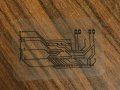
2) A4 transparent paper. Here it is anyway:
46456079_492246611184319_8722524621884096512_n.jpg
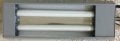
3) I don't really know since it doesn't say its type anywhere. This is what I'm using:
46427474_2532161826823772_1296112544569622528_n.jpg
4) I tried increasing the exposure time to 2 minutes but it seemed it failed so that, I was trying to decrease the exposure time as much as I can.
5) DP-50 pack is the developer solution I'm using. I'm not in favor of using anything else since the instructions I was given included this 'Kinsten' PCB and DP-50 developer solution. I actually don't want to waste more boards trying to figure it out :/

Welcome to AAC!

The typical way to determine appropriate exposure times is to do a test with varying exposure times on the same same board. Make an exposure, cover that part, make another exposure, cover that part, ... You'll end up with an exposure gradient and you can pick the one that works best. If the time intervals you chose were too long, do another test with shorter intervals around the best time from a previous test.

Don't guess at the proper concentration for the developer. Consult the datasheet.
Thanks :)

I don't really want to test more, I have only one board left. However, if you are 100% sure this was caused due to the exposure interval wasn't appropriate, I can try your method.

For etchant, haven't gone wrong yet with hydrochloric acid and peroxide mix.


Mix mix 1 part Mix mix 1 part hydrochloric acid with 2 parts hydrogen peroxide. Add the acid to the hydrogen peroxide. with 2 parts hydrogen peroxide. Add the acid to the hydrogen peroxide. Make sure you use it in a WELL ventilated place. Outdoors is best.

I also use the toner transfer method. Both photographic and toner transfer methods have thoer pluses and minuses I guess. I never need to worry about a developer but do have issues with the transfer every once in a while.
Thanks for trying to help me but I'm not really into changing the developer solution since DP-50 developer solution is the solution that is stated in the instructions that were given to me.

The problem could also be caused by extraneous exposure to UV. Are you exposing the uncovered board to fluorescent lights, for example? I keep the board covered until I develop it in a dimly lit space lit by incandescent light.

Bob
Thanks for trying to help me out :)

I don't get what you mean. What I do is uncover the board then place the transparent paper that has the design on, above the board immediately then place the board under a UV light box along with a distance of 5.5cm approximately (between the UV light box and the board) then when done exposing, I get the board into a developer solution quickly to prevent it from exposing to the white/normal fluorescent lamp.
 

dl324

Joined Mar 30, 2015
18,327
I don't really want to test more, I have only one board left. However, if you are 100% sure this was caused due to the exposure interval wasn't appropriate, I can try your method.
I can't be 100% certain, but if you haven't done the exposure timing test, you're going to have to do it eventually.

Plan on buying more boards. You only need a strip of sensitized board to do your tests.

If you plan to do a lot of boards, you'll probably find it more economical to buy regular copper clad boards and spinning/spraying on your own coating. That'll give you more flexibility regarding board material and copper/board thickness.

If you don't have a way to cut boards, you'll need to address that too.
 

jpanhalt

Joined Jan 18, 2008
11,087
1) Your light source is very similar to mine, except I have 3 tubes. Each tube will have a number on it. In my case, they are made by GE and the number is: F15T8-BL. They are labeled "Backlight" and made in Hungary. Like the tubes in your unit, they have a phosphor. That is important. You do not want clear tubes. As for the phosphor, there are variations and the last time I looked, there was inconsistency between manufacturers. All you really need is something in the 380 to 405 nm range. I believe even ordinary bright white fluorescent tubes provide that. Mine look quite bright. (Even some incandescent bulbs can be used but exposure is longer and heating may be an issue.)

2) Since your resist is positive resist and is coming off easily, I do not think you are under exposing. Perhaps over exposing or your developer is too strong. If I double my developer concentration, it removes even exposed resist. Based on the comments of others using your brand of developer, I think it is the latter.

3) As for your transparency, the lines are a little less dense than what mine are, and in the lower left, one area appears particularly light. I have used both laser printers and inkjet printers. Either will work, if the printing is dense. I prefer the inkjet as the blobs of ink flow together. Remember, it is the denseness of the color. It does not have to be black. In fact dense yellow and magenta work fine.

4) I put the printed side against the PCB. That helps avoid shadows and light seepage.
 

Thread Starter

Mqtyx

Joined Nov 16, 2018
3
I can't be 100% certain, but if you haven't done the exposure timing test, you're going to have to do it eventually.

Plan on buying more boards. You only need a strip of sensitized board to do your tests.

If you plan to do a lot of boards, you'll probably find it more economical to buy regular copper clad boards and spinning/spraying on your own coating. That'll give you more flexibility regarding board material and copper/board thickness.

If you don't have a way to cut boards, you'll need to address that too.
I actually did a semi-test. At first, I managed to leave it an hour but literally failed. The second attempt, left it 3 minutes but also failed. The third attempt, left it 2 minutes but failed. The 4th, left it 75 seconds but failed. The 5th, left it 60 seconds but failed. The last attempt, left it 50 seconds but failed.

The first two attempts when I tried to leave it in a developer solution, nothing even appeared. The last other attempts when I tried to place it in a developer solution, it began to appear but the appeared part began to disappear for some reason when I put it back in the developer solution one more time. I tried to decrease the concentration of the developer solution and the design began to appear very well but eventually got disappeared again.

Thanks for that advice, appreciated. I'm still a beginner though so I need to stick to the normal/usual ways first. I will try to improve by time.

Yes, I do have a basic way of cutting which I used already.

1) Your light source is very similar to mine, except I have 3 tubes. Each tube will have a number on it. In my case, they are made by GE and the number is: F15T8-BL. They are labeled "Backlight" and made in Hungary. Like the tubes in your unit, they have a phosphor. That is important. You do not want clear tubes. As for the phosphor, there are variations and the last time I looked, there was inconsistency between manufacturers. All you really need is something in the 380 to 405 nm range. I believe even ordinary bright white fluorescent tubes provide that. Mine look quite bright. (Even some incandescent bulbs can be used but exposure is longer and heating may be an issue.)

2) Since your resist is positive resist and is coming off easily, I do not think you are under exposing. Perhaps over exposing or your developer is too strong. If I double my developer concentration, it removes even exposed resist. Based on the comments of others using your brand of developer, I think it is the latter.

3) As for your transparency, the lines are a little less dense than what mine are, and in the lower left, one area appears particularly light. I have used both laser printers and inkjet printers. Either will work, if the printing is dense. I prefer the inkjet as the blobs of ink flow together. Remember, it is the denseness of the color. It does not have to be black. In fact dense yellow and magenta work fine.

4) I put the printed side against the PCB. That helps avoid shadows and light seepage.
1) Correct, there is a unique number below every tube. F6T5-BL is what I'm using. The UV light box was made in China.
2) I've actually tried to decrease the exposure time to 50 seconds while the instructions said I need to expose it for 60-90 seconds but also failed so I don't think the exposure time isn't appropriate.
3) I'm using HP Laserjet 1018. I will try to use a marker so I make sure it is not from the denseness.
 

jpanhalt

Joined Jan 18, 2008
11,087
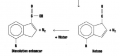
Have you considered making several concentrations of developer? You can start very low and work up (each dilution 2x more concentrated than the previous). So long as you are in very subdued incandescent light time from exposure will not matter. In fact, there is a chemical reaction involving water that has to happen after exposure to the light.
upload_2018-11-16_17-0-36.png


I routinely let my PCB's sit in a humid chamber for 10 minutes or so before developing. Don't know for sure if that helps. Started doing it when I started using very old pre-sensitized boards.
 
Top