test equipment question, ohms not accurate on multimeter

Thread Starter

tsmspace

Joined Mar 16, 2026
126
Why are you inserting yourself into the circuit you are trying to measure? This is like complaining about how you can't get an accurate reading of the weight of some item but insisting on putting one foot on the scale while taking the measurement.

If you want to measure the value of a resistor, then the resistor needs to be removed from any circuit it is in, which includes YOU.

Human body resistance, from one hand to another with dry hands and at the voltages generally produced by a multimeter, tends to be in the hundreds of kilohms to a few megohms when the probe tips are grasped lightly, but can go down to ten kilohms or so if grasped very firmly. Thus, you will greatly impact the measurement of a 1 MΩ resistor, moderately impact the measurement of a 100 kΩ resistor, could noticeably impact the measurement of a 10 kΩ resistor, but probably not, and will almost certainly have little noticeable effect on a 100 Ω resistor.

It sounds like you need to learn a lot more about basic circuit and measurement concepts. You are using meters that are perfectly adequate but, because you are using them improperly, you are concluding that they are broken and must be replaced. What's broken is your knowledge and skill -- but, hey, we were all there at one point and, fortunately, it's something that is pretty easy to fix.

Well, I have basically always held the component and leads at the same time and have measured actually quite a few things over time without ever having an error. One interesting thing here is that I've never really had reason to use more than a 10k resistor, and none of the resistors I've ever measured were really more than that as a result, which meant that touching them or not I never got a different reading, leading me to feel there should be no reason to worry about assembling some kind of jig, while holding the leads all at once I can be very confident everything is touching.

But, at 1meg the problem arises. So, because of the amount of times I've touched the leads with no impact, I didn't think twice about it. Unless I set the multimeter to 20meg, touching the leads just shows o.l, and measuring almost all of the resistors in most basic circuits reads the same touching them or not, which is something I've tested many times. in fact, I think that for like 10 years, I touched the leads and didn't touch the leads every single time I did a measurement, to see no difference, just to check if there was one.

I think for digital circuits, and all relevant values in most "learners circuits" relating to digital electronics, there will be few if any occasions where this problem would arise. (just based on my experiences, since I've never experienced it until now).
 

WBahn

Joined Mar 31, 2012
32,930
Well, I have basically always held the component and leads at the same time and have measured actually quite a few things over time without ever having an error.
You mean without having an error that you noticed. How many of those bad multimeters were really just you messing up the measurement?

This is why it is important to understand circuit fundamentals and not just "learn" by experimentation and trial and error. While the latter has its place, if it is your primary source of knowledge, it will often lead you down a wrong path that will bite you sooner or later. It will make you think that something is always the case when it only happens to be the case in the small subset of instances you've observed. Sometimes, that bite is fatal.
 

Jon Chandler

Joined Jun 12, 2008
1,614
Well, I have basically always held the component and leads at the same time and have measured actually quite a few things over time without ever having an error.
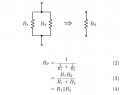
Perhaps if you take a minute to understand the math, you'll understand the issue.

If you're touching the leads, you are changing the measured value. Is it a significant change? Maybe. Maybe not. The value of the resistor being checked and the resistance across your figures (which isn't constant, it can vary widely) is the key. But you don't know what the resistance of your touch is at any given time, so how can you know if the measured results are close enough?

[Have you considered that the differences you've seen between measuring the the meter and measuring with the component tester (not a transistor tester) are because when you use the component tester, the resistor is clamped in the socket? No finger contact involved.]

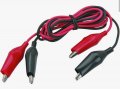
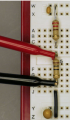
Getting a set of clip leads solves the question. And may protect you from nasty shocks if you start measuring things on live circuits (NOT RESISTANCE).

parallelr.png

Clip leads like these clip to the test leads and the part being tested.

Screenshot_20260514_232907_Edge.jpg

Clip leads like these replace the standard test leads.

Screenshot_20260514_233036_AliExpress.jpg
 

MrChips

Joined Oct 2, 2009
34,886
We often use the rule of 10.

If the effect of your body resistance is 10 times that of the resistor being measured, then you can expect a 10% error in your measurement.

For example, if your body resistance is 100kΩ, don’t try to measure 10kΩ or higher while holding the test leads with your fingers.

What I often do is, I grip the test lead and one leg of the resistor with thumb and index finger of the left hand, and touch the other test lead to the other leg keeping the fingers away.
 

dl324

Joined Mar 30, 2015
18,373
Unless I set the multimeter to 20meg, touching the leads just shows o.l, and measuring almost all of the resistors in most basic circuits reads the same touching them or not, which is something I've tested many times. in fact, I think that for like 10 years, I touched the leads and didn't touch the leads every single time I did a measurement, to see no difference, just to check if there was one.
That just means that your resistance was more than 1M.

As I mentioned in post #34, I touched the DVM probe tip and one lead of the resistor with one hand. The other DVM probe isn't touched (hand on the plastic), so I'm not in the circuit.
 
Last edited:

MisterBill2

Joined Jan 23, 2018
27,679
The other reason for not putting fingers on the probes while measuring WILL BECOME VERY CLEAR the first time you do it accidentally on a mains connected circuit!!
It would be even more exciting in the areas with 220 volt mains. AND, DC circuits also tend to demand respect.
I am not going to deliver any safety lecture, though.
 

neonstrobe

Joined May 15, 2009
200
For testing a meter cheaply, just buy a 1% tolerant metal oxide type device|***. They're cheap. Unless you are making an analogue circuit that needs anything more accurate, that tends to be sufficient. I've made a simple board with a range of 1%resistors and compared cheap and expensive DMM's and good old analogue meters. The analogue meters have been accurate to at least 1/3 scale (that's on the left and getting to the not-high-resolution end - but at least they measure infinity, something you can't say about a DMM).
Always use probes or clips, never touch any part if you want a decent measurment, let alone a safety issue.

*** the leaded type ("through-hole") unless you have SMD probes, of course
 

Reloadron

Joined Jan 15, 2015
7,892
The only way to know how accurate and repeatable any ohmmeter actually is would be to measure a known standard. The same is true for voltage and current measurement. How to take a measurement has been well covered.

Ron
 

Homebrew1964

Joined Nov 22, 2024
242
Since every meter is calibrated against a different standard how do you know which one is correct? I had this happen to me just the other day where i set my power supply to ~5V, the power supply read read 5V, one of my meters read 4.98V and another read 4.95V they are all different brand meters two costing around $30 and the third costing $82 but i have no idea what the true voltage out of the power supply was because as far as the meters are concerned they are all accurate as far as the manufacturer was concerned during their calibration process. Rather like saying what is the correct time of day since the vast majority of clocks are set relative to another clock.
 

dl324

Joined Mar 30, 2015
18,373
the power supply read read 5V, one of my meters read 4.98V and another read 4.95V
Who's to say which is more accurate than the others. What matters is the tolerance of the circuitry using the 5V supply. 5V TTL is specified to operate from 4.75-5.25V. It doesn't really matter if it's 5.00V, 4.98V, or 4.95V; all are acceptable.

A 5V regulator typically has a 5% tolerance.
 
Last edited:

WBahn

Joined Mar 31, 2012
32,930
Since every meter is calibrated against a different standard how do you know which one is correct? I had this happen to me just the other day where i set my power supply to ~5V, the power supply read read 5V, one of my meters read 4.98V and another read 4.95V they are all different brand meters two costing around $30 and the third costing $82 but i have no idea what the true voltage out of the power supply was because as far as the meters are concerned they are all accurate as far as the manufacturer was concerned during their calibration process. Rather like saying what is the correct time of day since the vast majority of clocks are set relative to another clock.
You need to determine how accurate the measurement needs to be and the ensure that your equipment is capable of achieved the needed level of accuracy.

If it really matters whether your supply voltage is 4.98 V instead of 4.95 V, then you have several other issues that you need to deal with. But if it only matters that you are within the specified supply voltage range for your circuitry, which might only require that you be within 5% (or ±0.25 V), then what does it matter which meter is closer to the true value (the only thing you are pretty much guaranteed of is that neither is actually correct).

Look at the specifications for your meters. You will likely find that their accuracy is specified as something like 0.5% of reading plus three digits. So if you are measuring something that if 5 V on a range that has a resolution of 0.01 V, then the meter is within spec if it displays anything from 4.95 V to 5.05 V. Conversely, if it is displaying 4.95 V, the actual voltage can be anywhere in the range of 4.90 V to 5.00 V.

There are relatively few situations in electronics (or in most engineering disciplines) where there is really a need to know or do something to better than 1%. There's a reason that 2% resistors are generally considered "precision" resistors.
 

WBahn

Joined Mar 31, 2012
32,930
I do have OCD to a certain extent :p
Most engineers do -- it tends to go hand-in-hand with the type of attention-to-detail that is needed.

At some point, most of us have had to come to grips with the notion that if it's good enough, then it's good enough. Seeking perfection is almost always a fool's errand and is actually away from goodness in most situations.
 

Reloadron

Joined Jan 15, 2015
7,892
Since every meter is calibrated against a different standard how do you know which one is correct? I had this happen to me just the other day where i set my power supply to ~5V, the power supply read read 5V, one of my meters read 4.98V and another read 4.95V they are all different brand meters two costing around $30 and the third costing $82 but i have no idea what the true voltage out of the power supply was because as far as the meters are concerned they are all accurate as far as the manufacturer was concerned during their calibration process. Rather like saying what is the correct time of day since the vast majority of clocks are set relative to another clock.
Well, it plays out this way. In it's simplest terms Calibration is a comparison between a know (Standard) and an unknown UUT (Unit Under Test). Real world standards have traceability, an unbroken chain of comparisons. When a comparison is made the standard should be 10X greater in accuracy than the UUT. In some cases a 4 to 1 test uncertainty is acceptable and even a one to one depending on state of the art. Here are a few examples of standard traceable resistors.

These are Standard Resistances:
20260515_181233.jpg

20260515_181330.jpg

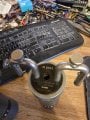
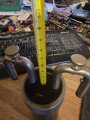
Both images are of a Standard 10 Ohm resistor. These resistors are normally submerged in a mineral oil bath, temperature controlled. The second image reflects a mercury in glass thermometer. The reason for the terminals is the outer terminals are for applying current and the inner terminals for the voltage out. Sorry about the mess.

When standards are calibrated temperature is important, thus the thermometer. This is just a very broad overview.

Ron
 

MisterBill2

Joined Jan 23, 2018
27,679
Consider that the need for accuracy, both measuring AND controlling voltages, depends on the application. MOST equipment designers are aware of that, and take it into consideration. A few devices around do not.
 
Top