test equipment question, ohms not accurate on multimeter

dl324

Joined Mar 30, 2015
18,362
Well I would usually be looking for a short or open , so i would have been just seeing if there WAS a reading.
You can still look for opens and shorts by measuring voltages. Or use a continuity checker. Your DVM likely has one, but I use one consisting of 2 AA batteries and a flashlight bulb.

I use it to check transistor junctions, diodes, LEDs, and continuity.
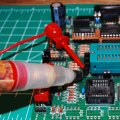
junctionTestContinuityTester.jpg
This particular tester was purchased at Home Depot as part of a package of testers. My original tester, that I still have, is the type I used when I was a technician at HP.
 
Last edited:

wayneh

Joined Sep 9, 2010
18,119
Don't be deluded into thinking that spending more on a meter will solve your problems.

I have a handful of the Cen-Tech DMMs that I got for free at Harbor Freight. (These days they're $8 and I don't think they discount them the way they used to.) They have an input resistance of 1MΩ for voltage measurements on the 20V scale.

Every review I've ever seen where one was tested against a Fluke showed the cheap meter was nearly, or exactly, spot on. It can be trimmed internally if you're really anal about it. If/when they fail, it's usually mechanical reasons such as broken leads. Pull the battery, throw the meter away, move on to the next one. Blow the fuse making an ammeter measurement incorrectly? Find out if the fuse or the entire meter is cheaper to replace.

Meter choice is all about context. If my job or my safety depended on my meter, I wouldn't be using a free one. The savings from less frequent calibration testing probably justifies the expense of a better meter in that scenario. Add on additional capabilities, safety features, lifetime ruggedness, and there's a solid argument for a more expensive meter. I just think it's too easy to dismiss a cheap but perfectly workable tool for the jobs many people need it for.

I honestly think that if you're relying on a meter just because you spent a lot of money on it, you're just as vulnerable to a bad measurement as you are with a cheap meter. In other words, if you really care about precision, you can't just rely on a meter. You need to have a calibration schedule. You really have to question every aspect of a measurement, not just the instrument you're using.
 

MisterBill2

Joined Jan 23, 2018
27,666
Meaasuring resistance on an analog multimeter is a challenge. Typicaly the top half or third of the scale is not only non-linear, it also covers a wide range. In fact, even if the meter were to be "perfectly accurate" reading the scale to withing 10 % oreven 20% OF THE ACTUAL INDICATED VALUE would be very difficult at best.
Formeasurements that need to be accurate I use my BECKMAN 4 1/2 digit DMM. For the first few years, the yearly calibration it never needed adjustment. After that I have not bothered with the additional expense of having it certified every year. I no longer have the clients who demanded current certifications.
 
Last edited:

Thread Starter

tsmspace

Joined Mar 16, 2026
124
"Learning Electronics" Is better done with more reading AND STUDY than with "doing experiments", BECAUSE with experiments it is not often that the "WHY" part is correctly and adequately explained. That "why" part is what is important to build understanding. But understanding the WHY part is how you know how to create a circuit that achieves what you want to make happen actually work.
books is hard but I'm trying to some things with learning that theory stuff.
 

Thread Starter

tsmspace

Joined Mar 16, 2026
124
Don't be deluded into thinking that spending more on a meter will solve your problems.

I have a handful of the Cen-Tech DMMs that I got for free at Harbor Freight. (These days they're $8 and I don't think they discount them the way they used to.) They have an input resistance of 1MΩ for voltage measurements on the 20V scale.

Every review I've ever seen where one was tested against a Fluke showed the cheap meter was nearly, or exactly, spot on. It can be trimmed internally if you're really anal about it. If/when they fail, it's usually mechanical reasons such as broken leads. Pull the battery, throw the meter away, move on to the next one. Blow the fuse making an ammeter measurement incorrectly? Find out if the fuse or the entire meter is cheaper to replace.

Meter choice is all about context. If my job or my safety depended on my meter, I wouldn't be using a free one. The savings from less frequent calibration testing probably justifies the expense of a better meter in that scenario. Add on additional capabilities, safety features, lifetime ruggedness, and there's a solid argument for a more expensive meter. I just think it's too easy to dismiss a cheap but perfectly workable tool for the jobs many people need it for.

I honestly think that if you're relying on a meter just because you spent a lot of money on it, you're just as vulnerable to a bad measurement as you are with a cheap meter. In other words, if you really care about precision, you can't just rely on a meter. You need to have a calibration schedule. You really have to question every aspect of a measurement, not just the instrument you're using.
I wonder if you have the ability to measure some 1Meg resistors and post your results on some of these cheap multimeters? I ask this because 1Meg is actually a very high resistance, My meter isn't nearly so far off with 10k for example, and not that I have been measuring them with my meter, I've just been reading them and sticking them onto breadboards, but most of the little experiments I've been doing are all values down below 20k, mostly below 10k. But,I am interested to see data points relating to other cheap meters to know how they compare.
 

Thread Starter

tsmspace

Joined Mar 16, 2026
124
they won't measure any resistance accurately enough

i have double DVM850BL --and-- 2 other alike = all 4 have same measurement ranges and they have different displays at all of theses ranges - however 1 of them compares better than others to a KYORITSU voltage ranges + the 5-th cheapo DMM has a calibration pot inside so i matched it also to a japanese thing at its voltage range (which might have impacted the other ranges for worse ?)

i got also an ancient comparative bridge resistance meter which is most accurate but not error free
i had a set of EXCEL tables** that had statistics over a box of resistors by which** i was able to estimate the apx precision of each of my DMM

even if you set up a speciffic resistance test rig - then all values that can have an error do have 'em !!!

► your option is -- to have few...enough expensive calibrated resistors --and/or-- voltage references --and-- you work your way out based on them

DMM is basically a "black box" when it comes to precision
I've never considered getting some calibrated resistors, I think that might be fun. voltage references sounds harder I think, it sounds like a much bigger thing. I can definitely see having some calibrated resistors though, and then just doing a percent comparison to ballpark the value check. I wonder how resistors age? Would calibrated resistors be good for a long time if I don't juice them much, or will they have a lifespan of a few years or longer? Would aging correlate to having voltage applied? I've never investigated this kind of thing. I suppose even the resistors sound expensive.
 

Thread Starter

tsmspace

Joined Mar 16, 2026
124
If you really want to learn electronics how about building your own multi "meter" - quotes because when I didn't have one I built a circuit with potentiometer and comparator driving LEDs which assumed the pot resistance was linear so I could compare an input voltage to a potentiometer wiper voltage to watch the position where one LED went out and the other came on. Point being, although a multimeter is probably your first and most important measuring instrument, you can probably get by without it if you have to. A bridge circuit using know resistor values to measure resistance for example
I'm not actually in the situation where "I have to perform a resistance check to achieve a goal". So while sitting in my room with some junk I probably never would have thought of doing something like this. This is actually a really fun idea though, I think I will try to make it a list item for an experiment to try. Especially considering how fragile and complicated measuring resistance appears to be, even if I don't break it perhaps someone else will, and then it's a really believable scenario that I just wish I could measure a resistance, and just don't have some kind of meter available. (I mean, I'm in it right now, it's just that when I can't measure the resistance nothing bad happens, because it's just my experiment maybe fails. But were I in the situation where I could genuinely achieve a goal like fix a thing, then it would be completely different).
 

Thread Starter

tsmspace

Joined Mar 16, 2026
124
to all.

I have the strangest experience to report. But, now my meter is working to measure apparently accurately. I repeated this measurement over the course of at least two sessions consistently reading between 300k and 500k on the 1Meg, and now at this moment it is reading very accurately when compared, at 1.03M. it floated a lot before also. the 330ohm resistor that I also measured still measures the exact same as it did before, at 319 on that particular meter. I want to say well user error , but I was very certain with the setting and repeatedly measured it to try and understand, and while the 330 ohm measurement has not changed, the 1Meg has. Also, right now if I try to measure the resistance on one setting lower, it simply shows OL , there is only one setting that can possibly show a reading for a 1meg resistor on this device.

i did do soldering basically always just before this measurement, and wonder if there could be some kind of capacitor charge involved from having the soldering iron's power supply nearby the meter, but I don't understand why the 1meg resistance measure would be affected and not the 330ohm, as the circuit should just be further down the resistor line in the meter for the 1meg, there should be nothing else different between the two measurements.

---- scribble the above. If I touch the leads while holding such a large resistor, it measures me I think along with the resistor. If I put it down and touch it i get a good reading. This is not how it works with smaller resistors, I can touch the resistor leads while measuring to get a good measurement on those. actually, if I hold the leads while on any other setting, it shows O.L. ... but on the highest option (20M) , I get a reading on my fingers.

hmmmm. I wonder how much I am just reading my own resistance and how often this has caused me issues.
 

MisterBill2

Joined Jan 23, 2018
27,666
Certainly there can be an effect on the actual resistance when you shunt your hands across the resistance being measured. Both the shunting effect and also the addition of coupling in from any random electric fields that happen to be present at the time..
 

dl324

Joined Mar 30, 2015
18,362
I wonder if you have the ability to measure some 1Meg resistors and post your results on some of these cheap multimeters?
Using a 1M 5% resistor.

On a free Cen-Tech, I measured 1.029M. With a $20 (on clearance) Cen-Tech 61593, I measured 1.027M. On a Fluke 27, I measured 1.027M. On an auto ranging Radio Shack DVM I bought in the 1980's (in a wallet type case), I measured 1.030M.

DVMs used:
4dvms.jpg
 
Last edited:

ci139

Joined Jul 11, 2016
1,998
I've never considered getting some calibrated resistors, I think that might be fun. voltage references sounds harder I think, it sounds like a much bigger thing. I can definitely see having some calibrated resistors though, and then just doing a percent comparison to ballpark the value check. I wonder how resistors age? Would calibrated resistors be good for a long time if I don't juice them much, or will they have a lifespan of a few years or longer? Would aging correlate to having voltage applied? I've never investigated this kind of thing. I suppose even the resistors sound expensive.
Ai → https://www.google.com/search?chann...ibrated+resistors+for+electrical+measurements
??
 

dl324

Joined Mar 30, 2015
18,362
I wonder how much I am just reading my own resistance and how often this has caused me issues.
Where your touching things with your hands only matters on higher resistances because your resistance would be in parallel with whatever you're measuring.

I get 3-25M when I measure resistance of my hands/body. 3M in parallel with 1M gives 750K. 25M in parallel with 1M gives 960K.

When I was measuring the 1M resistor, it was one with clipped and formed leads. I touched one lead with my hand, but not on the other.

330 ohms in parallel with 3M is 329.9 ohms, so touching both ends of the resistor doesn't make a significant difference.
 

WBahn

Joined Mar 31, 2012
32,929
to all.

I have the strangest experience to report. But, now my meter is working to measure apparently accurately. I repeated this measurement over the course of at least two sessions consistently reading between 300k and 500k on the 1Meg, and now at this moment it is reading very accurately when compared, at 1.03M. it floated a lot before also. the 330ohm resistor that I also measured still measures the exact same as it did before, at 319 on that particular meter. I want to say well user error , but I was very certain with the setting and repeatedly measured it to try and understand, and while the 330 ohm measurement has not changed, the 1Meg has. Also, right now if I try to measure the resistance on one setting lower, it simply shows OL , there is only one setting that can possibly show a reading for a 1meg resistor on this device.

i did do soldering basically always just before this measurement, and wonder if there could be some kind of capacitor charge involved from having the soldering iron's power supply nearby the meter, but I don't understand why the 1meg resistance measure would be affected and not the 330ohm, as the circuit should just be further down the resistor line in the meter for the 1meg, there should be nothing else different between the two measurements.

---- scribble the above. If I touch the leads while holding such a large resistor, it measures me I think along with the resistor. If I put it down and touch it i get a good reading. This is not how it works with smaller resistors, I can touch the resistor leads while measuring to get a good measurement on those. actually, if I hold the leads while on any other setting, it shows O.L. ... but on the highest option (20M) , I get a reading on my fingers.

hmmmm. I wonder how much I am just reading my own resistance and how often this has caused me issues.
Why are you inserting yourself into the circuit you are trying to measure? This is like complaining about how you can't get an accurate reading of the weight of some item but insisting on putting one foot on the scale while taking the measurement.

If you want to measure the value of a resistor, then the resistor needs to be removed from any circuit it is in, which includes YOU.

Human body resistance, from one hand to another with dry hands and at the voltages generally produced by a multimeter, tends to be in the hundreds of kilohms to a few megohms when the probe tips are grasped lightly, but can go down to ten kilohms or so if grasped very firmly. Thus, you will greatly impact the measurement of a 1 MΩ resistor, moderately impact the measurement of a 100 kΩ resistor, could noticeably impact the measurement of a 10 kΩ resistor, but probably not, and will almost certainly have little noticeable effect on a 100 Ω resistor.

It sounds like you need to learn a lot more about basic circuit and measurement concepts. You are using meters that are perfectly adequate but, because you are using them improperly, you are concluding that they are broken and must be replaced. What's broken is your knowledge and skill -- but, hey, we were all there at one point and, fortunately, it's something that is pretty easy to fix.
 

MisterBill2

Joined Jan 23, 2018
27,666
Realy, for many measurements you should be using insulated clips, not probes. That allows securing the connections with the circuit not energized, which for both mains power and high voltages is the safe way to go.
 

WBahn

Joined Mar 31, 2012
32,929
Realy, for many measurements you should be using insulated clips, not probes. That allows securing the connections with the circuit not energized, which for both mains power and high voltages is the safe way to go.
I like the minigrabber leads for most uses. They can be used like a probe, but also allow clipping onto small diameter wires and IC pins (provided the pitch isn't too small). But it's good to have a collection of lead styles so that you can match the situation at hand. Remember -- Safety First. Measurement quality next, and convenience last. And also remember that the measurement quality only has to be good enough for the purpose at hand.
 

Homebrew1964

Joined Nov 22, 2024
242
"Learning Electronics" Is better done with more reading AND STUDY than with "doing experiments", BECAUSE with experiments it is not often that the "WHY" part is correctly and adequately explained. That "why" part is what is important to build understanding. But understanding the WHY part is how you know how to create a circuit that achieves what you want to make happen actually work.
I totally disagreee....I am learning electronics through reading AND doing experiments, without the hands on experience you cannot appreciate what you have just read and also it keeps the hobby interesting.
 

WBahn

Joined Mar 31, 2012
32,929
I totally disagreee....I am learning electronics through reading AND doing experiments, without the hands on experience you cannot appreciate what you have just read and also it keeps the hobby interesting.
I'm pretty sure that @MisterBill2 was not saying that experimenting wasn't a valuable, even critical, component of learning electronics. Only that STUDYING, as opposed to just reading (there is a huge difference between the two) with the goal of understanding the underlying fundamentals and why a circuit behaves the way it does or why components are chosen the way that they are. Experimenting should be used to complement the studying in order to verify and cement understanding. It should not be the primary means in which you attempt to learn electronics, for the reasons he stated.

Consider that progress in electronics took centuries to get where we are today. There were a lot of extremely brilliant people that learned from experimenting and came to the wrong conclusions, some of which lasted a century or more before being corrected as a result of lots of other people doing experiments and noting the inconsistencies in the explanations. The culmination of all of these eventually-corrected errors is what is contained in the things we call textbooks.

Electronics is both an art and a science. The art is learning from your own mistakes and the science is learning from the mistakes of others. If you refuse to practice the science, then you get to practice the art.
 
Top