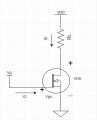
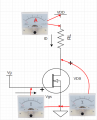
Using analog meter, my picture, makes it hard to do N & P testing. Are you really going to test P MOSFETs?
With a digital meter you can measure +V or -V without changing the meter.
Use a DPDP switch to invert the VDD supply and another to invert the VG supply.
Data sheets often give some details about the test setup for measuring different parameters.
When you say different environmental conditions, you may be opening a bit of a can of worms, particularly with respect to temperature, since the temperature of the air, the temperature of the case, and the temperature of the junction are all different unless care is taken into account. This is why many tests use short pulses and let the devices sit without conducting for long enough to stabilize at ambient temperature throughout between pulses. Can make for long testing sessions. But the resulting data may not be directly relevant to your needs since you probably care about the device's performance under conditions that will actually be seen by the device. So you need to give some thought as to why you are characterizing the device and what type of data is really apropos for that purpose.
You also need to consider how good the data needs to be, which again comes back to why you are doing this in the first place. Is it because you need to get a feel for typical behavior beyond the range of operating conditions contained in the data sheet? Is it because you need to build up a better statistical model for the distribution of parameter values? Or is it because you need to bin parts to find ones that have parameters within a narrower range than off-the-shelf parts. If so, how narrow is that range.
A big part of your decisions also involve the physical set up and the scale of the testing. If you are testing ten devices at a few operating points at temperatures not too far removed from room temperature, that's one thing since you probably have easy access to the set up and aren't taking lots of data. But if you want to measure at cryogenic or extremely elevated temperatures, now you have access issues. If you are measuring hundreds or thousands of devices, no you have scalability issues and need to spend time and effort standardizing and automating as much of the process is possible.
The Mosfet BUK7Y3R5-40H has beginning to end examples on calculations. Others are also documented, spice model is available.
Compare the accuracy to simulation data, does a tech support pick up the telephone and provide real support?
reference AN11158 The merit is in the quality of the semiconductor. The datasheets all have caveats, marketing games. Understanding MOSFET datasheets: Safe Operating Area (SOA) | Video | TI.com
Linear Technology link is difficult, search
linear Technology AN_2112_PL18_2112_024619
These make good test fixtures Product Evaluation Boards and Kits | Analog Devices
see design files for quality mosfet pcb
By following a complete Mosfet sample design example shows why they highlighted certain characteristics.
The importance and priority in the order of development helps for your own unique set of priorities.
If the planning has good structure then design changes can be made less time systematically.
Sometimes it comes down to two candidates in the same Safe operating area but opposite sides of the diagram.
Having the transfer function for your application will help , the best Rds, the allowed temperature affecting drain current ect.
The PCB may need some adjustment and it should be corrected if possible and the test fixture is reasonably close because it was corrected early.
Buy good parts. Make the test fixture close to the actual pcb.

 Facebook
 Google
 GitHub
 Linkedin