temperature sensor

Thread Starter

hero22222222222

Joined Dec 22, 2019
78
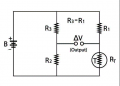
Hi im currently making a temperture sensor using a thermistor for general home use.

Ive been doing some research and i found the following
1583025833211.png 1583025897789.png 1583025977512.png

I would like some advice on which one i should use, how can i use these designs to measure temperture and what are the advantages of each one...

Any help will be much appreciated.
 

MisterBill2

Joined Jan 23, 2018
27,501
The main advantage to using a thermistor for measuring temperature is that thermistors are cheap. They are not very linear over much range, another problem to deal with. So using one to measure both refrigerator temperatures and cooking temperatures would be a challenge.
 

sparky 1

Joined Nov 3, 2018
1,218
I recall that balancing the bridge was tedious on all of them.
just buy one ready made, try to find one that gives an accuracy of 1/10th a degree.
or be prepared to spend a great deal of time for what cost I think you will end up silly.
 

Dodgydave

Joined Jun 22, 2012
11,395
A simple 10K resistor and 10K thermistor will do, if you're using a micro you need to create a look up table for each temperature change. It's not worth the hassle when there are loads of ready made modules on Ebay.
 

MisterBill2

Joined Jan 23, 2018
27,501
This is one place where a micro with a look-up table will work out. But at that point it has become a lot bigger than just a temperature readout. The stability required for the sensor voltage supply will take some effort, and it will need to be far better than a zener reference, and probably better than a regular three-terminal regulator.
 

Reloadron

Joined Jan 15, 2015
7,886
Hi im currently making a temperture sensor using a thermistor for general home use.

Ive been doing some research and i found the following
View attachment 200295 View attachment 200296 View attachment 200297

I would like some advice on which one i should use, how can i use these designs to measure temperature and what are the advantages of each one...

Any help will be much appreciated.
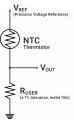
Some of what you are asking depends on the range of temperatures you want to measure. The first drawing is as basic as it gets. Thermistors are merely a resistor which changes resistance based on temperature. When we see NTC that tells us the thermistor in question has a Negative Temperature Coefficient which means as temperature increases resistance decreases. Thermistors have corresponding charts which display the resistance with respect to temperature. Their naming conventions are based on their resistance at 25 degrees C or 77 degrees F. Here is an example of a typical chart. Something to consider is you want to measure temperature and not make your own. Looking at your first example you want Vref to be low enough that the current through the divider is kept low enough so as to not induce self heating through the thermistor. You may want to read up on Thermistor Self Heating Effects.

Which circuit you use is a matter of application, what exactly are you measuring? Thermistors also come in a variety of shapes and sizes along with insulators and the list goes on. Also before I forget, any resistor placed in series with the thermistor should be a precision type and metal film is OK but whatever it is it should have a good temperature coefficient since you want that resistance to be as stable as possible.. Additionally as was pointed out thermistors have really lousy or nicely put poor linearity. Just looking at any of the linked tables will show you that.

Should you pursue the use of a thermistor then the Steinhart–Hart equation is a model of the resistance of a semiconductor at different temperatures. Should you choose a uC like an Arduino or similar you will find this calculator a new best friend. So it comes back to which thermistor? What temperature range and how to you plan to read out the temperature?

Ron
 

Thread Starter

hero22222222222

Joined Dec 22, 2019
78
Some of what you are asking depends on the range of temperatures you want to measure. The first drawing is as basic as it gets. Thermistors are merely a resistor which changes resistance based on temperature. When we see NTC that tells us the thermistor in question has a Negative Temperature Coefficient which means as temperature increases resistance decreases. Thermistors have corresponding charts which display the resistance with respect to temperature. Their naming conventions are based on their resistance at 25 degrees C or 77 degrees F. Here is an example of a typical chart. Something to consider is you want to measure temperature and not make your own. Looking at your first example you want Vref to be low enough that the current through the divider is kept low enough so as to not induce self heating through the thermistor. You may want to read up on Thermistor Self Heating Effects.

Which circuit you use is a matter of application, what exactly are you measuring? Thermistors also come in a variety of shapes and sizes along with insulators and the list goes on. Also before I forget, any resistor placed in series with the thermistor should be a precision type and metal film is OK but whatever it is it should have a good temperature coefficient since you want that resistance to be as stable as possible.. Additionally as was pointed out thermistors have really lousy or nicely put poor linearity. Just looking at any of the linked tables will show you that.

Should you pursue the use of a thermistor then the Steinhart–Hart equation is a model of the resistance of a semiconductor at different temperatures. Should you choose a uC like an Arduino or similar you will find this calculator a new best friend. So it comes back to which thermistor? What temperature range and how to you plan to read out the temperature?

Ron
Hi

I want to measure temperature that is no more than 32°C and I want the temperature sensor to measure with high accuracy +-2°C .
I have a ntc thermistor at home so I would like to use it rather than buying a ready made sensor.
In addition I will be using a pic microcontroller.
So do I need to convert the analogue output to digital by building an ADC circuit or can I keep it to analogue.
(This is my fist time using a microcontroller)
Furthermore, I do not have precise resistors @ home they are cheap....
 

Reloadron

Joined Jan 15, 2015
7,886
Hi

I want to measure temperature that is no more than 32°C and I want the temperature sensor to measure with high accuracy +-2°C .
I have a ntc thermistor at home so I would like to use it rather than buying a ready made sensor.
In addition I will be using a pic microcontroller.
So do I need to convert the analogue output to digital by building an ADC circuit or can I keep it to analogue.
(This is my fist time using a microcontroller)
Furthermore, I do not have precise resistors @ home they are cheap....
OK with thet known here is what I would do. Using an Ohmeter measure the resistance of the thermistor you have. I have a 10K Ohm NTC thermistor laying here and it measures 10.31 K Ohm so just based on that I know it is a 10K Ohm thermistor since it reads about 10 K at ambient room temperature. Since you plan to use a pic chip you can use as was mentioned a lookup table or just use the Steinhart-Hart coefficient method. Then you only need to place three coefficient numbers in your code. The code will depend on which uC you use, for example the PICAXE code won't be the same as the Arduino code. Anyway I would just apply the Steinhart-Hart coefficient method. As to accuracy? You can always make a small ice bath slurry using some distilled water ice. That should get you 0 degrees C and then consider your altitude above sea level and boil some distilled water which should get you 100 degrees C. Using a good standard thermometer try and measure a known temperature in the middle give or take. That or just assume your thermistor is accurate as it is.

Ron
 

MisterBill2

Joined Jan 23, 2018
27,501
If that NTC device is perfectly linear then you can use a simple analog circuit and have an accurate temperature display. That would just need scaling. Do you have a resistance versus temperatyure list for your device?
 

Thread Starter

hero22222222222

Joined Dec 22, 2019
78
OK with thet known here is what I would do. Using an Ohmeter measure the resistance of the thermistor you have. I have a 10K Ohm NTC thermistor laying here and it measures 10.31 K Ohm so just based on that I know it is a 10K Ohm thermistor since it reads about 10 K at ambient room temperature. Since you plan to use a pic chip you can use as was mentioned a lookup table or just use the Steinhart-Hart coefficient method. Then you only need to place three coefficient numbers in your code. The code will depend on which uC you use, for example the PICAXE code won't be the same as the Arduino code. Anyway I would just apply the Steinhart-Hart coefficient method. As to accuracy? You can always make a small ice bath slurry using some distilled water ice. That should get you 0 degrees C and then consider your altitude above sea level and boil some distilled water which should get you 100 degrees C. Using a good standard thermometer try and measure a known temperature in the middle give or take. That or just assume your thermistor is accurate as it is.

Ron
I'll try and check if the seller can provide me a graph for temperature vs resistance but if I can't get this would the Steinhart-Hart coefficient method work for both linear and non linear thermistors?

In addition, for the equation do I just substitute temperature values and then get a resistance value... which means I'll effectively be making a "look up table"?

Finally, do you know any good website to help me activate and use the Analogue to digital convertor using assembly language?
 

Reloadron

Joined Jan 15, 2015
7,886
I'll try and check if the seller can provide me a graph for temperature vs resistance but if I can't get this would the Steinhart-Hart coefficient method work for both linear and non linear thermistors?

In addition, for the equation do I just substitute temperature values and then get a resistance value... which means I'll effectively be making a "look up table"?

Finally, do you know any good website to help me activate and use the Analogue to digital convertor using assembly language?
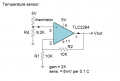
The tables are all the same. You first need to determine which thermistor you have. Just for example as I mentioned earlier thermistors can be for example a 10,000 Ohm NTC type or a 1,000 Ohm type and any of a dozen or more types. Each type has an associated table of temperature verse resistance. A Google of Thermistor Tables should bring them up Here is a link to what should be all thermistor tables. Also going back to your first post the second image shows an operational amplifier TLC 2264 which has a 2X gain and is a basic rail to rail op amp so with a 2X gain I have no idea how it will linearize anything. You can use an op amp designed for the purpose and they work fairly well. This is a pretty good write up from Texas Instruments on the subject: Methods to Reduce Thermistor Linearization Error, Memory, and Power Requirements Over Wide Operating Temperature Ranges. They suggest a few of their own op amps designed for thermistor linearization. However if you are going to start adding parts and building then you are getting into a more complex project.

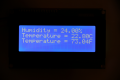
There are a bunch of sensors out there which are cheap and work great with uC designs. The DS18B20 comes to mind and I have done quite a bit with the DHT 11 & DHT 22 which work well and can use a simple I2C interface with a uC. Sensors like this come already on a board have a simple uC interface and cost under $2.00 USD through outlets like Amazon. Not trying to dissuade your desire to use a thermistor but anymore there are other sensors which do more and cost less. Here is a DHT 11 running on an Arduino Uno which is a Atmega 328P chip.

DHT 22 1.png

Ron
 
Top