Tektronixs Scopes Recapping & Memory

Thread Starter

aguaman99

Joined Dec 23, 2012
30
Hoping one of you with a love for the old stuff will chime in with some advice... I've got two old Tek scopes (2465B & 2467B), love them both and have enjoyed using them on occasion. Recently I decided to look into the world of single sequencing and the XY functions they have. So I got them off the top shelf and started playing with them... I can't get the single sequencing to display a signal on either scope but I have had some successes (although not without glitches) playing around with the XY. Anyway... a few questions:

1. I'm not able to display a signal on either scope when triggering single sequence. They both react the same way; indicates "ready" then seems to trigger but there is no trace of a signal, the crt's both just go blank after triggering and they becomes non-responsive. I did some reading on it and can't tell from the manuals how this works or what might be wrong so I'm just guessing at this point. Could it be that the battery's supporting the memory chips are dead. Do these have a separate memory to store the image and then recall and display similar to a digital scope? Anyway any insight on this one would help...

2 Because of my suspicions about the memory, the glitches I'm experiencing with the XY, display, brightness fluctuations and some other misc. one off anomalies I'm thinking it might be time to have one or both scopes refurbished (batteries, caps, etc.) Anyone done this? Have any advice regarding if I should try it myself? I'm thinking no, as I'm fairly novice but I'm also an overachiever ;-). Are there people/companies that do this as a service? guessing if there are it would be fairly expensive.

Anyway I know that's a lot in one post but if anyone can chime in on any of it i would appreciate it.

Thanks
 

dl324

Joined Mar 30, 2015
18,219
Could it be that the battery's supporting the memory chips are dead.
Don't know why single sweep isn't working but, other than the NVRAM, I don't think there's any other memory because this was among the last of the analog scopes.
I'm thinking it might be time to have one or both scopes refurbished (batteries, caps, etc.) Anyone done this? Have any advice regarding if I should try it myself?
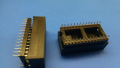
I think the only battery is in the NVRAM. That should be removed and backed up so you can restore function without needing to recalibrate when the battery eventually dies. Put the chip in a socket (dual wipe) when you replace it. I read that removing the ground lead is difficult due to the ground plane. It's suggested to remove solder from all pins except ground, then remove the IC while applying the iron to the ground pin (14).

In general, I don't believe in replacing caps just for the sake of replacing them. There are some SMT caps on the A5 board prone to leaking, so I'd inspect them.

I use Willem EPROM programmers to read/program NVRAMs.
 

Thread Starter

aguaman99

Joined Dec 23, 2012
30
Don't know why single sweep isn't working but, other than the NVRAM, I don't think there's any other memory because this was among the last of the analog scopes.
I think the only battery is in the NVRAM. That should be removed and backed up so you can restore function without needing to recalibrate when the battery eventually dies. Put the chip in a socket (dual wipe) when you replace it. I read that removing the ground lead is difficult due to the ground plane. It's suggested to remove solder from all pins except ground, then remove the IC while applying the iron to the ground pin (14).

In general, I don't believe in replacing caps just for the sake of replacing them. There are some SMT caps on the A5 board prone to leaking, so I'd inspect them.

I use Willem EPROM programmers to read/program NVRAMs.
Thanks for the response. Regarding single sweep, maybe there’s hope then! It could very well be me doing something incorrectly. The fact that both scopes do the exact same thing and everything “basically “ functions on them. I’m thinking I might be the problem.
Regarding swapping the battery… yes I read about some of that as well… I don’t understand “Put the chip in a socket (dual wipe) when you replace it. I read that removing” I’m guessing that may be above my pay grade.
 

dl324

Joined Mar 30, 2015
18,219
I don’t understand “Put the chip in a socket (dual wipe) when you replace it. I read that removing”
The NVRAM is soldered to the board. After removing it to back up the data, you'll need to reinstall. When you do that, install a dual wipe socket to install the NVRAM in. That way, when you eventually have to replace due to a dead battery, no soldering will be involved. Dual wipe was suggested due to the nature of the leads on the NVRAM. Might not work well with a machined pin socket.
 

nsaspook

Joined Aug 27, 2009
16,250
Thanks for the response. Regarding single sweep, maybe there’s hope then! It could very well be me doing something incorrectly. The fact that both scopes do the exact same thing and everything “basically “ functions on them. I’m thinking I might be the problem.
Regarding swapping the battery… yes I read about some of that as well… I don’t understand “Put the chip in a socket (dual wipe) when you replace it. I read that removing” I’m guessing that may be above my pay grade.
NVRAM replacement on a TEK scope.
https://forum.allaboutcircuits.com/threads/tek-2432-nvram-replacement.165205/post-1454665
1768971341251.png
 

Thread Starter

aguaman99

Joined Dec 23, 2012
30
The NVRAM is soldered to the board. After removing it to back up the data, you'll need to reinstall. When you do that, install a dual wipe socket to install the NVRAM in. That way, when you eventually have to replace due to a dead battery, no soldering will be involved. Dual wipe was suggested due to the nature of the leads on the NVRAM. Might not work well with a machined pin socket.
Thanks for taking the time and all your help.Very helpful!
 

sarahMCML

Joined May 11, 2019
695
Thanks for the response. Regarding single sweep, maybe there’s hope then! It could very well be me doing something incorrectly. The fact that both scopes do the exact same thing and everything “basically “ functions on them. I’m thinking I might be the problem.
Regarding swapping the battery… yes I read about some of that as well… I don’t understand “Put the chip in a socket (dual wipe) when you replace it. I read that removing” I’m guessing that may be above my pay grade.
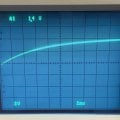
When set to "single sweep" you get just that: one single pass of the beam when the scope receives the trigger point from the input signal, and that is it! If the timebase is set to a fast sweep rate you will probably miss it unless the brightness is turn up high. As a test, set the timebase to 0.5sec/div, an input that gives a stable trace when set to Auto or Norm, and then try Single. You should then see one sweep that takes about 4 seconds to traverse the screen. Then the screen will blank.
 

Thread Starter

aguaman99

Joined Dec 23, 2012
30
When set to "single sweep" you get just that: one single pass of the beam when the scope receives the trigger point from the input signal, and that is it! If the timebase is set to a fast sweep rate you will probably miss it unless the brightness is turn up high. As a test, set the timebase to 0.5sec/div, an input that gives a stable trace when set to Auto or Norm, and then try Single. You should then see one sweep that takes about 4 seconds to traverse the screen. Then the screen will blank.
So i had been thinking about this ever since dl324 's first response... if it has no memory how can it display a still image of a moving sweep??? finally got back into the lab today and started playing with it, thinking there must be something I just don't understand. I was online researching and came across a post where a gentleman was talking about how tek sold a camera for the 2465... it hit me ;-) Duhhh you cant capture an image on these olds scopes... and then i saw your post as well sarahMCML thanks for taking the time.

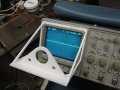
OK so in the off chance somebody still hasn't figured out what i just did... now with modern tech you can capture the image very simply. Just take a video of it with your phone and then grab the frame from the video and create a single frame image. Anyway i bet most of you guys with old tube scopes already new this, just thought id share.
 

Attachments

MrChips

Joined Oct 2, 2009
34,628
So i had been thinking about this ever since dl324 's first response... if it has no memory how can it display a still image of a moving sweep???

... Duhhh you cant capture an image on these olds scopes... and then i saw your post as well sarahMCML thanks for taking the time.

... now with modern tech you can capture the image very simply.

... Anyway i bet most of you guys with old tube scopes already new this, just thought id share.
Old tube scopes can show a trace on the screen easily with no memory. If you have not figured this out as yet I can explain.

Persistence... Then we had variable persistence scopes
And we had an HP1703 storage scope. One of the best diagnostics tool I every had, long before DSO was invented.

Finally, there was a thing called a sampling scope which was able to capture signal transitions down to pico seconds.
 

Thread Starter

aguaman99

Joined Dec 23, 2012
30
Not sure why the operational text was included there. I definitely understood that.

I'm just a noob so everything's a rabbit hole for me... Although my first inclination was (correctly) telling me I couldn't get the beam to capture a one shot type event and display that shot indefinitely like I can on my digital scope; Instead of trusting that original thought I got sidetracked and began focusing on the fact that the scope clearly states it can do "single sequence" triggering. At that point I got obsessed with figuring out how it can do that and why I cant make mine do it.... thinking there must be something I just don't know or understand... Anyway its comical to me when I fall into one of these simple new player traps and then I finally figure it out. So the simple thing I didn't know or understand was that typically its done by using a camera ;-).

Yes I immediately started thinking about pit falls using a cell phone and using my DSLR on a stand with a hood instead or delaying the shutter speed etc.... Thinking about grid pattern consistency parallax etc.. but I quickly realized that's just another rabbit hole I'm choosing not to stick my head into for now ;-). I'm just happy i figured out an easy way and that I wasn't crazy!

Thanks everyone for your patients with the noob and chiming in. Love this forum! I think we can close this one, the caper is solved.
 

Thread Starter

aguaman99

Joined Dec 23, 2012
30
Old tube scopes can show a trace on the screen easily with no memory. If you have not figured this out as yet I can explain.

Persistence... Then we had variable persistence scopes
And we had an HP1703 storage scope. One of the best diagnostics tool I every had, long before DSO was invented.

Finally, there was a thing called a sampling scope which was able to capture signal transitions down to pico seconds.
Thanks for the reply! Interesting that those types of scopes existed, I'm fascinated by "the way they did it back then" and its why I have so many old machines and tools. Its actually an obsession.... I think what you talking about will have something to do with getting the phosphorus to persist on the screen somehow and it sounds like more cool older tech. I'm sorry I'm not sure if you're telling me I can get my 2465B to do this by creating persistence through some type of settings or if you're saying "if I had the right scope i could then do it"... If its the latter then unfortunately I don't have a scope that can do that so there would be no need to explain in any more detail unless you want to; in which case, I'll definitely read it. If your saying i can do it with my scopes then I'm definitely interested in learning more and hearing how to do that.
 

MrChips

Joined Oct 2, 2009
34,628
I think that you already know this but here it is in any case.

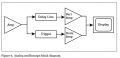
The CRT in an analog oscilloscope rely on an electron beam hitting a phosphor on the CRT screen. The emitted light does not decay immediately but persists for a finite time. The decay time (or persistence) varies from one CRT to another. A long persistence CRT allows us to see the oscilloscope trace long after the electron beam has moved off the screen.

By scanning a periodic waveform repeatedly, we take advantage of the long persistence and hence the trace appears to be stationary on the screen. To achieve this, we take advantage of three things:

1) a CRT with long persistence,
2) a repetitive input signal,
3) horizontal time base and trigger circuitry to trigger at the same voltage and edge on the waveform.

As we well know, the analog oscilloscope is not suited to capture a one-shot event without using external equipment such as a scope camera. (Tektronix did have a Polaroid instant camera attachment which allowed one to capture single events.)

Then came along the HP 1703A variable persistence oscilloscope. I don't know the details of how they did this but that scope was capable of capturing a one-shot event. After the event was captured on the CRT screen, the trace would remain for a finite time but not forever. Eventually, the trace would spread causing a "blooming" or "bleeding" effect.

The Tek 2465 is a high end 300 MHz 4-channel analog oscilloscope with digital readout.


Single Event Capture Mode
(AI generated)

The Tektronix 2465 analog oscilloscope can capture single-event, non-repetitive signals using a specialized Single Sequence triggering mode. This mode allows the scope to trigger once, display the waveform, and hold it, with readout data and scale factors appearing momentarily at the end for potential photography.
Here is how to set up the Tektronix 2465 for single event capture:

1. Initial Setup
  • Set the trigger mode to NORM (Normal) rather than Auto. This prevents the scope from constantly sweeping without a trigger.
  • Adjust the vertical volts/division and horizontal time/division to ensure the expected event is properly scaled, ensuring it doesn't clip.
  • Set the trigger source to the channel holding the signal (e.g., CH1).
  • Adjust the trigger level (position indicator on the side) to a point where it will intersect the expected signal, typically around 50% of the anticipated amplitude.

2. Enabling Single Sequence
  • To enable the single-shot mode, press the SGL SEQ button (or "Single Sequence" button, depending on the specific 2465 variant).
  • The system is now waiting for a trigger. The display may appear blank or show a faint dot until the event occurs.

3. Capture and Display
  • When the signal meets the trigger conditions, the scope captures one sweep and holds the display on the CRT.
  • The readout at the bottom of the screen will flash, and the graticule illumination may pulse, indicating that the sequence is complete and the waveform is locked for viewing or photography.
  • To capture a new event, press the SGL SEQ button again to reset the trigger circuitry.

Tips for Single Event Capture
  • High-Speed Events: If the event is very fast and dim, you may need to increase the intensity.
  • 2467 Option: The 2467 variant (MCP) is specifically designed for high-speed single-shot capture, as its high-speed, bright screen captures faster pulses than the 2465.
  • Wait for Trigger: If the signal is truly a single event, the scope will only update the display once, requiring a manual reset of the trigger for subsequent captures.

https://www.sglabs.it/public/TEK_2465.pdf

https://neurophysics.ucsd.edu/Manuals/Tektronix/2465 Oscilloscope Manual.pdf
 

MrChips

Joined Oct 2, 2009
34,628
Update: I have a Tek 2465. I tried the SGL SEQ mode. I can get it to show READY and get it to trigger. But I don't see the trace being held on the screen.

Edit: Sorry. I just reread your entire thread from post #1. I see that the whole purpose of the thread is to get SGL SEQ working.

I have both 2465 and 2467 but never had a reason to use SGL SEQ since I was already hooked on DSO.

I will dig into this and see if I come up with anything that can help you.
 

Thread Starter

aguaman99

Joined Dec 23, 2012
30
Update: I have a Tek 2465. I tried the SGL SEQ mode. I can get it to show READY and get it to trigger. But I don't see the trace being held on the screen.

Edit: Sorry. I just reread your entire thread from post #1. I see that the whole purpose of the thread is to get SGL SEQ working.

I have both 2465 and 2467 but never had a reason to use SGL SEQ since I was already hooked on DSO.

I will dig into this and see if I come up with anything that can help you.
Thanks for those details, much appreciated! Yes exactly! That was the focus or main point of what I was originally asking. My results were identical to yours. I follow instructions as you laid out, I see it trigger, it flashes and at times I can briefly see the intend target signal but in a few ms it's gone and the CRT goes blank. I'm feeling like it may have been a 'Marketing gimmick" ... By that I mean it's capable but you have to photograph it to see it. The manual is so vague regarding the single sequence function... I find it hard to believe that the scope would be capable of something so new and innovative without providing a bunch of hype and or more details in the manual. Biggest clue is that a camera was available for this specific scope.

Regardless ;-) If you're willing to research further and attempt to confirm, I'll go down that rabbit hole with you. I cant wait to see what you find, it bugged me for an entire week ;-).
 

Thread Starter

aguaman99

Joined Dec 23, 2012
30
I have both 2465 and 2467 but never had a reason to use SGL SEQ since I was already hooked on DSO.
I too have both scopes. 2467B and 2465B. Both in really good shape. Also have HP 500MHZ 54616B that i like a lot. Then there is the older battery powered Tek TDS 1002 that goes outside when needed. In the end my main scope is a Rigol DS4024 and I too am hooked on the DSO. Ha! You just reminded me of when I also had a PC based scope and I was even more novice than I am now.... I blew that "cheap lil" scope off my desk and fried my gaming pc. Touched positive 120V with the ground probe. Hard lesson but I can guarantee you that I think slow and hard about touching anything with my ground clips.
 

Thread Starter

aguaman99

Joined Dec 23, 2012
30
When set to "single sweep" you get just that: one single pass of the beam when the scope receives the trigger point from the input signal, and that is it! If the timebase is set to a fast sweep rate you will probably miss it unless the brightness is turn up high. As a test, set the timebase to 0.5sec/div, an input that gives a stable trace when set to Auto or Norm, and then try Single. You should then see one sweep that takes about 4 seconds to traverse the screen. Then the screen will blank.
Thanks, I tried this as a test and it does work exactly as you described. In practicality, because that's really no different than just looking at any signal at a slow sweep I guess the only real usefulness to the feature of the scope is to see weather you actually do have a one off event and then one could zero in on that by some other means. Unless of course you had the camera option ... That's why I was so excited about my simple little workaround and how easy it is to capture a signal and hold it long enough to get useful data from it. Modern tech makes ol school Tek a little more relevant than it was 10 years ago. I luv it ;-).
 
Top